Why Should You Be Careful About Monitoring Competitors?
Explore the legal limits and ethical lines behind the question: why should you be careful about monitoring competitors? Get a responsible checklist.
Anyone shopping for competitive-intelligence advice gets the same pitch: track more competitors, add more sources, switch on more alerts. Volume gets treated as diligence, and a short watch list gets treated as neglect. That advice is half right, and the half that's wrong is expensive.
Monitoring is a decision instrument, not a collection habit. Every alert rule a team switches on costs reviewer time, creates a record that may later be kept, forwarded or subpoenaed, and produces evidence somebody will eventually act on. Add enough of them and the loudest signal wins by default, which is rarely the signal that matters.
Why should you be careful about monitoring competitors? Because the failure modes aren't symmetrical. Too little monitoring surprises a team once a quarter. Too much misleads it continuously, and now and then creates legal or reputational exposure that has nothing to do with competition at all.
A risk map with a first control against each major risk, scoped to specific decisions, produces a calibrated routine. Restraint isn't caution for its own sake. It's what keeps the signals you do keep worth reading.
Table of Contents #
- Five Risks Behind Careful Competitor Monitoring
- Scope Monitoring to Decisions, Not Volume
- Where Monitoring Crosses Legal Lines
- Why a Mention Is Not Proof of Advantage
- Ethics, Brand Safety and Unfair Association
- Set Up a Responsible Monitoring Routine
Five Risks Behind Careful Competitor Monitoring #
See the whole map before the detail. Each row names a risk, how it usually goes wrong, the trigger that sets it off, and the first control to put in place.
| Risk | What Goes Wrong | Common Trigger | First Control |
|---|---|---|---|
| Legal exposure | Breaching website terms or collecting restricted data | Automated collection without checking terms | Read terms and use licensed data sources |
| Privacy | Profiling named individuals beyond their public business roles | Tracking hosts, guests or executives as personal profiles | Limit scope to business-relevant public statements and set retention limits |
| Misleading conclusions | Treating one mention as proof of market advantage | A single episode or one host driving the alert | Require a second signal and recurrence over time |
| Reputational harm | Linking a rival to controversial content or passing on decontextualized clips | Broad keyword alerts on sensitive topics | Review context and classify the relationship before sharing |
| Internal misuse | Findings or transcripts reach people or clients who should not see them | Broad access and unrestricted exports | Role-based access and written redistribution rules |
These risks compound rather than sit side by side. A broad keyword rule creates noise and privacy exposure in the same move, because the rule that catches every passing mention also catches material about people who never agreed to be profiled. One careless forward turns a research note into a contractual problem. And a finding that was never checked against a second signal is exactly the one most likely to be shared with confidence, which is what makes it damaging.
Two of the five stay invisible until something breaks. Internal misuse and reputational harm rarely generate an incident report. They generate a client complaint, a screenshot in the wrong channel, or a meeting where nobody can explain where a claim originated.
Test to run today: name the risk your current monitoring is most likely to trigger. Not the one you'd put on a slide, the one your rules actually invite. If your alert logic has never been read against the platform terms, start at legal exposure. If your alerts are keyword-broad and your team forwards clips, start at reputation.
Scope Monitoring to Decisions, Not Volume #
None of this argues for watching rivals less. Companies that stop watching lose speed, and they lose it precisely where a rival is already moving.
The case for watching is stronger than many assume. A 2020 analysis published by UC Berkeley's California Management Review, citing an Economist survey conducted for the Brightline Project, found that 90% of executives at companies with more than $1 billion in annual revenue said their organizations failed to achieve all the goals of their strategic projects, and 53% of that group said inadequate delivery capability left the business unnecessarily exposed to competitors.
Read that as a warning about execution. These are organizations with market data, strategic plans and analysts. What they lack is translation: a signal exists, and it never reaches the person who could act on it while acting still mattered. Long-form podcast interviews are unusually good at leaking that signal early, because a founder or product lead will discuss hiring priorities, positioning shifts or a rival's weakness in conversation months before any of it appears in a press release.
Ambition is concentrated in the companies that already perform. In 2024, 57% of market-winning companies said addressing disruptive factors was extremely urgent, against 3% of underperformers, according to PwC's Global Market Winners Survey. The deciding variable is whether anyone turns information into a decision.
Narrow Scope Creates False Confidence #
The opposite failure costs more and gets discussed less. Kodak built one of the first working digital cameras, set it aside, and spent years defending film economics while digital photography took its market; the company ended in bankruptcy. Nokia led the global mobile-phone business when the smartphone era arrived and lost that position within a few product cycles.
Neither company was out-monitored by a rival it already tracked. Both were undone by something sitting outside the competitive set they were watching: a new business model rather than a new name on the watch list.
So widen the list in three directions, and no further:
- Substitutes customers could switch to. A spreadsheet, an in-house build or a cheaper workflow can take the deal before any named competitor does.
- Adjacent businesses moving in. A platform adding a feature, a distributor selling direct, a services firm productizing.
- New formats where the audience already spends time. Attention migrating to a different channel is a competitive event even when no rival brand is involved.
Then cap the list. Attach a review date to every watch item, and drop anything that hasn't fed a decision after two quarters. An item that survives two review cycles without producing an action is monitoring for its own sake, and it consumes the attention genuine signals need.
A watch list that only grows is a subscription to anxiety. The cap is what turns it into a portfolio.
Where Monitoring Crosses Legal Lines #
Legal exposure is usually discovered after the fact, when a platform, a vendor or a lawyer asks a question nobody prepared for. What follows is general orientation rather than legal advice. The rules differ by jurisdiction, by platform and by contract, and any specific collection plan belongs in front of counsel.
Four Areas to Check Before Collecting #
- Website and platform terms. Many sites and apps restrict automated collection, and terms of use bind you the moment you visit. Read the terms and the robots directives before scraping or bulk-downloading anything, and where the language is ambiguous, buy a licence or walk away. A competitor's pricing page that forbids automated access is not a target; it's a boundary.
- Personal data. When monitoring names hosts, guests or executives, data protection law may attach to collecting, storing and profiling them. The GDPR covers the EU and UK, and the CCPA covers California, each with its own conditions and exemptions. Keep the record to public business statements, and don't extend it to private life, health, politics or family.
- Confidentiality. If an interview or a leaked document surfaces non-public figures, using it can create trade secret or confidentiality exposure that dwarfs any competitive advantage. Quarantine the material, log how it arrived, and get a decision from counsel before it informs anything.
- Deception. Posing as a customer, a journalist or a job candidate to extract information can breach law and professional codes in many jurisdictions. Identify yourself, use open channels, and treat a source who asks you to misrepresent yourself as a risk rather than an opportunity.
Where the Contract Bites #
Vendor licences catch out more teams than statutes do, because nobody reads the resale clause until a client deck is already circulating. Podzone's terms are a useful illustration of the category: customers may not resell or redistribute transcripts, search results or catalogue data in bulk or systematically to anyone outside their organisation, and they may not use Podzone data to train machine learning models without a separate written data licence, apart from transient internal analysis of their own matches. Most data providers write similar clauses, and an agency that exports a feed into a client portal is usually the one who finds out.
Take four questions to counsel and get answers in writing: what exactly are we collecting, who inside the organization can see it, how long do we keep it, and can we share a clip outside the company? Those four cover most of the ground a monitoring program occupies.
Why a Mention Is Not Proof of Advantage #
The costliest mistake in podcast monitoring isn't missing a mention. It's treating one as a finding.
A brand that appears constantly may be riding a single host's audience, a two-week news cycle or a paid campaign, and two of those three vanish the moment the spend stops. The measurement gap behind that confusion is well documented: 49% of audio and podcast buyers said limited performance data constrained additional spending, and a further 3% lacked sufficient data to justify larger budgets, according to Insideradio's coverage of Oxford Road's findings. The same coverage identifies fragmented measurement and attribution as persistent obstacles, including weaker comparability between audio and video performance.
Reading the Signals Row by Row #
| Signal | What It Can Show | What It Cannot Show | Check Before Acting |
|---|---|---|---|
| One mention in one episode | That a brand came up in a conversation | Whether audiences prefer it | Confirm recurrence across several episodes |
| Host praise or criticism | The host's view and tone | Broad audience sentiment | Check the speaker role and whether other hosts agree |
| Sponsor campaign | That a brand is buying ad time | Whether the campaign drives sales | Compare with conversion or market data |
| News-driven spike | Short-term attention | Lasting preference | Compare mention volume over a longer window |
| Guest appearance | A competitor executive is speaking publicly | Strategy or binding commitments | Verify against the company's own statements |
Work the table as triage. A single episode is a lead, a sponsor campaign is a budget fact, and a guest appearance is a public statement that may or may not reflect company intent. Reading podcast transcripts makes each check faster, because the search lands on the passage rather than the whole recording, and a timestamp lets a second reviewer confirm the reading without re-listening.
Act when several rows agree. Recurrence across episodes over several weeks, more than one speaker making the point, sentiment that survives reading the full exchange, and at least one downstream number such as pipeline, conversion or share. Timestamped evidence makes a claim auditable, which is what lets a colleague check it. Auditability isn't impact, and a clean citation doesn't upgrade a weak inference.
Treat every mention as a hypothesis, and write down in advance what evidence would change the conclusion. If nothing could change it, it's a belief with a citation attached.
Ethics, Brand Safety and Unfair Association #
The instinct to widen coverage runs into a harder constraint here, because more aggressive monitoring isn't automatically better monitoring. In brand safety it's frequently worse.
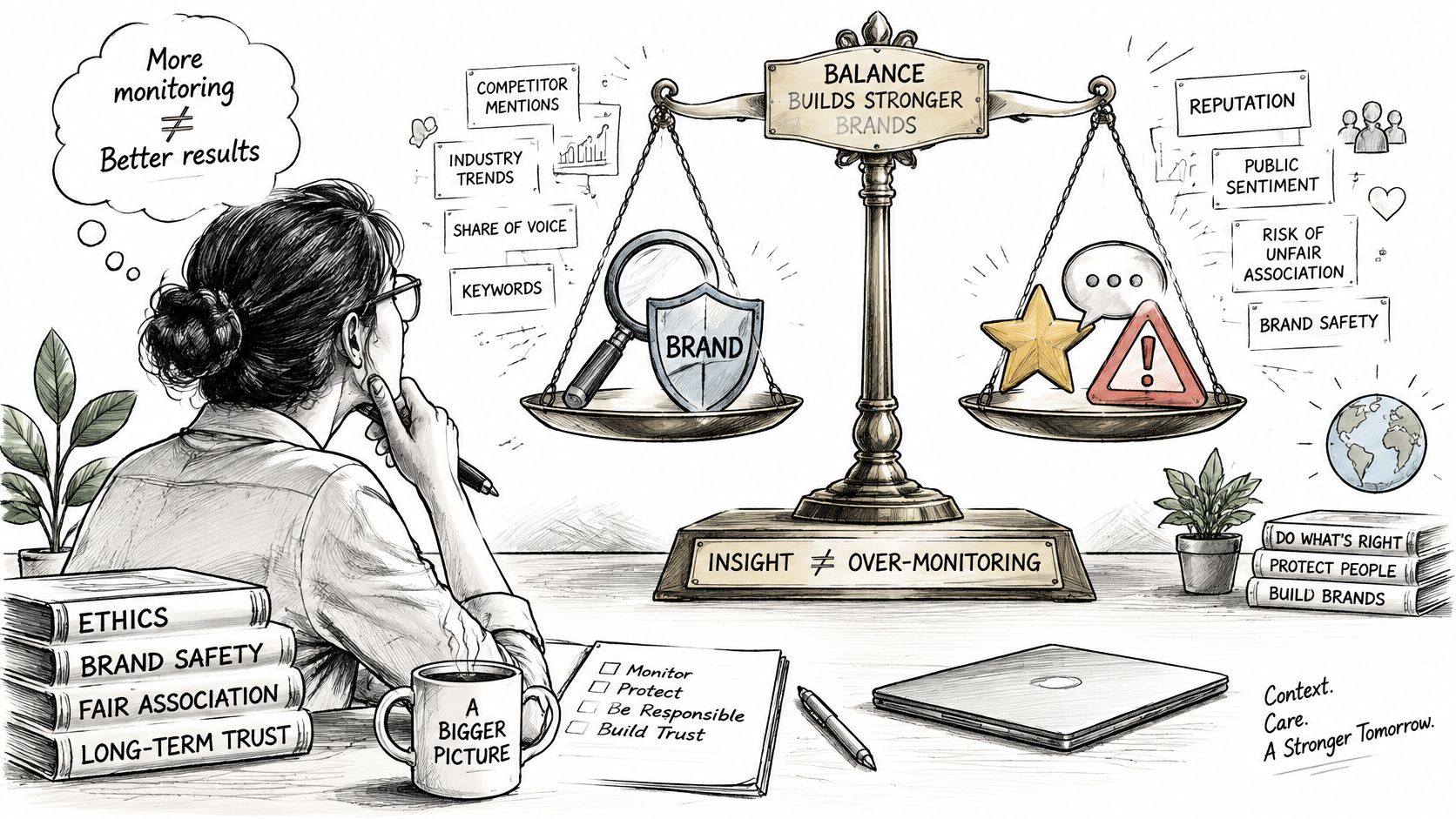
Brand-safety concerns now span political extremism, violence and misinformation, and the collapse of common industry standards left teams without shared benchmarks, as Oxford Road's report on podcasting's growth problem sets out. That same release notes emerging suitability systems that classify speech-to-text content at episode level, which tells you automated context analysis is becoming standard equipment rather than a bonus feature.
Classify the Relationship Before Anyone Shares It #
A mention in a controversial episode proves the episode was controversial. It doesn't prove endorsement, and a keyword alert strips away the distinction that matters most. Sort every match into one of five categories and weight it accordingly.
- Paid advertising is the most verifiable relationship: money moved, the placement is dated, and the creative is on record.
- Host-read endorsement carries the host's credibility alongside the commercial tie, which makes it stronger in tone and easier to quote out of context.
- Editorial discussion reflects the host's opinion, not the audience's and not the company's.
- Guest remarks belong to the guest, and may contradict the guest's own employer.
- Incidental reference is the weakest category and the most screenshot-friendly, usually a passing comparison in a list.
Keeping the placement visible makes classification straightforward. In Podzone, each sponsor ad read is marked over its lines in the transcript, so a reviewer can read or cite the advertisement itself instead of inferring the relationship from the surrounding conversation.
Then set the escalation rules before the first awkward alert arrives. High-risk matches get human review rather than auto-forwarding. A defined threshold governs when something reaches legal, communications or a client. Uncertainty gets written down rather than smoothed over, and retention and access policies get documented so that a request six months later has an answer. When a person's link to the business question disappears, stop tracking them, because continued monitoring at that point is unfair association with a maintenance cost.
More aggressive monitoring can lower decision quality. It floods reviewers with false positives, and it trains a team to reason by association, which is a reputational risk they created themselves.
Set Up a Responsible Monitoring Routine #
The routine below is the control layer that makes everything above workable. It's deliberately short, and it runs on a calendar rather than on enthusiasm.
Eight Steps That Keep the Routine Calibrated #
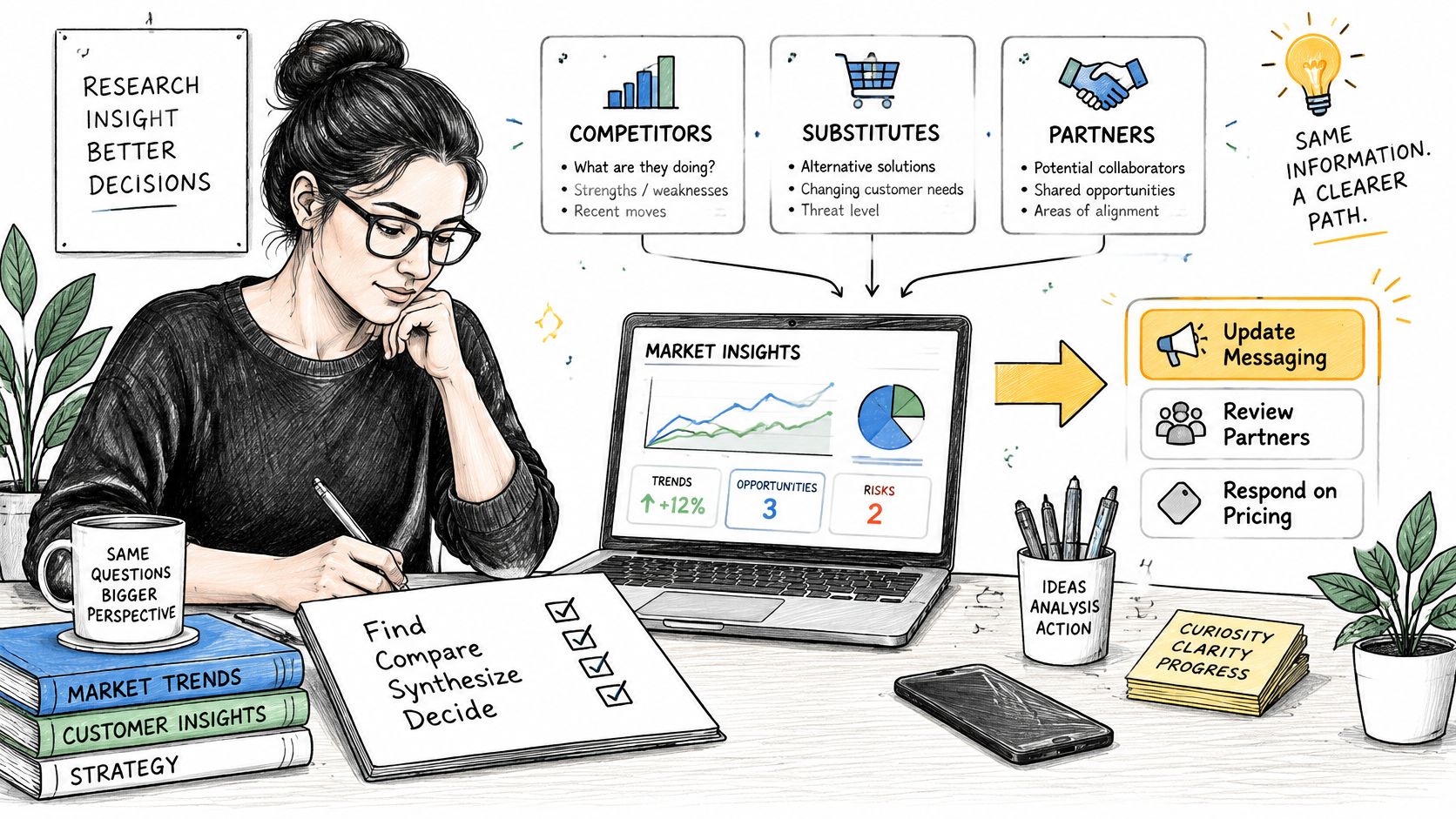
- Name the decision the research supports. A messaging change, a partner review, a pricing response. Unscoped tracking produces updates nobody asked for, and updates nobody asked for get ignored until the one that mattered gets ignored with them.
- Build the watch list from three directions, named competitors, plausible substitutes, adjacent players, and write one line beside each entry explaining why it's there. The reason is what lets you retire it later.
- Write alert rules with exclusions, then test the expected volume before switching them on. Broad keywords flood reviewers, and a rule that fires fifty times a week trains people to stop reading it. Mention alerts in Podzone let a team define keyword rules for a brand, a person or a competitor, with Teams available for managing alerts across their own customers, brands and other groups. Teams already running social listening tools for other channels will recognize the pattern: the tool is only as good as the rule set behind it.
- Restrict personal tracking to business-relevant public statements and attach a retention period. Profiling an executive's private life creates exposure that no competitive insight justifies.
- Classify each match by relationship type before anyone shares it, so a passing reference never travels as an endorsement.
- Require a second signal before a finding becomes a conclusion. Recurrence across several episodes is the cheapest available test.
- Limit access by role and keep exports inside the organization. Redistribution rules belong in writing, and they belong to whoever owns the vendor contract. Podzone notifies account holders before a material change to its Terms takes effect, which is one reason a quarterly read of the contract is worth the twenty minutes.
- Review scope every quarter and re-check vendor terms. Competitive sets drift, platforms change, and a rule that was defensible in January can be an anachronism by October.
What to Keep on File #
Three outputs make the routine auditable. A written scope that names every watch item and its reason. A decision log recording what was acted on, what was rejected and what remains uncertain. A review date on the calendar with an owner attached, because a routine without a date is a good intention.
The measure of a monitoring program isn't how much it collects. It's how many decisions it improves, and how few problems it creates along the way.
Podzone ingests podcast feeds, transcribes episodes, and turns keyword rules into timestamped alerts, so competitor mentions arrive with the transcript excerpt, show details and a link to the exact moment in the audio. That structure is what makes careful monitoring practical: you can check a claim against the full exchange, classify the relationship, and keep evidence that survives review instead of forwarding a clip. Visit Podzone to set up your first scoped alert and see how a calibrated watch list reads in practice.
- competitor monitoring
- competitive intelligence
- competitor research ethics
- brand monitoring risks
- responsible competitor research