10 Social Listening Tools Compared: Alerts and Coverage
Compare 10 social listening tools on monitoring coverage, analytics, alerts, and integrations, with notes on limits, pricing access, and podcast monitoring.
A communications lead hears that a competitor was praised on a weekly podcast. The team finds the episode, but the recommendation is buried in a long recording. Nobody can confirm the wording, identify the speaker, or give the client a usable reference before the reporting deadline.
That's where social listening tools start to differ. Finding a keyword isn't the same as preserving evidence. A useful result keeps enough context for an analyst to verify the claim, a communications lead to share it, and another system to store it without someone rebuilding the record manually.
The practical comparison isn't just about source lists or sentiment charts. It's about what happens after discovery:
- Verification: Can an analyst open the original passage, image, post, or audio moment?
- Sharing: Does the finding remain understandable outside the dashboard?
- Integration: Can the evidence move into reporting, client records, or an internal intelligence system?
Podcast coverage deserves particular scrutiny. A vendor may list podcasts among its sources without providing full-text transcript search or a direct link to the spoken mention. Those differences matter when a client asks what was said.
The options below serve different workflows, from podcast evidence and competitive research to visual analysis and integrated social management. None should be judged on mention counts alone.
Table of Contents #
- 1. Podzone
- 2. Brandwatch Listen
- 3. Talkwalker
- 4. Meltwater
- 5. Sprout Social Listening
- 6. Brand24
- 7. Awario
- 8. YouScan
- 9. Mentionlytics
- 10. Agorapulse Listening
- How the 10 social listening tools compare on pricing access, podcast monitoring, alerts, and integrations
- Choosing the Tool That Fits Your Monitoring Workflow
1. Podzone #
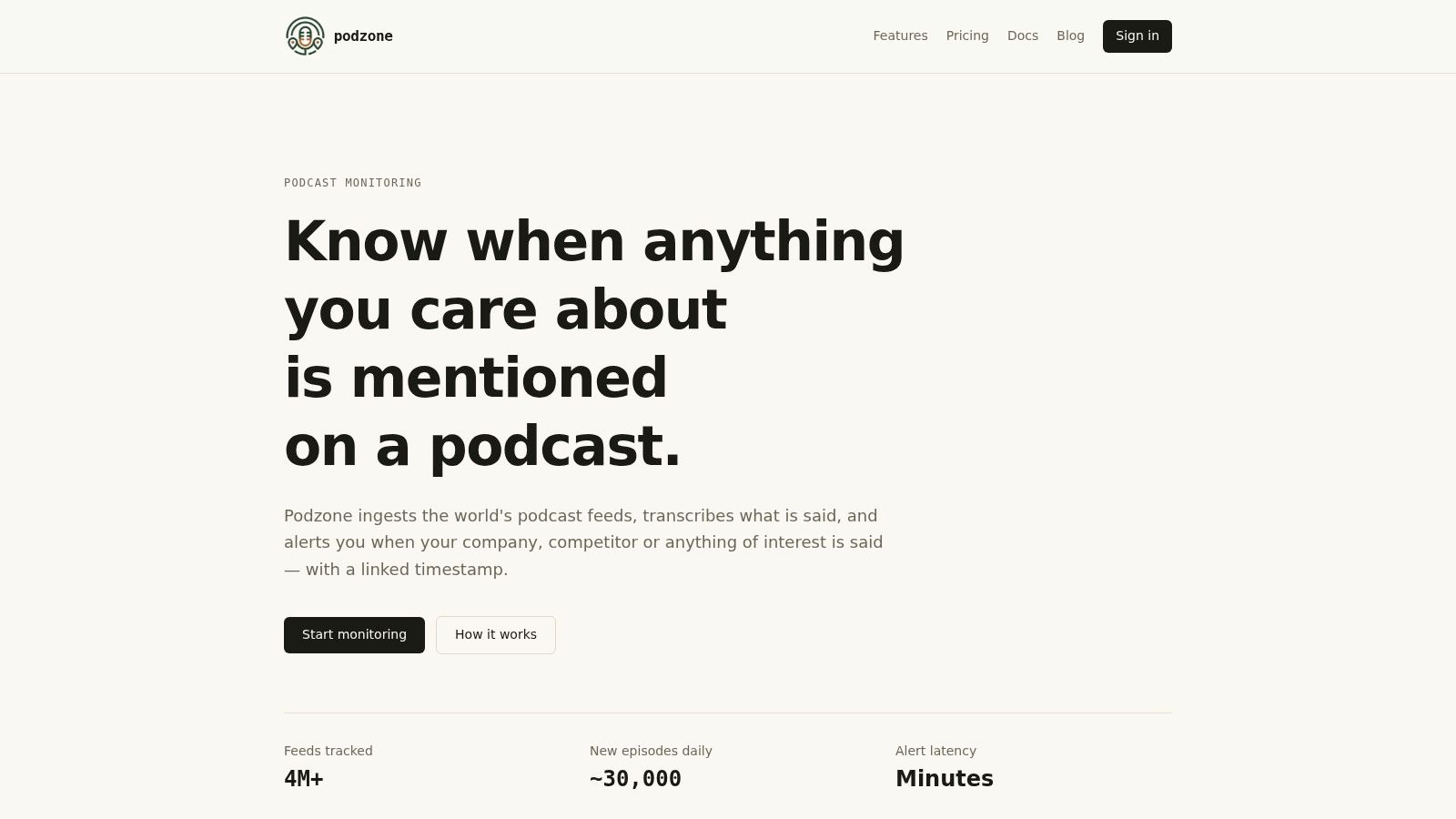
Best for podcast mentions that need to become verifiable evidence. Podzone ingests publicly published podcast feeds, transcribes episodes, and checks new transcripts against keyword rules for brands, competitors, people, and topics. It tracks more than four million feeds and adds approximately 30,000 new episodes daily.
Each mention result brings together the transcript excerpt, show, episode, and linked audio timestamp. That package addresses the difficult part of podcast reporting: proving what was said without asking a client or executive to search through an entire recording.
From mention to reusable intelligence #
Full-text search covers transcribed episodes, and transcripts can be read or downloaded. Alerts surface matches within minutes, while sponsor and people information support adjacent research, including competitor advertising, offer codes, guest histories, and potential booking targets.
Programmatic access is part of the workflow rather than a separate reporting exercise. Every plan includes the API alongside alerts, search, transcripts, sponsors, and people; signed webhooks can push alert matches to an external endpoint.
- Strong fit: PR agencies, competitive-intelligence teams, podcast bookers, and advertising researchers who need spoken evidence rather than show-level references.
- Integration options: The API supports custom workflows, while an MCP server makes podcast search, transcripts, sponsors, people, and alerts accessible through connected assistants and development tools.
2. Brandwatch Listen #
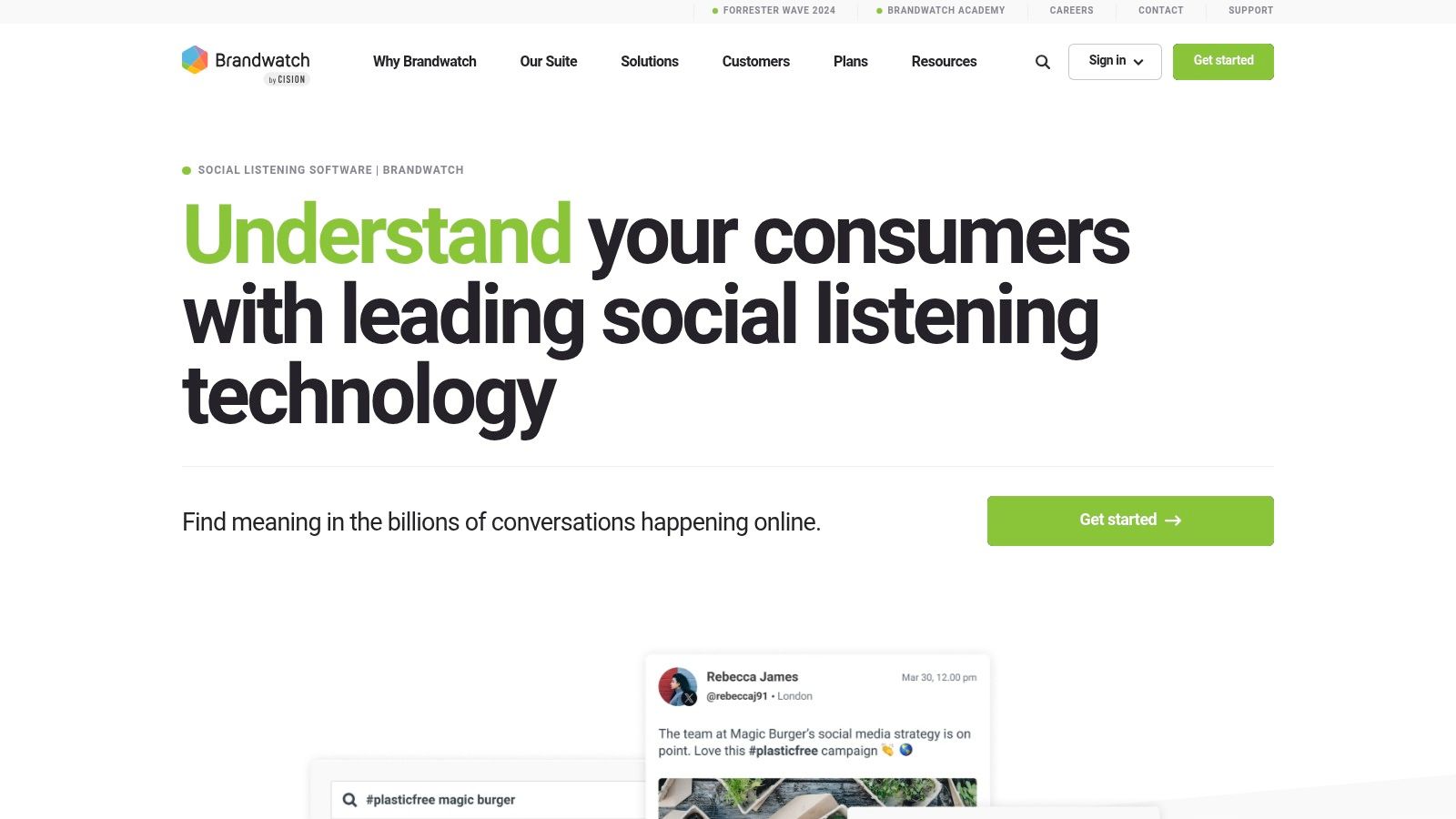
A research team investigating competitor positioning needs more than a stream of alerts. It needs searches that separate product names from unrelated uses, distinguish markets, and support repeatable comparisons. Brandwatch Listen is a candidate for that deeper, query-led work.
Its advanced Boolean searches, broad online-source coverage, historical data, and multilingual analysis support detailed consumer and competitive research. Sentiment analysis and spike alerts help analysts decide where to investigate, while the wider product suite can connect listening with engagement.
Research depth requires query discipline #
The advantage is flexibility. A team can investigate several narratives rather than treating every brand mention as equivalent. The trade-off is configuration: poorly scoped searches can produce impressive dashboards built on irrelevant matches.
For a demonstration, the useful test is a difficult real query. A brand with an ambiguous name, several product aliases, and a competitor comparison will reveal more than a prepared dashboard.
- Verify the package: Included sources, historical access, query entitlements, and export permissions should appear in the proposal.
- Test the handoff: An exported finding should retain source attribution, publication time, surrounding text, and the analyst's classification.
- Check podcast depth separately: Broad listening coverage doesn't establish full-transcript search or timestamped audio evidence.
Quote-based pricing makes early budget comparison harder, and the platform's research depth may exceed a small communications team's needs. The strongest fit is a team with an analyst who can maintain queries, not someone who needs a daily email digest.
3. Talkwalker #
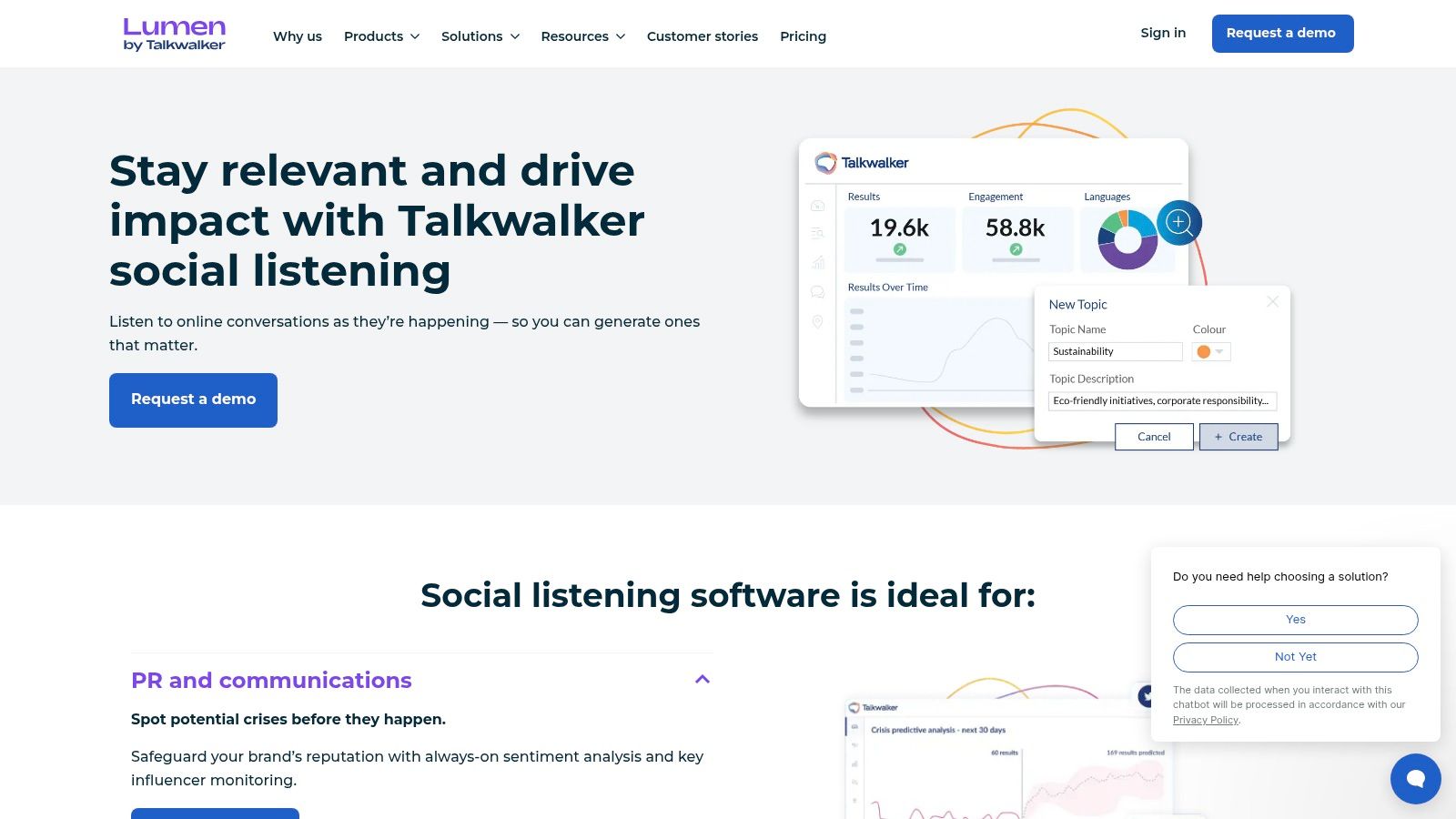
A logo in a video can matter even when nobody types the brand name. Talkwalker is worth considering when text searches alone leave an important gap, particularly for consumer brands whose products appear in visual content.
The platform combines social and website monitoring with visual-listening capabilities intended to identify references in images, video, and audio. Conversation clusters, virality maps, dashboards, sentiment analysis, and AI summaries support investigation beyond the initial match.
Evidence test: A visual or audio match should lead to the underlying material, not just an AI description of it.
For crisis monitoring, the practical question is whether an analyst can reconstruct the conversation. A spike alert may establish that activity increased, but the response team still needs the original content, its context, and a clear distinction between the originating post and later amplification.
Confirm what each media capability means #
Image recognition, spoken-word detection, video analysis, and podcast archive search aren't interchangeable. A demonstration should show the exact media type the team needs, using a brand reference that doesn't also appear in the caption.
Custom pricing and broad functionality make onboarding part of the buying decision. Teams should establish which networks, languages, historical sources, and visual capabilities belong to the quoted package.
Talkwalker suits multimedia investigation, but breadth can introduce configuration work. For podcast reporting, the decisive test remains whether a spoken match includes an accessible excerpt and audio location. An audio-related feature label alone isn't enough to establish that workflow.
4. Meltwater #
For a PR department, separate social, news, influencer, and media-relations systems can create repetitive reporting work. Meltwater brings social listening into a broader media-intelligence offering, making it relevant when the communications workflow extends beyond social channels.
Its offering combines monitoring, alerts, dashboards, and reporting with configurable capabilities for consumer insights, influencer marketing, and media relations. The benefit is organizational fit: a communications team can evaluate related tasks within the same commercial relationship.
The trade-off is modular scope. A polished demonstration may include capabilities that don't belong to the eventual subscription.
Buy the reporting workflow, not the demonstration #
A practical evaluation should start with a completed client deliverable. A media coverage report needs more than a chart of mentions: it needs attributable coverage, context, and a clear explanation of why each finding matters.
- Define the deliverable: Separate executive summaries, coverage evidence, competitor analysis, and operational alerts.
- Map the modules: Identify which capabilities produce each part of that deliverable and whether they require additional purchases.
- Inspect the export: Confirm that source references and contextual detail survive outside the platform.
Pricing is customized, and evaluation centers on a guided demonstration rather than a self-serve free trial. Teams should therefore bring their own terms, sources, and reporting requirements to the sales process.
Meltwater makes sense when broader PR coordination is the priority. A team seeking only focused keyword alerts may find the wider suite unnecessary. Podcast evidence should still be demonstrated directly, rather than inferred from general media-monitoring coverage.
5. Sprout Social Listening #
Existing Sprout users have a different buying calculation from teams starting fresh. Sprout Social offers listening alongside publishing, engagement, and reporting, so the attraction is keeping related social work in a familiar environment.
Topic searches cover brands, keywords, hashtags, competitors, and industry discussion. Listening reports can then sit near the workflows used to manage social activity, reducing the organizational distance between discovering a conversation and deciding who should handle it.
That convenience doesn't remove the need to inspect coverage. Data availability varies by source, and some listening access depends on connected or owned accounts rather than unrestricted public-conversation collection.
Separate convenience from completeness #
Listening is a separately purchased add-on, and its pricing isn't listed in the product information considered here. The relevant comparison is therefore the existing subscription plus listening, not the base social-management price.
- Good fit: A social team already using Sprout that wants topic monitoring close to engagement and reporting.
- Potential mismatch: An agency needing independent research across sources that aren't central to its social-management work.
- Critical buying test: A search for discussion outside the organization's connected accounts, followed by a client-ready export.
The demonstration should include both a source the team controls and a relevant conversation it doesn't control. That exposes the difference between account analytics and broader listening.
A shared interface is valuable only if the required evidence is available. Podcast transcript search, audio timestamps, and exportable episode context should be treated as separate requirements, not assumed extensions of a social reporting dashboard.
6. Brand24 #
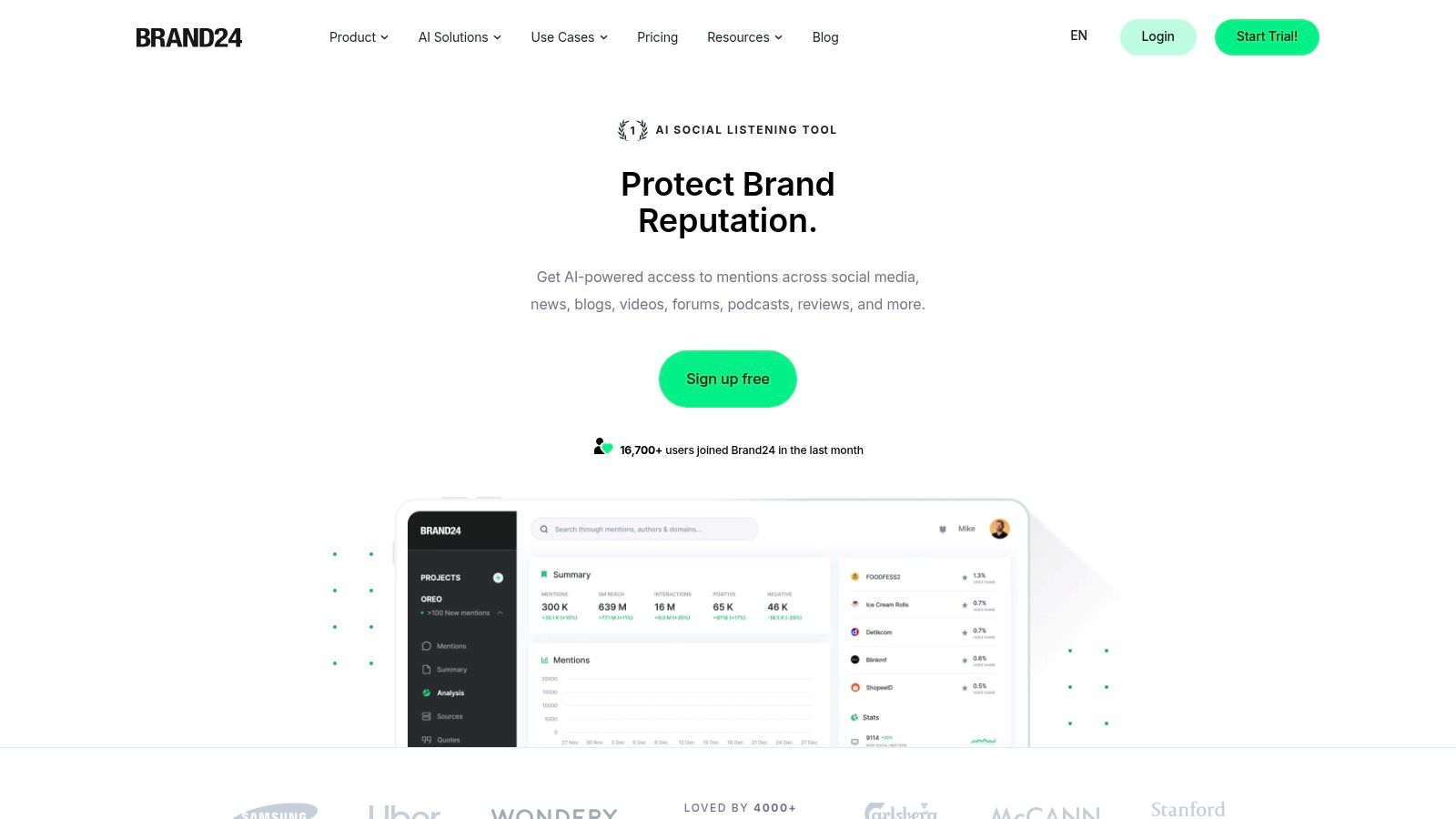
Brand24 explicitly includes podcasts among its monitoring source categories. That makes it relevant to this comparison, but the category label is the beginning of the evaluation, not the conclusion.
Its broader offering tracks mentions across social platforms, news, blogs, forums, review sites, and other online sources. Analytics include mention volume, sentiment, reach, share of voice, topics, and influential authors, with reporting and API options supporting downstream use.
Test the podcast result itself #
A useful evaluation starts with an episode containing a known spoken reference. The team should search for a phrase that appears in the discussion but not in the episode title or description, then inspect the returned evidence.
- Archive depth: Establish whether the result comes from searchable spoken content or episode metadata.
- Verification: Look for the surrounding passage and a precise route back to the audio.
- Portability: Export the result and inspect whether the episode reference, context, and matching term remain together.
Keyword and mention quotas can constrain broader monitoring. A common category term may generate substantially more review work than a distinctive company name, so a trial should include both narrow brand searches and noisier industry terms.
API access also needs commercial scrutiny because availability depends on plan or add-on arrangements. An exportable report isn't equivalent to a dependable automated feed.
Brand24 is a candidate for mixed-source brand monitoring. For agencies promising podcast evidence to clients, the deciding factor is whether the actual result supports verification, not whether podcasts appear on the coverage list.
7. Awario #
Public pricing and topic-based monitoring make Awario a candidate for teams that want to evaluate defined searches without beginning with an enterprise sales process. Its Boolean search supports tighter matching, while exports and white-label reports are relevant to agencies sharing findings under their own branding.
The important distinction is between search flexibility and collection capacity. Multiple keywords within a topic can support aliases and related phrases, but monthly mention allowances and stored-result limits still affect what the team can retain.
A client-ready PDF isn't an evidence archive. The original source and enough context to check the finding still need to travel with the result.
For an agency, the best demonstration is a report assembled from its own monitoring terms. Reviewers should be able to trace a conclusion back to the underlying mentions without asking the analyst to repeat the search.
Check alert behavior before report design #
Source coverage, refresh cadence, team access, and API availability should be evaluated against the intended operating process. A reporting-focused account may have different requirements from a crisis-monitoring account.
For audio-focused work, podcast mention alerts illustrate the evidence requirement: the notification needs to identify the episode and link to the relevant spoken passage. General web alerts shouldn't be assumed to provide that same behavior.
Awario's appeal is a defined monitoring and reporting workflow. The limitation is that clear pricing and flexible queries don't guarantee full coverage. Teams should test discovery speed, retained context, and export quality before committing to client deliverables.
8. YouScan #
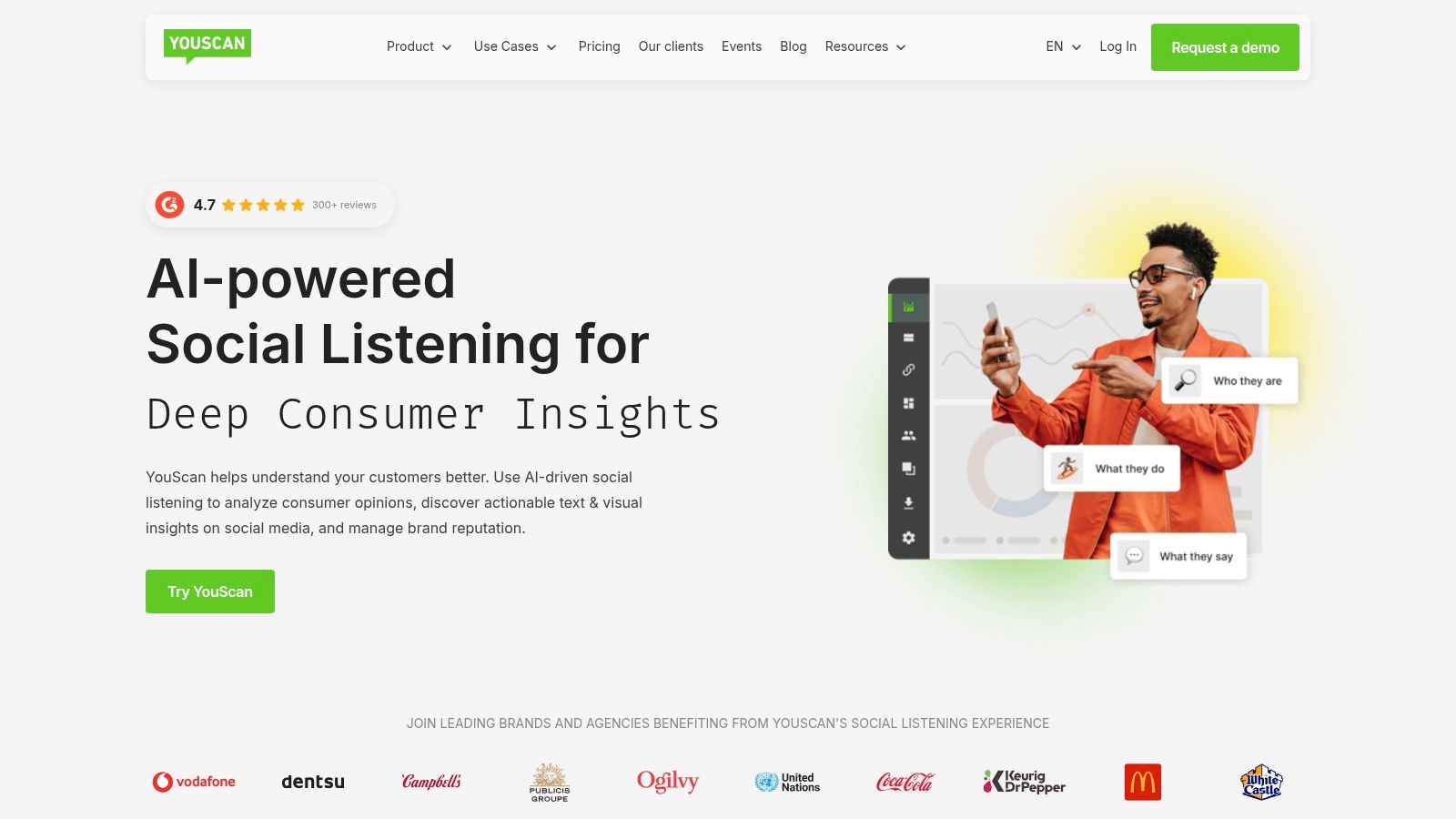
A product can appear in a customer's photograph without being named in the caption. YouScan addresses that blind spot through visual analysis alongside text-based listening.
Its Visual Insights capability analyzes images for logos, objects, scenes, and brand context. Audience insights, dashboards, and a conversational assistant for querying listening data support further exploration of those results.
Visual context changes the review task #
For a consumer-research team, an image can help distinguish how a product is used from how a brand describes it. A beverage on a desk, at an event, or beside a competing product offers different qualitative context, even when the caption says little.
The analyst still needs the underlying image and post. A detected logo doesn't automatically establish endorsement, purchase intent, or a positive experience.
- Strong fit: Brands studying product visibility, usage settings, and references that keyword searches miss.
- Less useful: Teams whose primary requirement is text alerts or timestamped podcast quotations.
- Demo requirement: Show the original image, explain the detected elements, and demonstrate how that evidence appears in an export.
Pricing and feature access depend on the plan, so visual capabilities should be tied explicitly to the proposal. Non-social source requirements also need separate confirmation.
YouScan's differentiator matters when visual evidence is central to the decision. It's less compelling when image analysis would become an occasional curiosity. For audio-heavy communications work, the relevant comparison remains searchable transcripts, reviewable passages, and reliable evidence transfer rather than visual feature depth.
9. Mentionlytics #
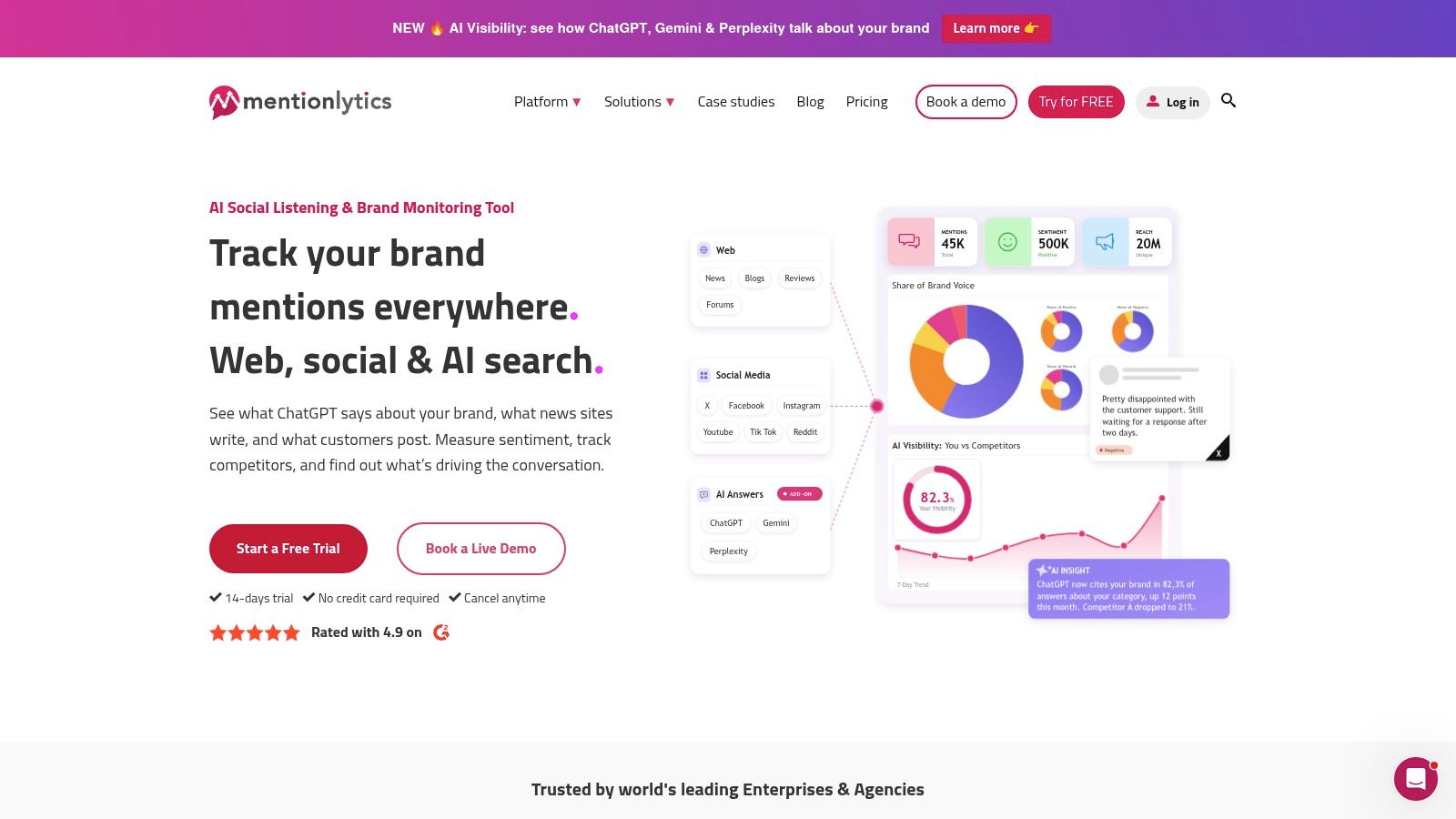
Update cadence can disqualify a monitoring plan before analytics enter the discussion. Mentionlytics offers keyword and mention monitoring through tiers that differ in allowances, users, reporting, and refresh behavior.
That structure can suit teams with clearly defined monitoring needs. It also means the entry package and a higher-tier configuration shouldn't be treated as the same operational product.
Sentiment and emotion analysis, more frequent updates, and report customization vary by tier. An optional AI Visibility add-on addresses brand appearances in AI-generated answers, which is a different evidence category from public social posts or podcast speech.
Match the tier to the response window #
A weekly research digest can tolerate collection delays that an urgent reputation workflow can't. The evaluation should therefore begin with when the team must know about a mention, then move to keyword capacity and reporting.
- For routine reporting: Test whether scheduled collection and standard reports support the intended client deliverable.
- For urgent monitoring: Establish actual refresh behavior, notification delivery, and what happens during a collection interruption.
- For AI visibility: Keep generated-answer monitoring separate from human conversation metrics and identify the evidence retained.
Public pricing and trials make initial evaluation more straightforward, but quotas still need testing with realistic queries. A narrow company-name search won't reveal the workload associated with a broad industry topic.
Mentionlytics is a candidate for tiered, requirements-led monitoring. Buyers should avoid choosing by dashboard appearance while leaving cadence, source provenance, and export detail unresolved. Podcast transcript and timestamp requirements need their own demonstration.
10. Agorapulse Listening #
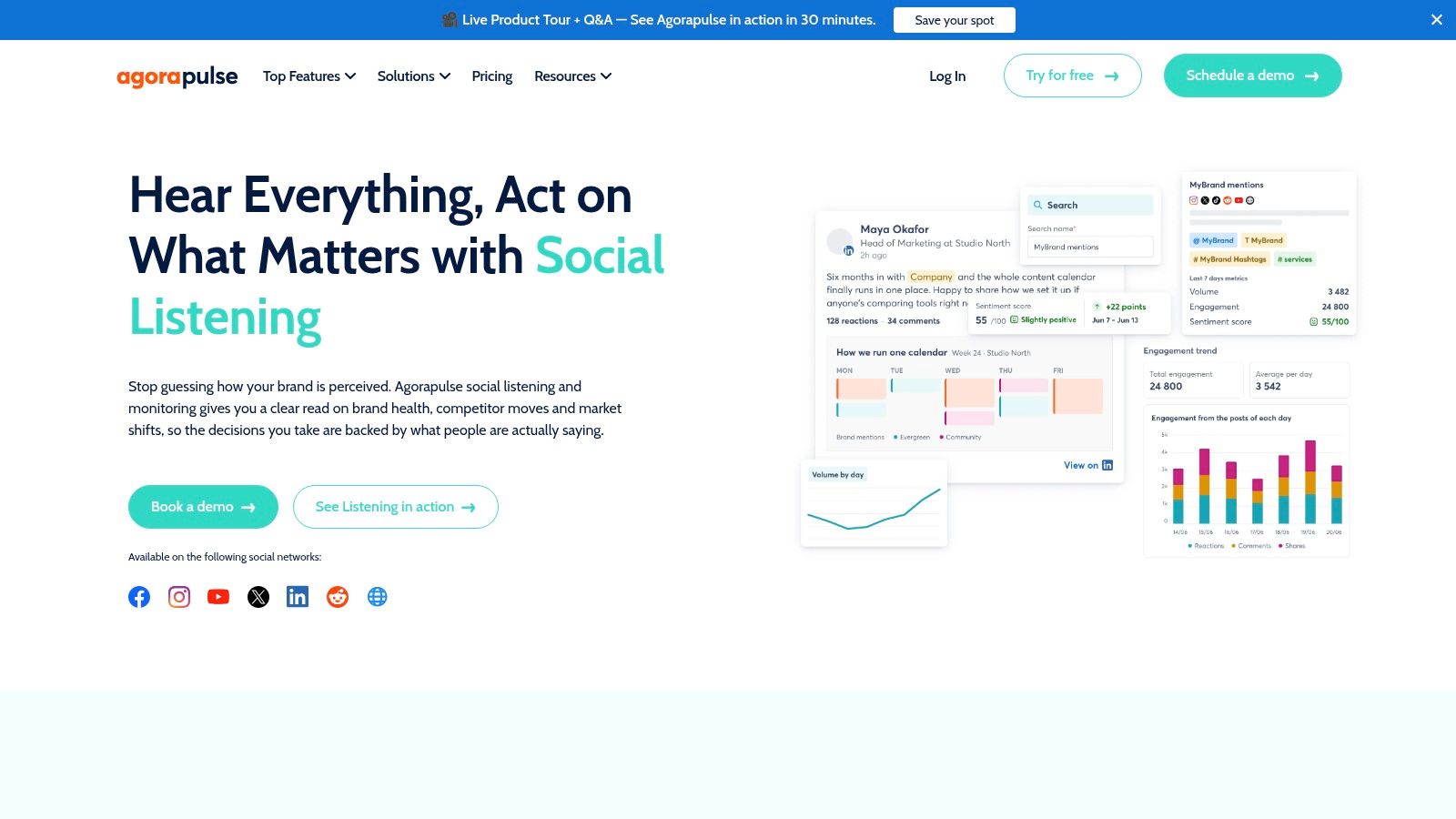
Ambiguous brand names create a practical problem: analysts spend time rejecting unrelated results before they can assess the conversation. Agorapulse Listening includes AI screening intended to reduce those coincidental keyword matches.
The listening capability sits within a broader social-management platform and covers social networks and web sources such as news, blogs, and forums. Sentiment and share-of-voice reporting support analysis near publishing, engagement, and reporting work.
Inspect what screening removes #
Noise reduction is useful only when relevant mentions survive. A demonstration should include an ambiguous company name, a shorthand reference, and an unfavorable comparison, rather than only clean exact-name examples.
Review safeguard: Automated relevance screening should make analyst decisions easier, not make excluded evidence impossible to inspect.
Listening is an add-on, with cost affected by conversation volume and historical-data requirements. The proposal should distinguish the social-management subscription from the monitoring configuration being demonstrated.
For historical comparisons, teams should establish whether the same sources and collection rules apply across the periods being compared. A larger archive isn't automatically a consistent archive.
Agorapulse fits teams that want monitoring near day-to-day social operations. Its relevance screening may reduce cleanup work, but teams needing deeper research or podcast transcript search should test those requirements directly. The final acceptance test should include an export: source references, contextual text, classification, and review notes need to remain useful after the result leaves the dashboard.
How the 10 social listening tools compare on pricing access, podcast monitoring, alerts, and integrations #
| Item | Pricing Access | Podcast Monitoring | Alerts | API or Integrations |
|---|---|---|---|---|
| Podzone | Public pricing | Dedicated monitoring across 4M+ feeds; searchable transcripts and timestamped mentions | Keyword alerts within minutes | API, signed webhooks, and MCP server |
| Brandwatch Listen | Quote-based | Not specified; verify source coverage | AI alerts for mention spikes | Can pair with Brandwatch Engage |
| Talkwalker | Custom quote | Audio visual listening; podcast transcript monitoring not specified | Real-time alerts | Integrations not specified |
| Meltwater | Customized pricing; contact sales | Not specified | Alerts, dashboards, and reporting | Optional influencer marketing and media-relations modules |
| Sprout Social Listening | Add-on; pricing not listed | Not specified | Topic-based monitoring; alert details not specified | Integrated with Sprout publishing and engagement |
| Brand24 | 14-day free trial; API is paid add-on or Enterprise | Podcasts listed as a source; transcripts and timestamps not specified | Mention monitoring; alert details not specified | API access on select plans |
| Awario | Public pricing | Not specified | Boolean-search mention alerts | API access listed |
| YouScan | Plan-based pricing; demo available | Not specified | Listening insights; alert details not specified | Insights Copilot |
| Mentionlytics | Public pricing and trials | Not specified | Keyword monitoring; update cadence varies by plan | AI Visibility add-on |
| Agorapulse Listening | Paid add-on; cost varies | Podcast transcript search not specified | AI-screened monitoring; alert details not specified | Integrated with Agorapulse social-management workflows |
Choosing the Tool That Fits Your Monitoring Workflow #
The right choice starts with what a mention must do after discovery. If it becomes evidence for a client or executive, the result needs an attributable source and enough context to verify the interpretation. For podcasts, that means keeping the excerpt, show, episode, and audio timestamp together.
If the finding feeds another system, integration terms matter as much as the dashboard. In a survey of industry professionals described in Yahoo Finance's social-listening market coverage, more than 80% of surveyed listening experts used multiple tools. A practical integration test should inspect identifiers, timestamps, evidence fields, authentication, and duplicate handling, not merely confirm that an API exists.
Evaluate evidence, coverage, and interpretation separately #
- Evidence quality: Open the original material, check the surrounding context, and share the result with someone who didn't perform the search.
- Coverage transparency: Confirm included sources, collection methods, historical depth, exclusions, and how access changes are documented.
- Operational fit: Test alert delivery, review ownership, exports, API access, webhook behavior, and the applicable plan terms.
Coverage claims need particular care. Forage's discussion of listening-platform alternatives highlights conditional access and platform restrictions, reinforcing the need for source-specific commitments rather than an undifferentiated source list. Historical comparisons should be annotated when collection conditions change.
Interpretation needs similar discipline. Sogolytics' market-research analysis identifies non-representativeness as a central social-listening error: visible conversation doesn't represent everyone who buys, listens, or holds an opinion. Podcast mentions can establish narrative, recommendations, and message spread, but they don't directly measure total consumer awareness.
Run the handoff before signing #
A useful trial or demonstration carries a real keyword from discovery through verification, review, sharing, and export. Brandwatch and Talkwalker merit evaluation for deeper research; Meltwater for broader PR coordination; Sprout and Agorapulse for social-management proximity; and specialist requirements should decide the remaining shortlist.
Connected assistants introduce another review point. With Podzone, data retrieved by an AI assistant or third-party tool is sent to that tool and its provider under the customer's arrangement with them. Those terms belong in the integration review before any connection is enabled.
The strongest purchase is the tool that passes the complete workflow, not the one with the longest feature list. A mention that can't be checked or reused remains unfinished work.
Podzone combines searchable podcast transcripts, keyword alerts, timestamped audio evidence, sponsor research, and host and guest information. PR and intelligence teams can visit Podzone to evaluate how podcast findings can be verified, shared with clients, and delivered into existing systems through the API and signed webhooks.
- social listening tools
- social listening software
- brand monitoring tools
- podcast monitoring
- media monitoring tools