Media Coverage Report: Metrics That Hold Up
Compile a media coverage report with defensible metrics, a clear method, and findings clients can act on in 2026.

In 2025, 75% of respondents across 48 markets consumed video news in any format, up from 67% in 2020, according to the Reuters Institute's Digital News Report executive summary. A clipping folder built around published articles can't represent that audience's full experience of coverage.
A credible media coverage report records more than appearances. It distinguishes what was published, what audiences could have encountered, what speakers said, and what the communications team can reasonably conclude. Volume is inventory, not success. The report earns its place in a client meeting when its evidence supports a decision without claiming more than it can prove.
Table of Contents #
- Metrics Every Media Coverage Report Should Carry
- Podcast Mentions and the Context Layer
- How to Compile the Report from Brief to Codebook
- How to Present Findings Clients Can Use
- Pre-Send Checks When Volume and Scores Mislead
- Send the Package With One Clear Ask
Metrics Every Media Coverage Report Should Carry #
Metrics to include and claims they cannot support
| Metric | Use it to show | Do not treat it as |
|---|---|---|
| Article or episode count | Volume in the reporting window | Proof the coverage worked |
| Potential reach or impressions | Upper-bound exposure if the audience saw it | Unique people or business impact |
| Prominence | Headline or lead versus a passing mention | Influence on belief or behavior |
| Message presence | Whether agreed points appeared | Audience acceptance of those points |
| Tone | Favorable, neutral, critical, mixed or ambiguous | Trust, sales or risk on its own |
| Spokesperson | Who carried the quote or segment | Automatic endorsement by that speaker |
| Engagement | Observed shares, comments, listens or completion | Causation |
| Audience or business outcome | Awareness, behavior or a commercial effect tied to a goal | A stand-in for advertising value equivalent |
A media coverage report is a dated, reproducible record of where a brand, leader, issue or competitor appeared. Each row should connect to retrievable evidence, not merely a dashboard total.
Article and episode counts establish the size of the inventory. The counting unit must remain consistent: an article, episode, segment and social post aren't interchangeable items. Potential reach then describes the possible exposure attached to that inventory, with the audience source and estimation method visible.
Prominence establishes where the mention appeared. A headline reference deserves a different code from a passing line near the end, even when both belong to the same outlet. Message presence answers a separate question: whether the agreed point appeared accurately, partially or not at all.
What the scorecard needs beneath the totals #
Tone requires mutually exclusive labels. Mixed should mean that favorable and critical material coexist; ambiguous should mean that the evidence doesn't support a confident classification. Analysts shouldn't use either as a convenient bin for difficult items.
The spokesperson field identifies who delivered the relevant statement, including an outside expert or critic. Engagement records an observed response on the relevant platform, while outcomes require a stated objective and a measurement method suited to that objective. Comments can demonstrate response without demonstrating persuasion.
Reporting rule: Every metric needs a defined unit, an evidence source and a boundary around the conclusion it supports.
Scope follows audience behavior #
The Reuters Institute's 2025 Digital News Report found that six online networks each reached at least 10% of respondents weekly for news, compared with only two a decade earlier. That fragmentation makes an outlet-only collection strategy inadequate for a report intended to describe cross-channel exposure.
The practical channel list should therefore consider web publishing, broadcast, social networks, video and audio. Inclusion still depends on the campaign's audience and objective, not on collecting everything a monitoring platform can export.
Before collection begins, the reporting owner should freeze the inclusion rules. Original reporting, syndicated copies, reposts and commentary need separate classifications so that the final scorecard shows both the underlying story and its distribution.
Podcast Mentions and the Context Layer #
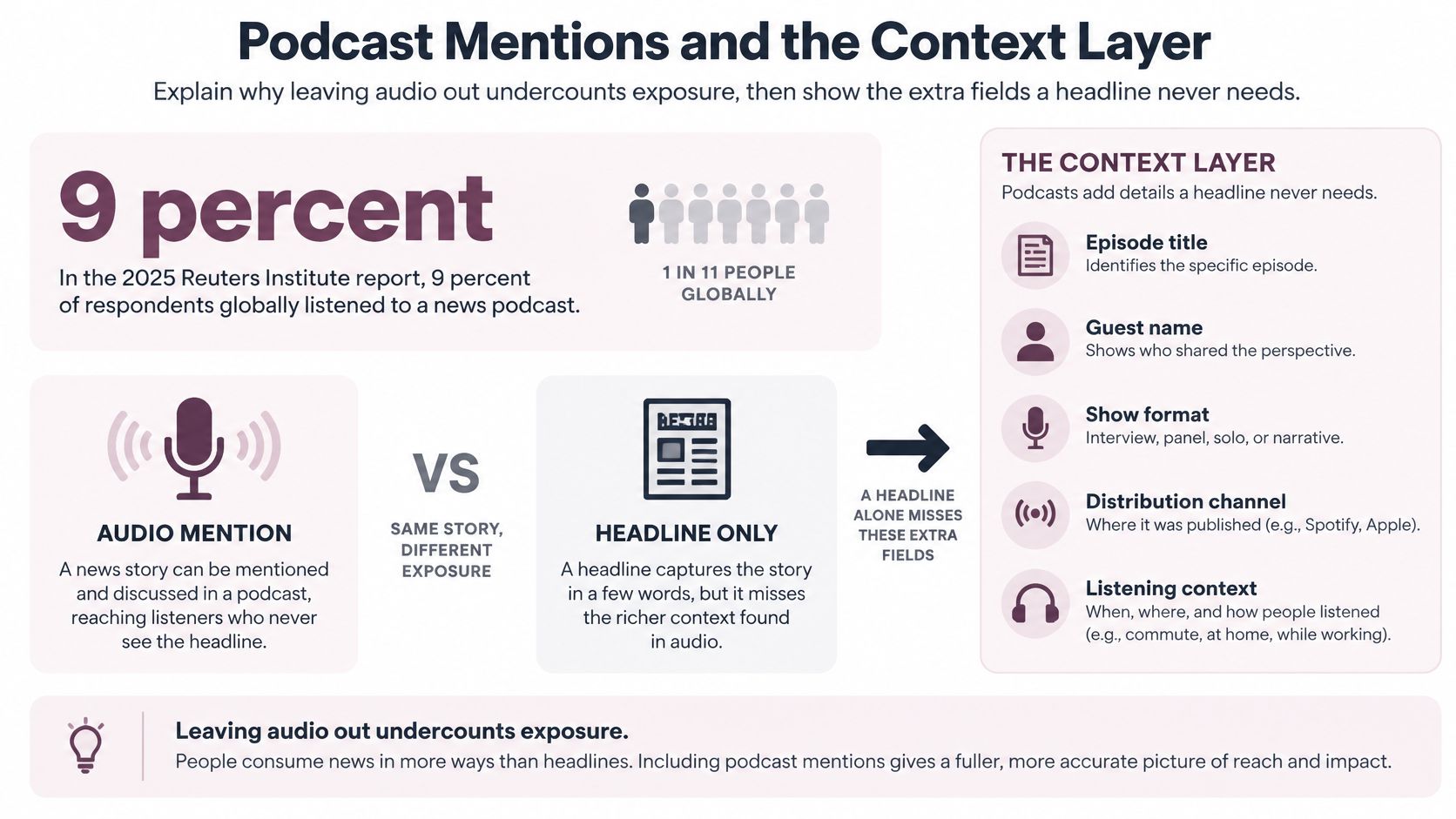
In the United States, 15% of respondents listened to a news podcast during the survey week in 2025, according to the Reuters Institute findings reported by Nieman Lab. Globally, the figure was 9%, making audio a relevant coverage channel rather than an optional appendix.
A podcast mention also demands a different kind of review. The episode title may never name the company, and the show notes may omit the relevant discussion entirely. A search result establishes that a name appeared; it doesn't establish what the speaker meant.
The passage matters more than the match #
Consider a hypothetical business podcast in which a guest recommends a competitor. The host agrees, describes a useful application, and moves on without qualification. The important finding is not just the competitor mentioned. It is an unchallenged recommendation supported by a practical example.
That distinction belongs in fields beside the standard coverage codes:
- Timestamp and speaker: The precise passage and the person responsible for the statement.
- Speaker stance: Whether the host or guest endorsed, repeated, questioned or challenged the claim.
- Evidence and correction: Whether the discussion supplied support, introduced a caveat or corrected an earlier assertion.
- Reputational risk: The analyst's assessment of the passage's significance, with a written rationale.
- Episode context: The title, guest, show format and distribution channel needed to interpret the exchange.
A host reading a disputed allegation before rejecting it shouldn't receive the same classification as a host endorsing it. Nor should a sponsor read automatically count as independent editorial approval.
Observation stays separate from judgment #
The context matters because 73% of podcast listeners say podcasts help them understand issues better than other media, according to the Reuters Institute findings summarized by the Global Investigative Journalism Network. That finding supports reviewing the surrounding discussion, not assuming that every listener accepted the speaker's position.
The coded log should preserve an observation such as host agrees with the guest's recommendation. A separate interpretation might identify competitive risk because the recommendation addresses the brand's core use case. The latter is a professional judgment, not a directly measured audience effect.
Searchable episode transcripts can locate the passage before an analyst reviews the surrounding audio. Playback remains necessary when emphasis, laughter, interruption or an unclear speaker label could change the meaning.
A methodology footnote should identify transcript evidence as observed content and reputational risk as analyst interpretation. That distinction makes the report easier to defend when a client disagrees with the risk call but accepts the underlying passage.
How to Compile the Report from Brief to Codebook #
A defensible report starts before the first export. The reporting owner needs a method another analyst could follow without privately knowing how the campaign worked.
The AMEC Barcelona Principles require transparent, replicable methodology, including source-selection rules, human versus automated analysis, the tone scale, target-audience reach and content-analysis parameters. They also caution that overall clip counts and general impressions can be meaningless without quality and audience context, and that advertising value equivalent isn't a substitute for outcome or impact measurement.
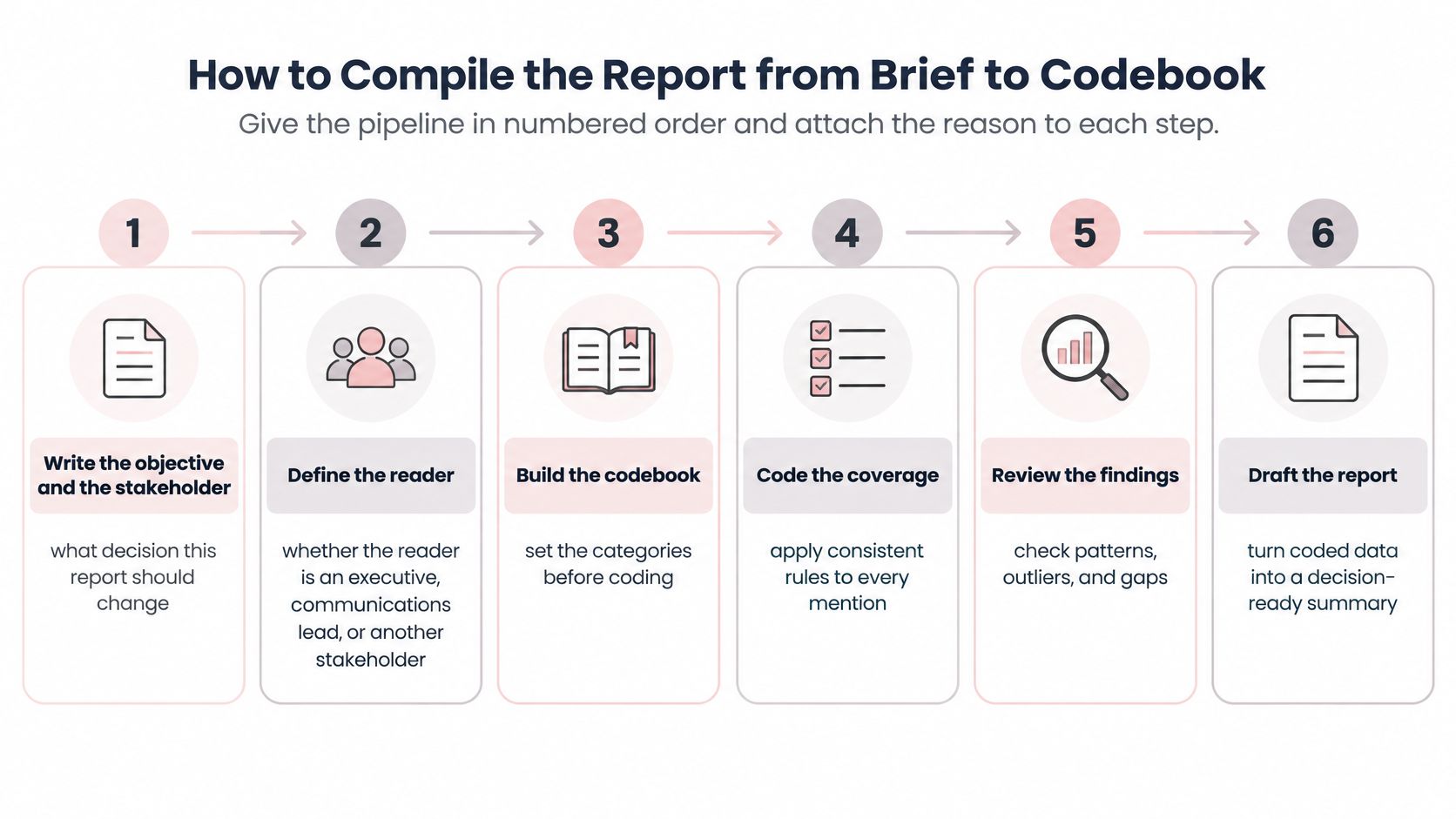
The reproducible working sequence #
-
Write the objective and identify the stakeholder. The brief should name the decision the report will inform and the person responsible for making it. An executive deciding whether to respond needs a different opening from an analyst checking campaign execution. A vague objective such as demonstrate success leaves the analysis open to selective interpretation.
-
Document sources and inclusion rules. The collection specification needs the reporting window, markets, languages, source types and treatment of owned versus earned content. It should also state whether social reposts qualify. Changing those boundaries after seeing the results breaks comparability.
-
Collect consistently and log the pull date. Web, broadcast, social and audio collection should follow documented searches rather than whichever dashboard is easiest to export. A keyword-alert workflow can support ongoing collection, but the log still needs the query and retrieval record. Missing access should appear as a coverage limitation.
-
Apply the codebook to every included item. Core fields cover outlet, publication date, reach basis, prominence, message presence, spokesperson and tone. Audio fields add timestamp, speaker stance, correction presence and reputational-risk rationale. The codebook should explain edge cases, not merely list category names.
-
Resolve duplicates using a written rule. A syndicated article can retain its distribution record while linking to the original story. A reshared clip should connect to its source episode. A later discussion containing new commentary may qualify as a new item, with the reason recorded.
-
Audit a sample with a human reviewer. The reviewer should check inclusion, speaker attribution, message coding and tone against the original evidence. Disagreements with automation belong in the audit note, along with any correction to the wider dataset. Fixing selected rows without noting it leaves the error pattern hidden.
-
Interpret the pattern without merging outputs and outcomes. The narrative should explain which messages, speakers or editorial choices shaped the results. Article and episode counts stay in the output record; awareness, behavior and business effects require their own measurement evidence.
A complete coded entry #
The following is a hypothetical worked example, not a reported placement.
| Field | Example entry |
|---|---|
| Outlet | Hypothetical business podcast |
| Date | Publication date recorded from episode metadata |
| Reach | Unavailable; no audience estimate assigned |
| Prominence | Dedicated discussion within an interview |
| Message presence | Product reliability point present and qualified |
| Spokesperson | Guest operations director |
| Tone | Mixed |
| Audio context | Guest endorses reliability; host challenges affordability |
| Risk interpretation | Pricing objection merits spokesperson preparation |
The minimum appendix contains the codebook, inclusion rules and audit note. Those documents let a reviewer reconstruct the result without relying on an analyst's memory.
How to Present Findings Clients Can Use #
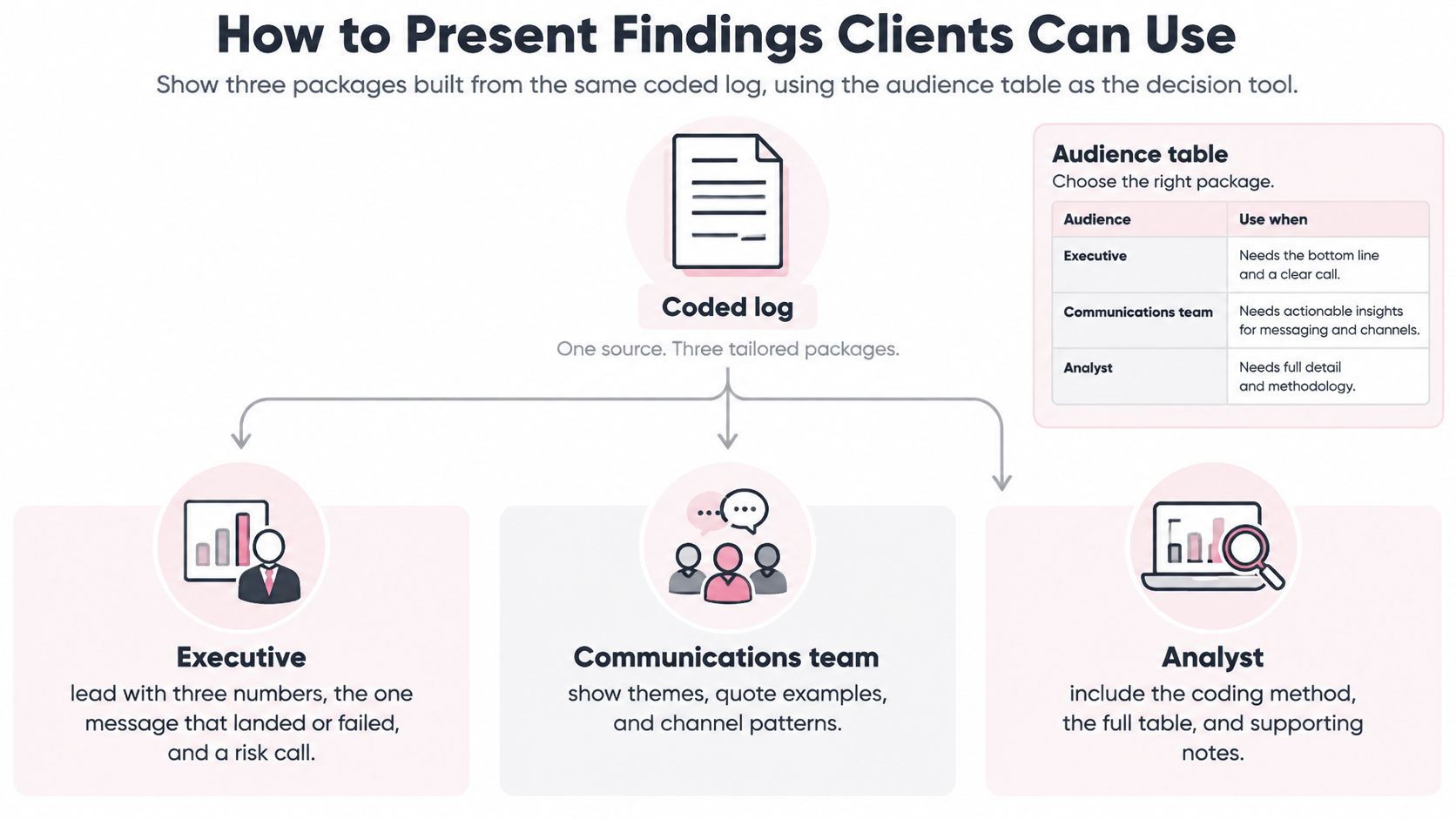
An executive package should open with a compact scorecard: the selected headline metrics, the message that landed or failed, and a risk call of increase, hold or correct. The attachment should support a decision without requiring the executive to interpret a raw monitoring export.
The same coded log can serve other readers, but the opening and attachments should change. Rewriting the underlying classifications for each audience would create conflicting versions of the evidence.
What each reader should see first
| Reader | Lead with | Attach |
|---|---|---|
| Executive | Three numbers, the message result and a risk call | One-page scorecard |
| Client PR lead | Message gaps, spokesperson share and outlet pattern | Coded log with links |
| Analyst or reviewer | Scope, duplicates, audience basis and confidence | Codebook and audit note |
The client lead needs editorial detail #
A client PR lead needs enough detail to change the next briefing. If the intended message appeared only in company quotes while journalists emphasized an unresolved objection, the report should identify that distinction rather than celebrate message presence alone.
Spokesperson share also needs a clear denominator. A share calculated from quoted spokespeople answers a different question from a share calculated across all coverage items. The label should make the calculation understandable without requiring a meeting.
For an analyst or procurement reviewer, methodology comes first. The report should identify source access, missing channels, estimated audience fields and unresolved coding judgments before presenting a confident-looking total.
Evidence should support the recommendation #
Every package benefits from the same reading order: answer, pattern, evidence, next action. The answer states the decision; the pattern explains why it's warranted; selected excerpts make the interpretation inspectable.
A headline or transcript excerpt should carry its tone, message and speaker codes beside it. Without those labels, a vivid quote can distract from what the report measured.
Charts should remain selective:
- Original-item trend: Shows changes in editorial activity across comparable windows.
- Tone split: Displays the coded distribution, with unresolved items visible rather than reassigned without notice.
- Message-presence rate: Uses an explicit denominator and distinguishes accurate repetition from partial inclusion.
Impressions and outcomes shouldn't share an axis. Their units answer different questions, and placing them together can imply a relationship the analysis hasn't established.
According to the Reuters Institute findings summarized by the International Federation of Journalists, overall trust in news remained at 40% for the third consecutive year in 2025. Publication therefore can't serve as evidence that an audience believed a message.
Counts describe inventory; the recommendation describes the decision.
Pre-Send Checks When Volume and Scores Mislead #
A clip total can rise while the underlying story barely changes. The first pre-send check should separate original items from syndicated copies and reposts, then confirm that the executive summary uses the correct total.
The reviewer should also inspect any sudden mismatch between volume and the narrative. A larger export doesn't justify a stronger conclusion when the additional rows contain no new reporting or substantive commentary.
Misleading report signals and the fix
| What you see | Why it misleads | Fix before send |
|---|---|---|
| Clip total jumps, story does not | Syndicates and reposts counted as originals | Deduplicate and report original items separately |
| Tone score looks strong | Automation missed sarcasm or long-form context | Human audit on a sample, especially audio |
| Impressions framed as ROI | Reach is not an outcome | Split potential reach from behavior |
| AVE in the value column | AVE is not impact | Delete it and restate the business question |
| Podcast set beside TV or social | Formats and attribution differ | Disclose format, repeats and confidence |
The diagnosis should trigger a correction #
When volume spikes but tone remains flat, the reviewer should inspect message presence after duplicate removal. Repeated distribution may have amplified the same material without adding a new message or editorial position.
An unexpectedly strong automated tone score warrants playback of difficult passages. Sarcasm, quoted criticism and a host's eventual rebuttal can make a sentence-level label unreliable. The audit should test the interpretation against the complete exchange.
When a summary labels impressions as ROI, the correction belongs in the summary itself, not only in an appendix. Potential exposure and observed behavior need separate fields. An AVE value column should be replaced with the actual business question and the evidence available to answer it.
Cross-format comparisons need qualifications #
In industry reporting published by Podnews, 50% of surveyed brand decision-makers cited measurement limitations as the leading barrier to podcast advertising growth, and 76% said they would increase investment if YouTube podcast attribution matched audio attribution. Those findings concern advertising decisions, but they illustrate why a coverage report needs explicit measurement boundaries when formats sit side by side.
A podcast audience figure, television rating and social impression total shouldn't appear as equivalent exposure units without qualification. The report needs the format, whether repeat exposure is included, whether the audience is observed or estimated, and the confidence attached to attribution.
Every disputed item should retain a source, publication date, speaker, excerpt and method note. An analyst should be able to reopen the evidence rather than defend an isolated dashboard label.
The final footnotes should state:
- Source scope: Included channels, markets, languages and access gaps.
- Lag: Publication and ingestion cutoffs, including late-arriving material.
- Duplicate rule: Treatment of syndication, reposts and derivative clips.
- Audience basis: Estimated versus observed figures and repeat exposure.
- Not measured: Audience or business effects outside the reporting method.
Send the Package With One Clear Ask #
The report should leave the sender with a decision request, not an invitation to browse attachments. A recommendation such as brief the spokesperson on the pricing objection gives the recipient something concrete to approve, assign or reject.
The delivery package should match that decision. The executive receives the scorecard, the client lead receives the linked coded log, and the methodological reviewer receives the codebook and audit note. Supporting files can remain available without overwhelming every recipient with every document.
The email needs an owner and a next action #
The subject line should identify the reporting window and the decision required. The opening sentence should state the finding and its consequence, while the next sentence names the proposed action and responsible owner.
An approval request shouldn't hide inside a paragraph of coverage highlights. If a disputed claim requires correction, the email should identify the claim, the evidence supporting a correction and the person authorized to respond.
Useful decision requests include:
- Correct a claim: The press lead approves an evidence-backed clarification for the relevant journalist or producer.
- Brief a spokesperson: The communications owner adds a recurring objection to the next interview preparation.
- Watch a rival: The analyst continues monitoring a competitor's recommendation pattern before proposing a response.
The reporting owner should also establish the next collection window before the thread closes. A stable weekday and unchanged inclusion rules support comparison; a changed campaign objective requires a documented change to the method rather than an unexplained shift in the chart.
Decision test: A recipient should be able to identify the requested action without opening the raw log.
Audio monitoring needs a filing rule #
For podcast coverage, the ongoing watch should include the brand, competing names and the issue under discussion. Each relevant hit needs an excerpt, show, episode and timestamp so that the finding can be forwarded without requiring another full listen.
Podzone is a practical audio option: its alerts watch new episode transcripts for brands, competitors or topics, and each mention result provides the excerpt, show, episode and timestamp.
The team still owns the editorial judgment. The passage belongs in the evidence log; its significance belongs in the risk assessment; the proposed response belongs in the decision request. Keeping those responsibilities distinct prevents a keyword match from becoming an unsupported recommendation.
Approval requested for the communications lead to brief the spokesperson on the pricing objection before the next interview, with competitor mentions retained in the next monitoring window.
Podzone offers podcast search, transcripts and mention alerts that help communications teams attach inspectable audio evidence to a media coverage report. Teams building a brand, competitor or issue watch can visit Podzone to locate relevant passages and carry timestamped findings into client reporting.
- media coverage report
- PR measurement
- coverage metrics
- podcast mentions
- AMEC