10 Sponsorship Marketing Examples That Actually Worked
10 real sponsorship marketing examples broken down by tactic, risk and result, with actionable takeaways you can apply to your own campaigns.
“Choose the biggest audience the budget allows” is poor sponsorship advice. A large audience can deliver little commercial value when the partner, message, and buying situation don't fit. The better bet is a partnership that gives the brand a credible role, a useful activation, and a result the team can evaluate.
The strongest sponsorship marketing examples are not just stories about famous logos. They reveal different ways to earn attention: owning a live moment, reacting intelligently to someone else's event, backing a recognizable set of values, or building familiarity through repeated appearances. Podcast host-read sponsorship adds another useful mechanism: a personal delivery paired with an offer that listeners can act on.
Not every example below is a conventional rights-based sponsorship. Oreo illustrates event-adjacent marketing; Mint Mobile illustrates celebrity-led advertising; Pepsi supplies a cautionary example rather than a success story. Those distinctions matter because buying sponsorship rights, hiring talent, and joining a cultural conversation create different obligations.
The useful question isn't whether a campaign became famous. It's which part of the approach another team could repeat without inheriting unnecessary cost or risk.
Each partnership therefore deserves scrutiny beyond exposure: what the brand controlled, what audiences were asked to believe, and what evidence would justify another investment. A spectacular activation can be commercially weak. A modest host-read campaign can be valuable. Neither conclusion should depend on a highlight reel alone.
Table of Contents #
- 1. Red Bull Stratos
- 2. Oreo ‘Dunk in the Dark'
- 3. Nike and Colin Kaepernick
- 4. Emirates and Arsenal Football Club Sponsorship
- 5. Visa as a Global Olympic Partner
- 6. Monster Energy and the UFC Partnership
- 7. Mint Mobile and Celebrity-Led Advertising
- 8. AG1 Host-Read Sponsorship on The Joe Rogan Experience
- 9. BetterHelp Host-Read Podcast Advertising
- 10. Pepsi ‘Live for Now' with Kendall Jenner
- 10 sponsorship marketing examples at a glance
- Steal the Playbook Without Copying the Budget
1. Red Bull Stratos #
Red Bull Stratos illustrates owning the moment rather than renting space around it. Felix Baumgartner's high-altitude jump gave the brand a central role in an event with a clear narrative: preparation, uncertainty, and an outcome audiences wanted to witness.
The illustration captures that association with extreme achievement.

The transferable tactic isn't the dangerous stunt. It's the combination of a compelling event and planned content rights. A sponsor that can distribute preparation footage, interviews, the live moment, and subsequent explanations has more activation options than a sponsor receiving a logo placement.
Separate the spectacle from the commercial result #
A technical equipment brand could sponsor a demanding field demonstration, then turn the preparation into educational material for prospective buyers. That gives the audience a reason to watch beyond brand exposure.
The measurable risk is attention without brand understanding. Reporting should distinguish views from changes in brand association, qualified website visits, and relevant inquiries.
The event footage provides the context for that distinction.
Production, permissions, safety planning, and distribution also need separate budgets. A sponsor shouldn't commit everything to staging the moment and leave nothing for helping the right audience discover it.
Next week: A brand team can outline a sponsored demonstration with a clear audience question, secure content-reuse rights, and define the business action each resulting asset should support.
2. Oreo ‘Dunk in the Dark' #
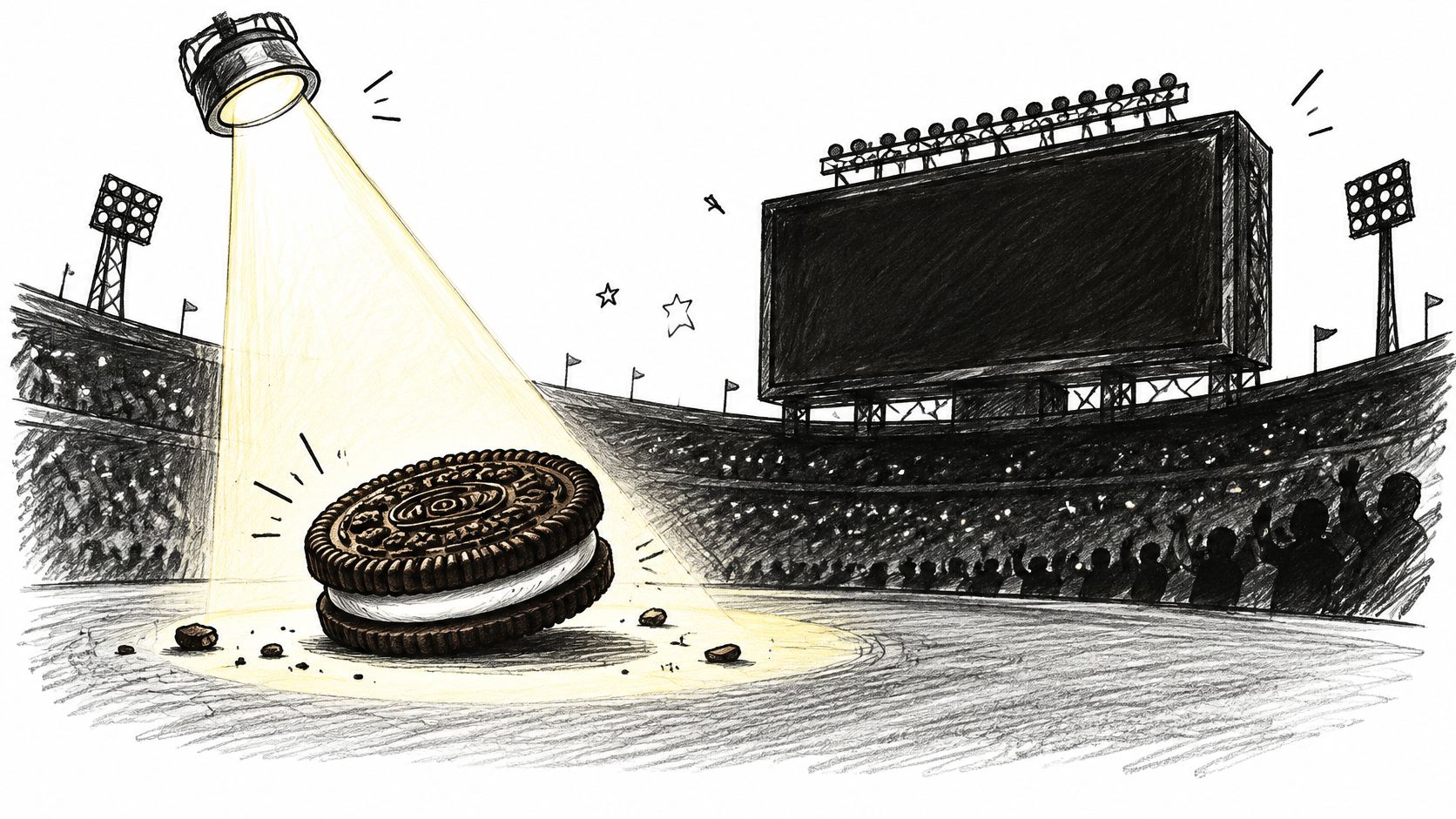
Oreo's response to the Super Bowl blackout demonstrates the value of prepared agility. The creative connected an unexpected interruption with a familiar product behavior, without requiring audiences to understand an elaborate campaign.
This is event-adjacent marketing, not proof that official sponsorship rights are unnecessary. Brands reacting around an event still need to distinguish ordinary cultural participation from implying an authorized commercial relationship.
The illustration emphasizes the product-event connection.
Prepare decisions, not predictions #
The repeatable advantage is a team that knows what it can approve. Trying to anticipate every possible event produces generic creative; agreeing on brand boundaries and decision authority makes a relevant response possible.
- Creative boundaries: Specify acceptable humor, product references, and topics that require escalation.
- Approval ownership: Give a named decision-maker authority to approve publication.
- Commercial tracking: Compare reactions with relevant site activity and brand conversation, rather than treating sharing as a sales result.
A snack brand sponsoring a local tournament could prepare flexible creative around weather delays or surprising match outcomes. It shouldn't force a joke into an injury, emergency, or sensitive dispute.
Practical rule: Fast approval is useful only when the team already knows what deserves restraint.
Next week: A communications team can run a simulated live-event exercise, test its approval process, and document which situations require silence rather than a post.
3. Nike and Colin Kaepernick #
Nike's Dream Crazy campaign featuring Colin Kaepernick makes a difficult trade-off visible: a brand can strengthen identification with some audiences while provoking rejection from others. The partnership is useful to study because audience agreement was never a safe assumption.
Calling that result “engagement” would obscure the strategic question. A sponsor needs to determine whether the association strengthens its position with the people it intends to serve, not merely whether people discuss it.
Values-led endorsement requires more than persuasive creative. The partner, the message, and the company's conduct need to withstand scrutiny together.
Measure alignment, not universal approval #
A running brand considering an athlete associated with a contentious cause should test more than immediate liking. Interviews can explore whether customers understand the connection, believe the commitment, and still consider the product relevant.
The monitoring plan should distinguish:
- Audience response: Reactions from customers and credible prospects versus general commentary.
- Issue relevance: Criticism of the partnership's position versus criticism of the company's consistency.
- Commercial consequences: Changes in consideration, customer retention, and qualified demand.
The risk isn't negative sentiment. It's a values claim that the company cannot defend operationally, or a partnership that makes the brand less relevant to its intended customers.
Next week: A sponsorship team can write the strongest argument against its proposed partner, then ask whether leadership has a clear, evidence-backed response before approving creative.
4. Emirates and Arsenal Football Club Sponsorship #
A stadium name works differently from a campaign slogan. Supporters, broadcasters, visitors, and travel planners encounter it as part of identifying a place, not just as advertising copy.
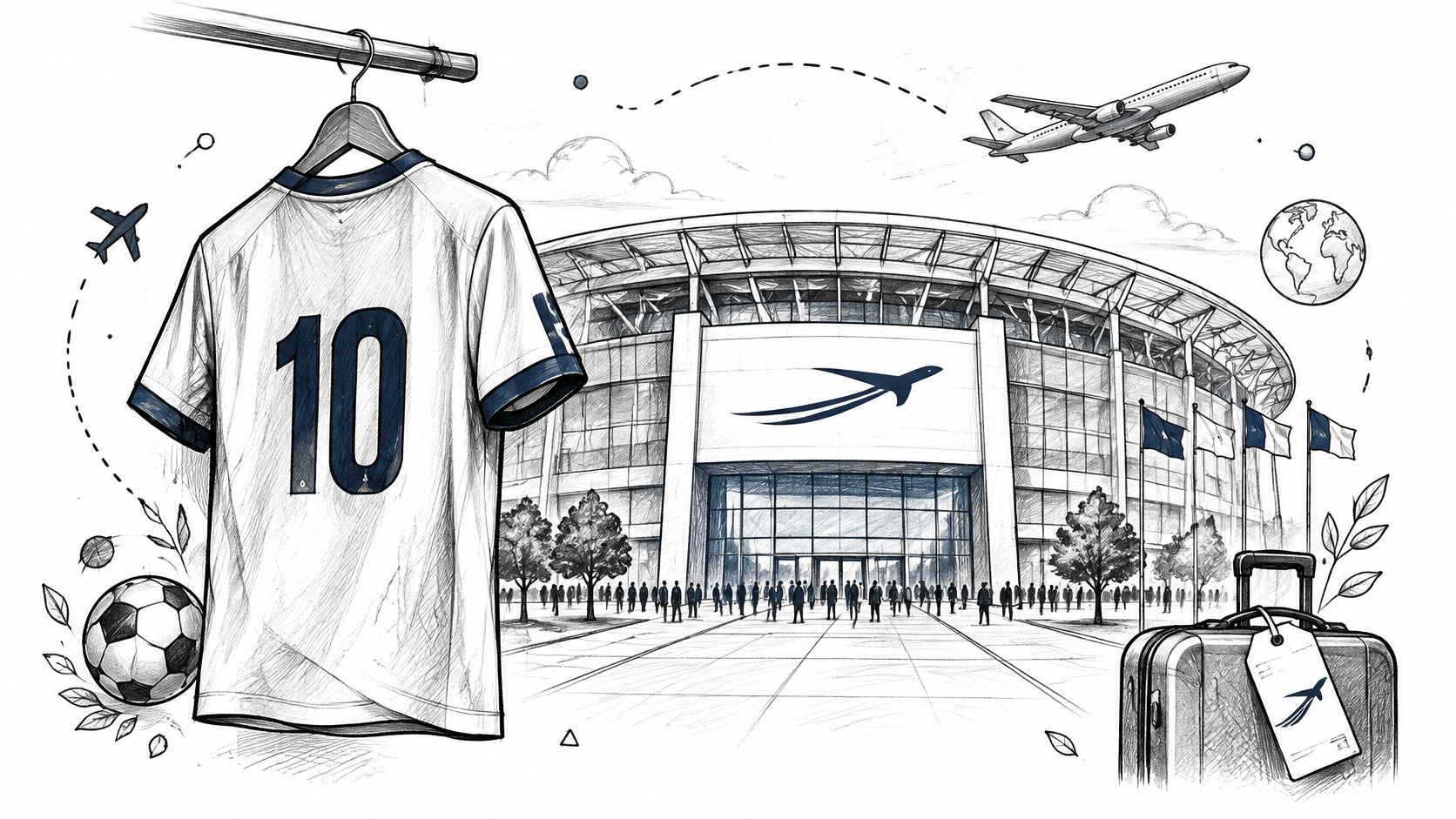
Emirates' association with Arsenal combines that naming presence with shirt sponsorship and hospitality opportunities. The strategic attraction is repeated familiarity across different fan experiences, rather than dependence on a launch moment.
The illustration reflects those connected travel and sporting touchpoints.
Buy usable rights, not just visible rights #
The practical question is what the sponsor can do with the association. Hospitality, customer experiences, content access, and relevant offers can give an otherwise passive placement a commercial purpose.
A regional transport company sponsoring a venue could build useful matchday travel information and customer packages around its rights. That creates a service connection instead of asking supporters to remember a name without context.
The measurable risk is familiarity without preference. Audience surveys should test whether people recognize the sponsor, understand its category, and consider choosing it.
Long commitments also reduce flexibility. Renewal terms should address changes in inventory, unavailable hospitality, reputational disputes, and the evidence needed to justify continuation.
Next week: A rights buyer can mark every proposed asset as either exposure, audience utility, customer access, or content access. Assets without a clear activation owner should be renegotiated or removed.
5. Visa as a Global Olympic Partner #
Visa's Olympic partnership illustrates a particularly useful principle: the sponsor's product can participate in the experience. Payment-related activation connects more directly to the company's purpose than an unrelated branded spectacle would.
The broader commercial structure matters, too. The IOC's Olympic marketing history identifies 1985 as the creation of The Olympic Partners programme, which grants category-exclusive marketing rights to a limited group of multinational partners.
That is a rights strategy, not a media purchase. Category protection and permission to activate around a respected property can give sponsors something ordinary advertising inventory cannot provide.
Connect global recognition to local usefulness #
For a payment brand, relevant activation can connect athlete storytelling with travel, shopping, or payment experiences. The emotional association and the functional benefit should reinforce each other.
A smaller payments provider sponsoring a trade exhibition could apply the same principle by improving the purchasing experience for participating vendors. The brand would demonstrate its product while supporting the event.
The risk is buying exclusivity without a practical use for it. A contract should define the protected category, permitted product claims, geographic scope, and activation permissions precisely.
Exclusivity is valuable when it protects an activation the sponsor actually intends to run.
Next week: A sponsorship team can identify an audience task its product could improve, then check whether the proposed rights allow that improvement rather than merely advertising it.
6. Monster Energy and the UFC Partnership #
Monster Energy and the UFC demonstrate cultural fit through repeated context. Fight events, athlete partnerships, and related content give the brand opportunities to appear within a recognizable sporting environment.
The transferable lesson isn't that an energy drink belongs beside every intense activity. It's that a sponsor should understand the community's language, personalities, and expectations before buying access.
A logo can establish presence. Athletes and credible editorial formats can help explain why the brand belongs there.
Evaluate the environment beyond event night #
For a specialist training-equipment company, a combat-sports partnership might support athlete preparation content, technical demonstrations, or gym education. Those activations would connect the product to something participants do.
The buying decision should weigh:
- Audience fit: Whether viewers include likely customers, not merely people with compatible demographics.
- Partner behavior: How athletes represent the brand outside contracted appearances.
- Content adjacency: Whether surrounding discussion creates avoidable reputational exposure.
- Creative durability: Whether the partnership offers useful material between events.
The measurable risk is mistaking cultural resemblance for purchasing relevance. A brand can fit the visual style of a sport without offering something its audience wants.
Monitoring should therefore include product questions, qualified traffic, consideration, and the context of brand mentions. Positive crowd energy alone doesn't establish commercial value.
Next week: A media buyer can review prospective partners' event content and ordinary off-event output, then document both the audience connection and the situations that would trigger escalation.
7. Mint Mobile and Celebrity-Led Advertising #
Mint Mobile's advertising with Ryan Reynolds shows why a recognizable creative voice can matter as much as celebrity recognition. Humor gives the spokesperson a role in explaining the offer rather than presenting a famous face.
This belongs beside sponsorship examples as a related talent-partnership model. It shouldn't be treated as identical to buying rights from a sports property or sponsoring a podcast.
The useful mechanism is consistency: the audience encounters a familiar personality, tone, and product proposition. The weakness appears when people remember the joke but not the service.
Make the offer survive the punchline #
A challenger software company could hire a comedian to dramatize an annoying customer problem. The creative should still make the product's purpose and next step understandable without relying on the performer's fame.
- Product clarity: Test whether viewers can explain what the company sells.
- Offer tracking: Assign campaign-specific landing pages and distinguish visits from completed purchases.
- Creative ownership: Agree on reuse rights, editing permissions, and what happens when the talent relationship ends.
A celebrity association also creates concentration risk. The company needs recognizable product benefits and creative assets that remain useful without the spokesperson.
That means evaluating acquisition quality, not just response volume. Entertaining advertising can attract curiosity from people who have little intention of becoming customers.
Next week: A brand team can test a proposed celebrity concept with the performer's name removed. If the product argument disappears too, the concept needs stronger commercial foundations.
8. AG1 Host-Read Sponsorship on The Joe Rogan Experience #
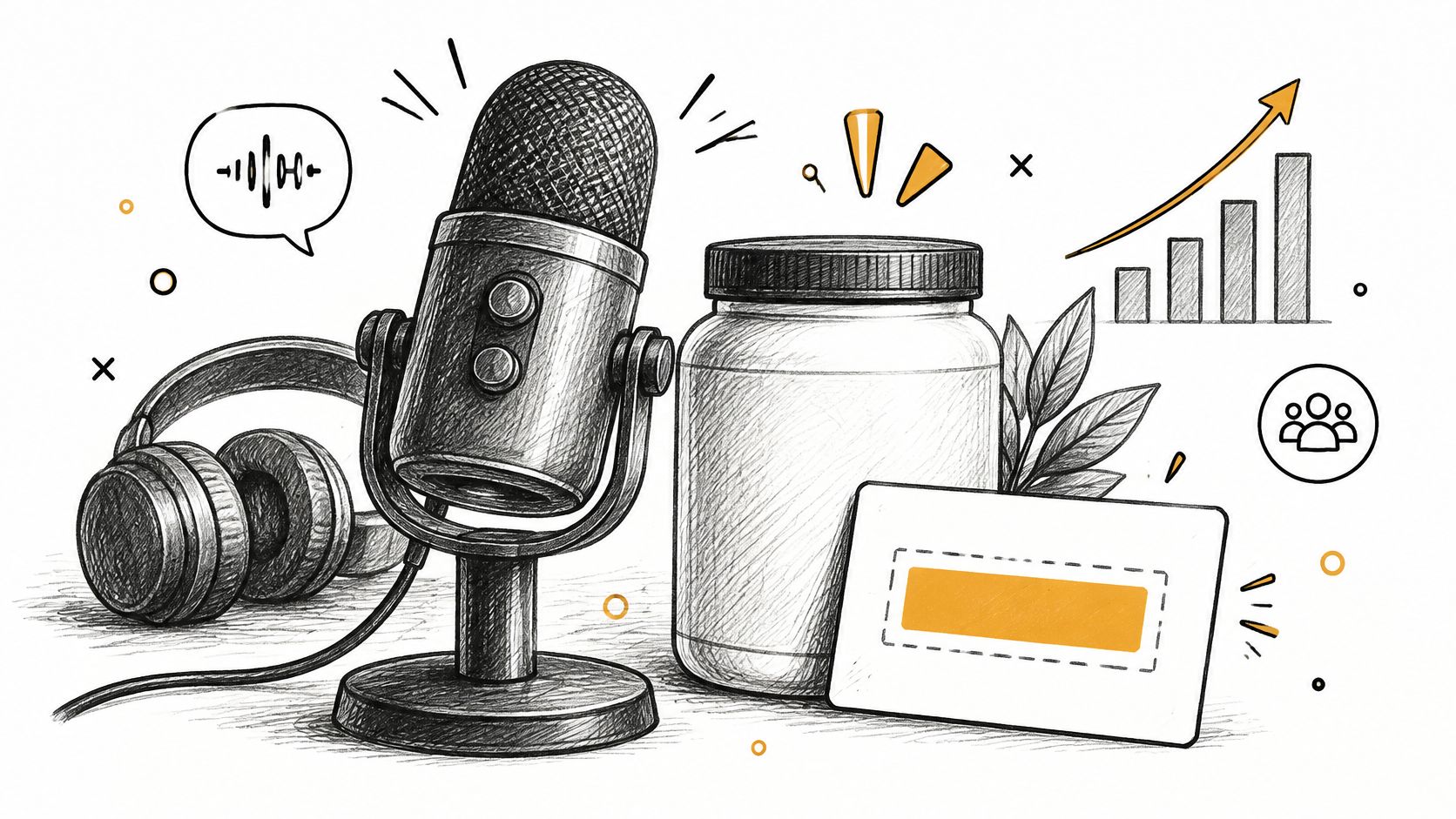
AG1's host-read advertising on The Joe Rogan Experience illustrates the combination of personal delivery and an identifiable response path. A spoken offer and dedicated destination give listeners a practical next step.
That doesn't make every resulting sale incremental, or every untracked sale irrelevant. Codes can circulate beyond the original audience, while listeners may purchase later without using the advertised route.
The illustration highlights the relationship between the read and its measurement.
Track the read, not just the redemption #
Acast's brand-lift research with Attest found that sponsorship alone increased awareness or familiarity by 6 percentage points, compared with 20 percentage points when sponsorships and standard podcast ads ran together. That finding supports testing an integrated format; it doesn't establish AG1's campaign results.
A supplement buyer should record the show, episode, timestamp, host involvement, offer, and campaign period. Approved product claims also need clear boundaries, especially when a host improvises.
For publishers approaching suitable advertisers, a practical guide to finding podcast sponsors can support prospecting around audience relevance rather than advertiser fame.
Next week: A sponsorship team can audit recent reads for offer accuracy, natural delivery, and claim compliance, then compare tracked conversions with branded-search and survey signals before recommending renewal.
9. BetterHelp Host-Read Podcast Advertising #
BetterHelp's podcast advertising illustrates a different operating challenge: repeating a recognizable proposition across varied hosts without making every read sound interchangeable. Show-specific offers can support attribution, but the category demands careful handling.
A host's conversational credibility isn't permission to improvise clinical claims or suggest outcomes the advertiser cannot substantiate. Personal experience should remain clearly distinguishable from general product information.
For a broad sponsorship programme, consistency should apply to factual accuracy and the offer. It needn't require identical wording across every show.
Separate delivery quality from business impact #
A campaign record should capture the live read, promotion, destination, and any departures from the approved brief. Teams comparing podcast advertising platforms should prioritize access to placement evidence alongside buying convenience.
Measurement should also separate existing customers from acquisition prospects. In a different category, a Libsyn and Signal Hill Insights video-podcast case study reported purchase intent among exposed non-customers rising from 52% to 67% for a quick-service restaurant campaign. That isn't evidence of BetterHelp's performance; it demonstrates why customer-status segmentation belongs in sponsorship evaluation.
For a hypothetical mental-health service, the practical design would combine show-specific response tracking with appropriately designed awareness and consideration surveys. Sensitive categories also require careful treatment of customer information.
Next week: A podcast buyer can review host guidance for unsupported claims, confirm that each show's offer resolves correctly, and create separate reporting views for acquisition prospects and existing customers.
10. Pepsi ‘Live for Now' with Kendall Jenner #
Pepsi's Live for Now campaign with Kendall Jenner provides the clearest caution in this group. By placing a soft drink inside a protest-resolution narrative, the creative invited audiences to judge the brand's interpretation of a serious social issue.
The strategic problem wasn't celebrity participation alone. It was assigning the product a role it couldn't credibly perform.
This distinction matters for sponsorship teams considering cause-related partnerships. Supporting organizers, funding useful resources, or amplifying participants differs from presenting a brand as the solution to the issue itself.
Test the premise before polishing the execution #
A beverage sponsor supporting a community event could provide refreshments and compensate organizers without claiming symbolic ownership of their work. The audience benefit would be concrete and proportionate.
Creative review should examine the premise, not just the wording:
- Participant perspective: Would people connected to the issue recognize the portrayal as credible?
- Product role: Does the brand provide practical support or claim undeserved significance?
- Response readiness: Who can pause distribution, explain the decision, and authorize changes?
Risk test: If the story only works by simplifying someone else's struggle, better production won't fix the premise.
The measurable risk includes whether audiences reject the brand's motives, not merely whether sentiment turns negative. Monitoring needs context and human review, especially when criticism concerns representation.
Next week: A brand team can commission an independent concept review before production, include people familiar with the subject, and give reviewers permission to reject the central idea.
10 sponsorship marketing examples at a glance #
Read the risk column before the campaign column. Each row pairs a tactic with the way it most often fails, so the table works as a filter: match your budget and risk tolerance to a row before borrowing its format. The two podcast entries deserve a closer look, because host reads with offer codes make response countable in a way stadium naming and broadcast spots rarely allow.
| Campaign / Partnership | Type | Primary Channel | Best For | Key Risk |
|---|---|---|---|---|
| Red Bull Stratos (2012) | Experiential sponsorship | Live YouTube stream and multi-platform content | Creating a high-stakes, memorable brand moment | High production and safety costs; weather and technical uncertainty |
| Oreo “Dunk in the Dark” (Super Bowl XLVII, 2013) | Real-time social marketing | Social media | Agile, low-cost responses to live cultural moments | Mistimed or tone-deaf posts |
| Nike “Dream Crazy” with Colin Kaepernick (2018) | Celebrity endorsement and purpose campaign | TV, digital, and out-of-home | Building brand distinction around social values | Consumer backlash and long-term polarization |
| Emirates and Arsenal Football Club Sponsorship | Long-term sports sponsorship | Stadium naming, shirt placement, and matchday hospitality | Global brand visibility and customer engagement | High long-term costs and limited control over team events |
| Visa as a Global Olympic Partner | Global event sponsorship | Olympic venues and broadcasts | Building worldwide brand recognition and trust | High cost and risk of being overshadowed by the event |
| Monster Energy and the UFC Partnership | Sports partnership | Fight events, broadcasts, and athlete sponsorships | Reaching a highly engaged combat sports audience | Reliance on the sport's popularity and reputation |
| Mint Mobile and Celebrity-Led Advertising | Celebrity-led advertising | Social media and streaming | Building challenger-brand awareness with humor | Dependence on the celebrity and creative fit |
| AG1 Host-Read Sponsorship on The Joe Rogan Experience | Podcast sponsorship | Host-read podcast ads | Trusted endorsement with trackable direct response | Reliance on host credibility and reputation |
| BetterHelp Host-Read Podcast Advertising | Scaled podcast advertising | Host-read ads across multiple podcast genres | Reaching varied audiences with measurable offers | Ad fatigue and sensitivity around the category |
| Pepsi “Live for Now” with Kendall Jenner (2017) | Celebrity-led advertising | TV and digital | Broad reach and campaign visibility | Reputational damage from trivializing social issues |
Next week: pick the row closest to your budget, write down its key risk, and decide who on your team would catch it before launch.
Steal the Playbook Without Copying the Budget #
The most useful lesson across these sponsorship marketing examples is fit before scale, activation before exposure, and evidence before renewal. Red Bull and Oreo illustrate different approaches to a live moment. Nike and Pepsi show why a brand's role in a values-led story deserves scrutiny before launch.
Emirates and Visa demonstrate the strategic logic of sustained association and usable rights. AG1 and BetterHelp make the reporting problem especially tangible: the team needs to know what ran, how it sounded, which offer appeared, and what happened afterward.
Agree on success before signing #
Optimy's State of Corporate Sponsorship benchmark reports that only 37% of sponsors have a standard sponsorship ROI measurement process, while only 40% put measurement requirements into sponsorship contracts. The practical response is to negotiate reporting access and evaluation methods with the rights, not after the activation.
A defensible plan separates distinct questions:
- Delivery: Did the agreed placement run in the promised format and context?
- Audience effect: Did relevant people become more aware, favorable, or willing to consider the brand?
- Business contribution: Did the campaign produce qualified demand or incremental purchases?
- Renewal value: Would the same investment outperform the available alternatives?
Codes and dedicated URLs belong in that plan, but they shouldn't carry the entire attribution burden. Baselines, comparison audiences, customer-status segments, and other media activity help explain results that a redemption report cannot.
Evaluate repetition and context together #
Reach alone also misses partnership quality. Medialist's podcast advertising analysis reports that 56% of U.S. podcast advertising spend in Q3 2025 went to brand awareness, compared with 41% to direct response. Those objectives require different success criteria.
For podcast teams, renewal reviews should inspect delivery consistency, host credibility, audience relevance, surrounding conversation, and response quality. A natural endorsement with weak audience fit may still be a poor buy; an accurate but mechanical read may need creative improvement rather than immediate cancellation.
Podzone supports that evidence-gathering process through keyword-based mention alerts for brands, competitors, or people; sponsor reads marked over their transcript lines; and brand-name searches showing sponsored episodes, shows, read counts, and first and last appearances.
Next week: A sponsorship team can choose a prospective or current partner, build a placement evidence file, and write the conditions for renewal before negotiating additional inventory. That turns an appealing example into a decision the team can defend.
Podzone helps sponsorship teams inspect podcast ad reads, offers, and the shows where brands advertise, while mention alerts surface relevant brand and competitor discussion. Teams can visit Podzone to research a potential partner, verify campaign delivery, and build a more useful renewal report.
- sponsorship marketing examples
- podcast sponsorship
- brand partnerships
- sponsorship strategy
- event marketing