How to Find Podcast Sponsors: A Step-by-Step Guide
How to find podcast sponsors: build a shortlist, score brands against your audience, and pitch the right deal size.
U.S. podcast advertising generated approximately $2.43 billion in 2024, growing 26.4% year over year, according to the Interactive Advertising Bureau, with revenue data prepared by PwC. For a creator learning how to find podcast sponsors, that changes the starting question: not which brands might like podcasts, but which brands already buy access to a relevant audience.
A useful sponsor list isn't a collection of familiar logos. It's a research file connecting observed advertising activity to a show's listeners, available placements, and a test the buyer can evaluate.
Table of Contents #
- Why Podcast Sponsors Are Worth Finding Now
- How to Build a Sponsor Shortlist Step by Step
- Score and Verify Each Brand Before You Pitch
- Pick a Pitch Model That Fits Your Audience Size
- Write an Outreach Message That Gets a Reply
- Send the First Five Pitches and Track Replies
Why Podcast Sponsors Are Worth Finding Now #
Podcast advertising revenue reached $2.9 billion in 2025, increasing 17.6% year over year, according to the Interactive Advertising Bureau and PwC. Brands are already allocating money to podcast inventory. A publisher's task is to identify the buyers whose objectives match the show, rather than persuade every prospect to try an unfamiliar channel.
That doesn't mean every advertiser has an open budget. A brand might buy broadly through an agency, reserve direct deals for specialist audiences, or stop spending after a seasonal campaign. A recognizable sponsor name is a starting point, not proof of a current opportunity.
Practical rule: Treat a past sponsorship as evidence to investigate, not permission to send a generic pitch.
Research the buyer before selling the placement #
Podcast owners need prospects that can become paid sponsors. PR and communications teams need to distinguish commercial placements from editorial coverage when evaluating opportunities for clients. Agencies and advertising buyers need evidence of which brands are active in a category and how they buy.
Each group benefits from the same discipline: record the advertiser, the relevant audience, the placement evidence, and the likely budget owner. That makes the eventual conversation about a business objective rather than a request to support a show.
A manageable starting assignment is an afternoon devoted to discovery and logging, followed by a scheduled quarterly review. These are working recommendations, not promises about how quickly a deal will close.
The useful output is a ranked shortlist, a defensible reason for each brand's inclusion, and a proposed experiment that matches the show's commercial strengths. A perfect media kit can wait. A clear account of who buys, where they advertise, and why the audience matters cannot.
How to Build a Sponsor Shortlist Step by Step #
Start with discovery channels rather than memory. Category charts and curated lists in Apple Podcasts or another podcast directory can surface adjacent shows; sponsor-tracking tools, network sponsor pages, and advertising marketplaces can reveal candidate brands. A brand's affiliate or partner page also signals willingness to pay for promotion, although it doesn't establish a paid podcast budget.
The workflow should move from audience definition to recorded buying evidence.
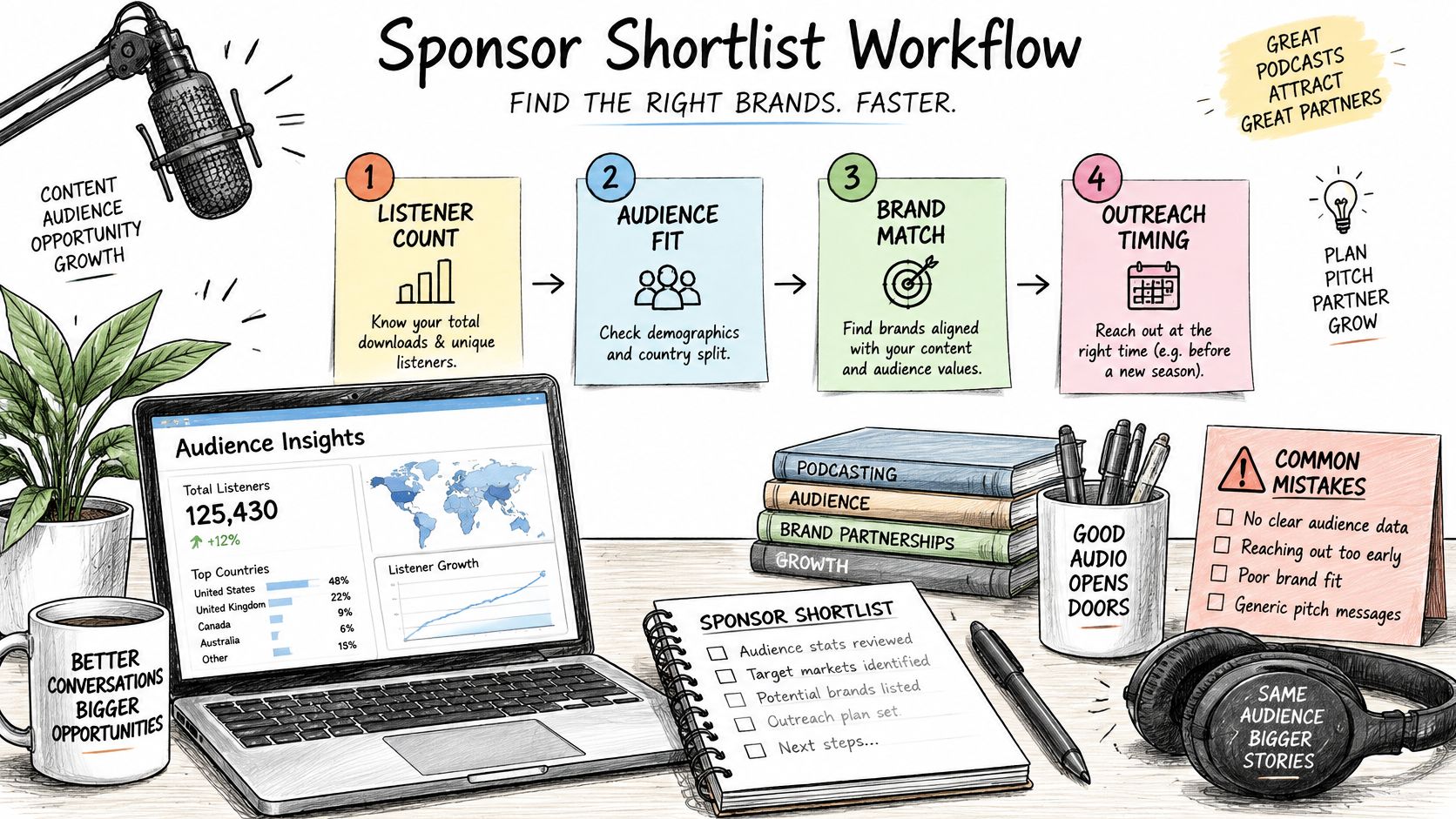
Build the evidence file #
-
Describe the audience in buying terms.
Export recent episode performance and listener geography from the hosting dashboard. Add supported details about occupations, purchasing responsibilities, and recurring listener problems, using surveys, email replies, and community discussions. Every later decision needs this reference point. The common slip is treating a broad label such as “entrepreneurs” as a usable customer profile. -
Choose adjacent shows, not just direct competitors.
A podcast for independent bookkeepers might examine shows about accounting practice management, small-business operations, and freelance finance. The audience's work matters more than matching category labels. Choosing only chart leaders can hide specialist advertisers that fit a smaller show better. -
Log the actual sponsorship evidence.
Review recent audio, transcripts, and show notes. Record the brand, product, episode, timestamp, offer code, and whether the placement is spoken or appears only in the notes. Smaller brands deserve the same attention as household names. The common mistake is recording a logo without enough context to verify the placement later. -
Compare recent placements with historical activity.
Review the available campaign history and mark repeated appearances separately from isolated mentions. Podmuse's sponsorship pricing guide recommends competitive ad intelligence and treats recurring campaigns as stronger buying signals than one-off mentions. Don't assume that every product recommendation was paid. -
Add commercially relevant brands from outside podcast ads.
Include tools listeners discuss, companies represented by suitable guests, and products that solve adjacent problems. A social listening tools workflow can help organize those conversations. These prospects need a separate label because audience relevance alone doesn't establish advertising intent. -
Create a working account list.
Consolidate duplicate brands and identify the likely contact role through LinkedIn and the company's website. Partnerships, creator marketing, brand marketing, and agency media-buying titles are useful leads, but the remit matters more than the title. A business-development contact may manage distribution partnerships without controlling advertising spend.
Keep the spreadsheet usable #
The spreadsheet should contain a row for each brand, with columns for category, discovery channel, relevant shows, episode evidence, product, contact role, and research status. Recording the discovery channel helps distinguish productive sources from directories that generate names but little buying evidence.
Separate observations from assumptions. “Offer code heard in an episode” is evidence; “probably has a large budget” is not. That distinction prevents an attractive prospect from becoming a high-priority account without a commercial reason.
Score and Verify Each Brand Before You Pitch #
A brand with extensive sponsorship history can still be a poor prospect. If its customers don't overlap with the show's listeners, the creator would be selling available space rather than a useful audience.
Use the following checklist to compare prospects consistently. The Podder podcast sponsorship guide supports evaluating category activity and observed advertising behavior rather than relying on generic brand lists.
Sponsor fit signals and what they tell you
| Signal | Where to check | Strong sign | Weak sign |
|---|---|---|---|
| Category relevance | Brand's product and ad copy | Brand sells to listeners' jobs or problems | Product is only loosely connected to the show topic |
| Recurring sponsorship | Sponsor history of adjacent shows | Same brand runs repeat campaigns over months | One-off mention in a single episode |
| Audience geography | Brand's markets and listener locations | Brand sells where listeners are | Brand only sells in markets the audience doesn't reach |
| Offer code or tracking | Ad reads and show notes | Brand already uses promo codes or vanity URLs | No visible tracking on past ads |
| Show notes only | Show notes compared with the ad read | Named in both the read and the notes | Named only in the notes, without a spoken read |
| Exclusivity conflict | Current sponsorship agreements | No direct competitor booked for the slot | A competitor already holds the category slot |
Weight fit more heavily than fame #
Use strong, uncertain, or weak for each signal, with a short explanation beside the rating. Category relevance and geography should function as gates: extensive buying history doesn't compensate for a product listeners can't use or purchase.
The other signals refine priority rather than automatically disqualify a brand. No visible promo code may indicate a campaign measured through another method. A show-notes-only listing may represent a legitimate commercial relationship, but it doesn't prove that the brand bought a host-read placement.
A strong prospect needs both a plausible customer match and evidence that the advertiser buys something the show can deliver.
Verify the underlying placements #
Podzone checks every episode it transcribes for sponsors. A brand-name search shows sponsored shows and episodes, read counts, and when the brand was first and last heard; show-level sponsor histories identify the brands associated with a show and the duration of their activity. Episode records include sponsoring brands, products, and offer codes, with show-notes-only mentions marked separately.
Open the underlying episode evidence before making a claim in an email. Check whether the offer still resolves, whether the product remains available, and whether recent appearances support the assumption of ongoing spending.
An expired campaign belongs in a historical or paused category, not automatically in the active outreach queue. An inactive code doesn't prove that a brand has abandoned podcasts altogether, so uncertain cases deserve verification rather than an invented conclusion.
Rank the surviving accounts by commercial fit and evidence quality. Keep the strongest prospects ready for outreach and park unresolved accounts with a clear research task.
Pick a Pitch Model That Fits Your Audience Size #
For a small or specialist show, a flat-fee pilot is a sensible starting recommendation. It lets the buyer evaluate a defined package without forcing the creator to sell a valuable professional audience as cheap reach. CPM or hybrid pricing becomes easier to defend when delivery and response can be documented.
The offer structure should match the evidence available, not the creator's preferred pricing label.
Pitch models compared
| Offer model | Best fit | What to specify | Main risk |
|---|---|---|---|
| Flat pilot fee | Small or niche shows with strong audience fit | Episode count, ad position, tracking, success criteria, reporting date | Fee remains hard to defend at renewal without results |
| CPM-based | Shows that document downloads in a defined window | Counting window, CPM rate, delivery guarantee | Small delivery totals can undervalue specialist access |
| Hybrid flat fee plus bonus | Shows with a clear conversion path | Base fee, bonus trigger, promo code or sign-up goal | Weak attribution makes bonuses hard to verify |
| Affiliate or revenue share | Shows promoting a low-cost product | Commission, tracking window, payout date, minimum payout terms | Creator carries conversion risk without guaranteed payment |
Sell buyer relevance when reach is limited #
Direct sponsors may work with shows below 1,000 regular listeners when audience fit is strong, as discussed in Captivate's guide to getting podcast ads. That isn't a guarantee of demand. It means a small show needs a different commercial case from a mass-audience publisher.
Evidence might include listeners' purchasing authority, qualified inquiries, affiliate activity, event registrations, or relevant email signups. A show for freelance bookkeepers should describe access to that buying community, not apologize for lacking entertainment-scale downloads.
A hypothetical pilot could pair a bookkeeping software tool with a short episode series, a host-read placement, a dedicated offer code, and a report on an agreed date. The fee should cover the creative work and placement commitments; the success criteria should distinguish delivered audience from resulting actions.
Make the offer contract-ready #
CPM requires a documented delivery window, not lifetime downloads or social followers. Hybrid pricing needs an agreed attribution method and rules for disputed conversions. Affiliate-only arrangements may be easy to propose, but they transfer substantial commercial risk to the creator.
A comparison of podcast advertising platforms can help evaluate alternatives to selling directly. Eligibility, sales control, and reporting responsibilities deserve attention alongside the pricing model.
The one-page offer should state the audience evidence, campaign objective, inventory, creative approval process, fee, payment terms, measurement method, reporting date, and any exclusivity or underdelivery obligations. A buyer should be able to understand exactly what acceptance commits each party to do.
Write an Outreach Message That Gets a Reply #
Sending a download-heavy media kit to a generic contact address asks the recipient to do the commercial reasoning. A stronger message identifies the likely buyer, establishes relevance, and proposes a decision that doesn't require a lengthy internal briefing.
The message should follow the buyer's evaluation process, not the podcast's biography.

Lead with a verifiable commercial connection #
Find the partnerships or marketing manager responsible for audio or creator spending. Where an agency handles the account, the relevant media buyer may be a better contact than the brand's general marketing inbox. Confirm responsibility rather than assuming that the most senior title owns the budget.
For a hypothetical tax-season show serving freelance designers, an adaptable opening is:
The tax-planning episode of the adjacent freelancer podcast featured the brand's quarterly-payment offer. This show's freelance-design audience faces the same estimated-tax problem, with listener questions focused on payment deadlines and deductible expenses.
The observation must be replaced with a real, checked placement before sending. No invented episode, audience characteristic, or campaign result belongs in outreach.
- Observed activity: Name the relevant show, episode, and product offer.
- Commercial connection: Explain the audience's buying problem and the evidence supporting that description.
- Proposed experiment: Specify the placements, tracking method, and reporting commitment.
- Clear decision: Ask whether the buyer would review the pilot proposal or discuss the available inventory.
Follow up with information, not pressure #
A useful follow-up adds a relevant episode topic, supported audience detail, or campaign result. Daily reminders, an unsolicited rate card, and repeated requests to “check the previous email” give the buyer little reason to respond.
Space follow-ups far enough apart for an internal discussion, then close the sequence politely if there's no engagement. Silence isn't evidence that the price is wrong, so discounting before receiving an objection is premature.
Before sending, the seller should ask whether the message demonstrates access to customers the brand wants. If the same email could go unchanged to an unrelated company, the commercial connection isn't specific enough.
Send the First Five Pitches and Track Replies #
A small initial outreach batch is easier to manage than a broad send. A practical hypothetical schedule is a pitch each working day to the highest-ranked verified brands, leaving room to handle questions and adjust weak wording.
Before each send, the seller should confirm the buyer's name and remit, reopen the cited sponsorship evidence, and check that the proposed inventory remains available. An accurate message sent promptly is more useful than a polished proposal built around an expired opportunity.
Turn replies into account information #
Record the response in the same spreadsheet used for qualification. Keep factual buyer feedback separate from the seller's interpretation so that a later review doesn't turn “budget committed” into “not interested.”
- Status: Mark the account as contacted, discussing, proposal requested, deferred, declined, or closed.
- Next action: Assign an owner and a follow-up date rather than leaving an open-ended reminder.
- Objection: Record whether the barrier concerns timing, audience, creative, measurement, or price.
- Commitment: Save requested revisions and agreed terms before preparing a formal offer.
A reply requesting information isn't a booking. Reserve inventory only under clearly agreed conditions, and document the campaign before recording sponsor creative.
Maintain the research file #
Put a quarterly refresh on the calendar. Revisit discovery channels, recheck active accounts, and replace assumptions with new evidence as campaigns and buyer responsibilities change.
The first outreach batch needn't wait for every possible sponsor to be researched. It needs sufficiently strong evidence to support an honest, relevant proposal.
The sponsor list is a research file showing who already pays for relevant access. The pitch must establish why this show's audience belongs in that buyer's plan.
Podzone combines sponsor histories, episode-level ad reads, and offer codes so sellers can investigate where brands already advertise. Podcast owners and commercial teams can visit Podzone to turn observed sponsorship activity into a better-qualified prospect list.
- podcast sponsors
- podcast sponsorship
- podcast advertising
- sponsor outreach
- podcast monetization