10 Podcast Advertising Platforms Compared for 2026
Compare 10 podcast advertising platforms by buying options, targeting, formats, and pricing so you can plan smarter campaigns in 2026.
Should a podcast advertiser start with a small self-serve test, apply for access to a host-read marketplace, or buy podcast inventory through a demand-side platform? The better question is what the budget is supposed to buy: audience access, a host's endorsement, or coordinated reach across channels. Those aren't interchangeable outcomes, even when platforms describe them with similar targeting and reporting language.
The commercial opportunity is substantial. U.S. podcast advertising revenue reached approximately $2.43 billion in 2024, up 26.4% year over year, according to IAB and PwC. That growth doesn't make every buying route suitable for every advertiser. A communications agency investigating competitors' sponsorships needs different tools from a retailer uploading an audio spot or a media team negotiating an integrated sponsorship.
Podcast advertising platforms fall into distinct workflows:
- Self-serve marketplaces suit advertisers who want budget controls, straightforward campaign setup, and an accessible testing process.
- Host-read marketplaces and networks suit campaigns where the speaker, show context, and creative integration matter.
- Programmatic DSPs suit buyers managing audience targeting and podcast inventory alongside other digital media.
- Research and monitoring tools support those buying decisions but don't replace an inventory seller.
The comparison table provides a shortcut to platforms matching each workflow. The practical distinction throughout is between buying delivery and verifying what appeared, where it appeared, and whether the campaign produced useful business results.
Table of Contents #
- 1. Podzone
- 2. Acast
- 3. Spotify Advertising
- 4. SiriusXM Media
- 5. Libsyn Ads
- 6. Gumball
- 7. Podbean Ads Marketplace
- 8. AudioGo
- 9. Amazon DSP
- 10. iHeartMedia
- 10 Podcast Advertising Platforms at a Glance
- Matching the Platform to Your Buying Model
1. Podzone #
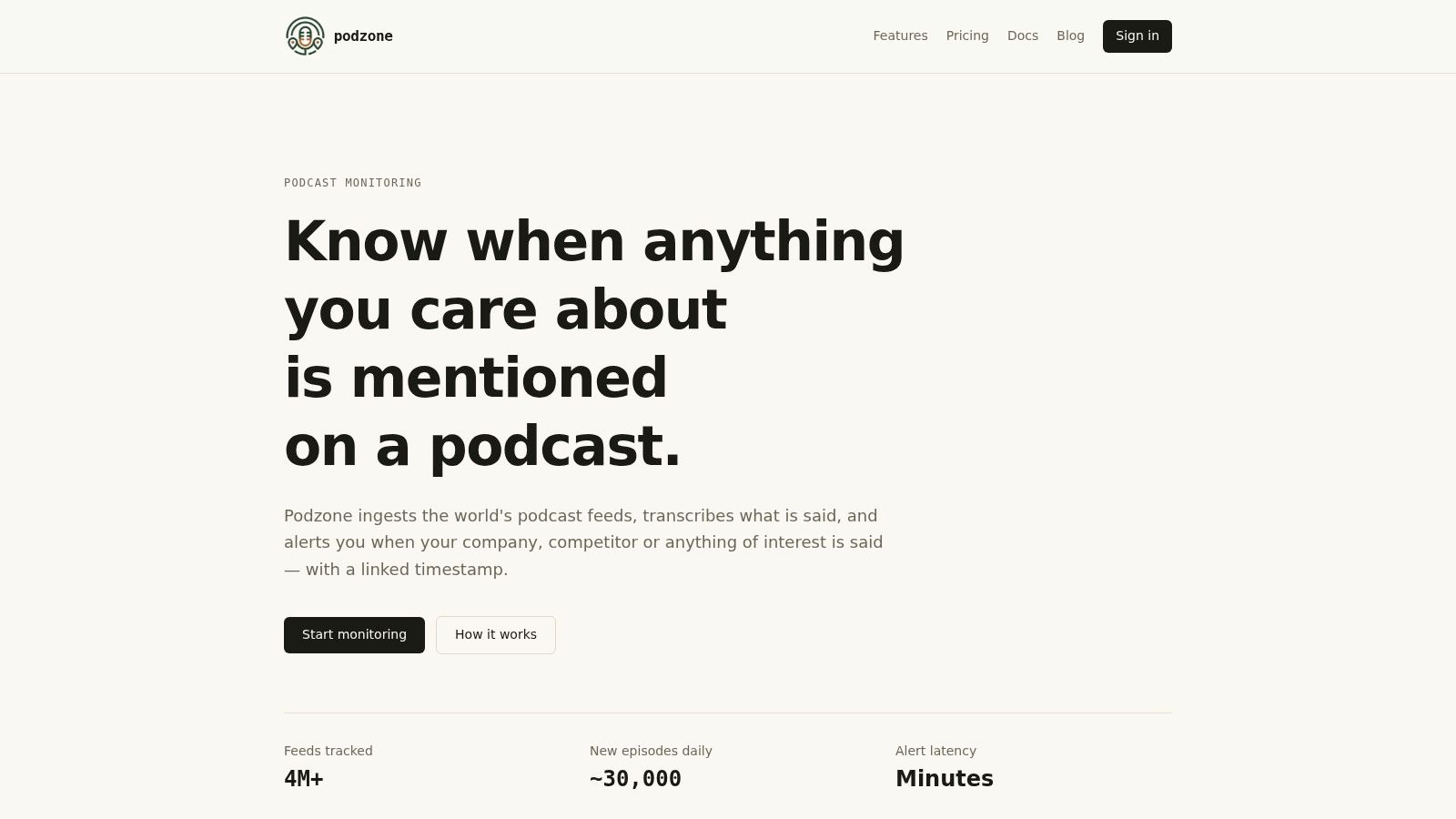
Best fit: pre-buy research, competitive intelligence, and sponsorship verification.
Podzone belongs upstream of the media transaction. It's a podcast monitoring and search service, not a self-serve ad marketplace or DSP, so advertisers shouldn't treat it as a place to purchase impressions.
Podzone tracks more than four million podcast feeds and adds about 30,000 new episodes daily. Teams can establish keyword rules for brands, competitors, people, or topics, then inspect matches through transcript excerpts, episode details, and timestamped links to the publisher's audio.
Evidence before inventory #
Its podcast sponsor tracking helps buyers investigate which brands sponsor which shows, inspect ad reads and offer codes, and examine sponsorship activity over time. Searching a brand can reveal sponsored episodes and shows, read counts, and when that advertiser was first and last heard.
That's useful when a network recommends a show but the buyer needs a clearer view of its commercial context. A competitor's presence can suggest category relevance, but it doesn't prove the audience will convert or that a rival renewed profitably.
- Research strength: Searchable and downloadable transcripts make it easier to inspect the language surrounding a sponsorship.
- Workflow strength: Host and guest information supports show evaluation, while API access, signed webhooks, and MCP support connect findings with existing tools.
For agencies, the practical benefit is a defensible research trail rather than another delivery dashboard. Findings can be included in client deliverables, provided clients don't receive direct service access.
2. Acast #
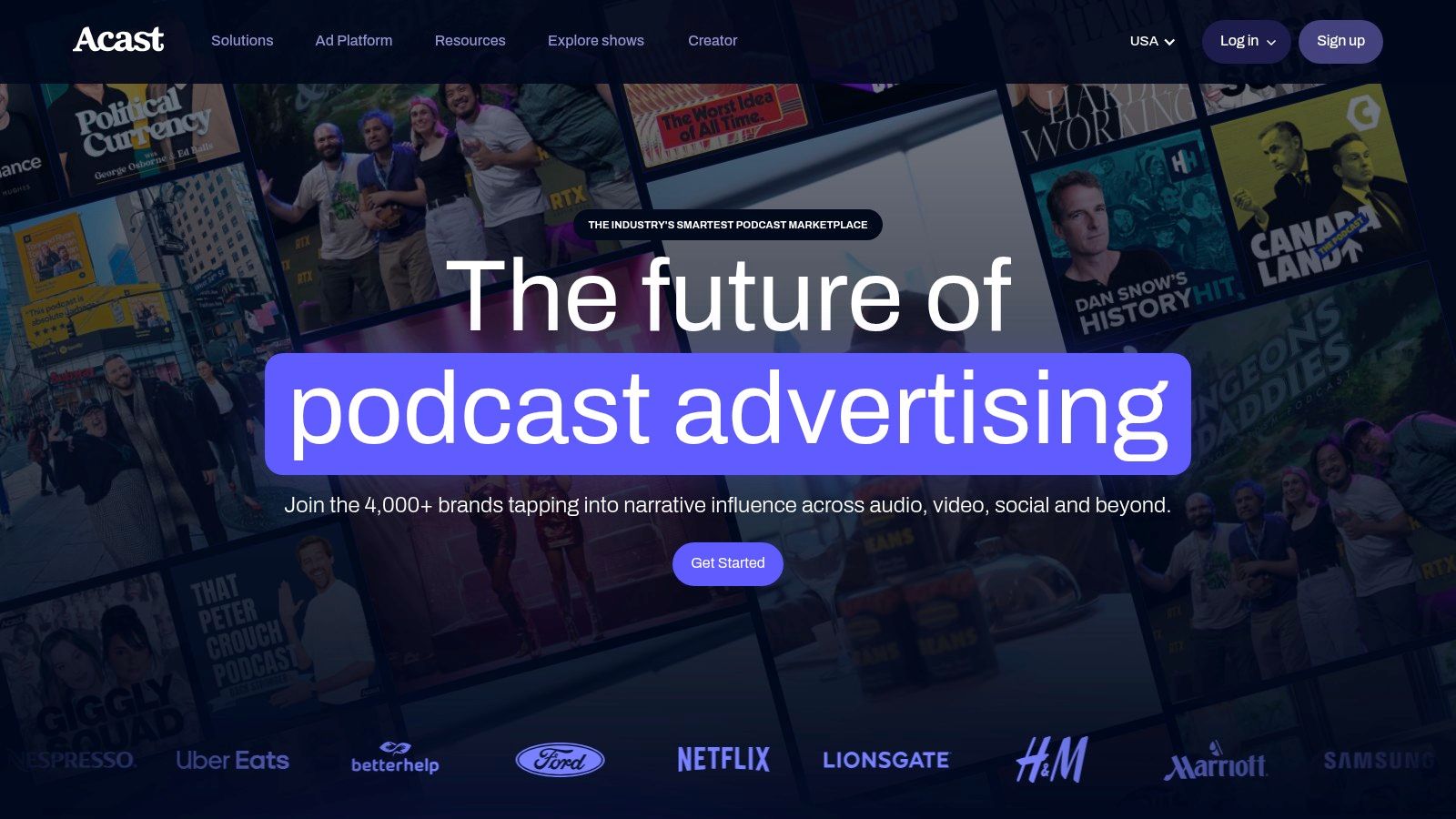
Acast suits buyers who don't want their initial buying method to dictate the entire campaign. Its advertising offering combines self-serve, programmatic, and direct buying, with dynamically inserted advertising, host-read sponsorships, branded content, and audio or video options.
That flexibility is useful when an advertiser wants broad audience delivery but also needs selected shows to carry a more detailed message. It creates planning work, however: a produced spot and a host-led integration need different briefs, approval processes, and success criteria.
Best for a mixed buying strategy #
Acast is a sensible shortlist candidate when the buyer expects to move between marketplace convenience and more involved partnerships. Its independent-show inventory also makes show selection relevant, rather than reducing the purchase to audience filters alone.
- What works: Multiple buying routes let a team choose the transaction around the campaign rather than force every placement into the same format.
- What needs attention: Format, targeting, and managed-service requirements affect the commercial proposal, so apparently similar campaigns may not be comparable.
- What to establish: Separate the budget for standard audio delivery from the budget for sponsorship or branded-content work.
The main trade-off is choice versus simplicity. Acast offers more room to shape a campaign than a narrowly defined self-serve product, but buyers must specify which inventory, creative treatment, and reporting they're purchasing. A broad proposal shouldn't substitute for placement-level clarity.
3. Spotify Advertising #
Spotify Advertising provides distinct routes through Spotify Ads Manager and the Spotify Ad Exchange, with programmatic access through supported DSPs. Its Spotify Audience Network offering is relevant to advertisers considering audience-led podcast buying rather than only negotiating individual shows.
Ads Manager is the more natural starting point for a smaller team that wants campaign forecasts, targeting controls, and performance reporting without adopting a full DSP workflow. Location, demographics, and podcast category can help narrow the campaign, subject to the selected inventory and buying route.
A familiar listening app doesn't automatically make every advertising route equally simple or every placement a host endorsement.
Choose the route before writing the brief #
For a straightforward test, the buyer should establish the campaign objective, available podcast inventory, creative requirements, and reporting fields before uploading an asset. For programmatic buying, the same advertiser also needs to establish the DSP's access and transaction requirements.
The strongest fit is audience access with operational control. The weaker fit is a campaign whose central requirement is a specific host explaining or recommending a product in that host's own style.
Spotify's audio and video options also require careful reporting discipline. A video view, audio exposure, and completed listen shouldn't be combined into a single engagement total just because they appear within the same broader media plan.
The platform choice should follow the desired purchase. Advertisers seeking a particular endorsement need to verify that deliverable explicitly rather than infer it from podcast inventory access.
4. SiriusXM Media #
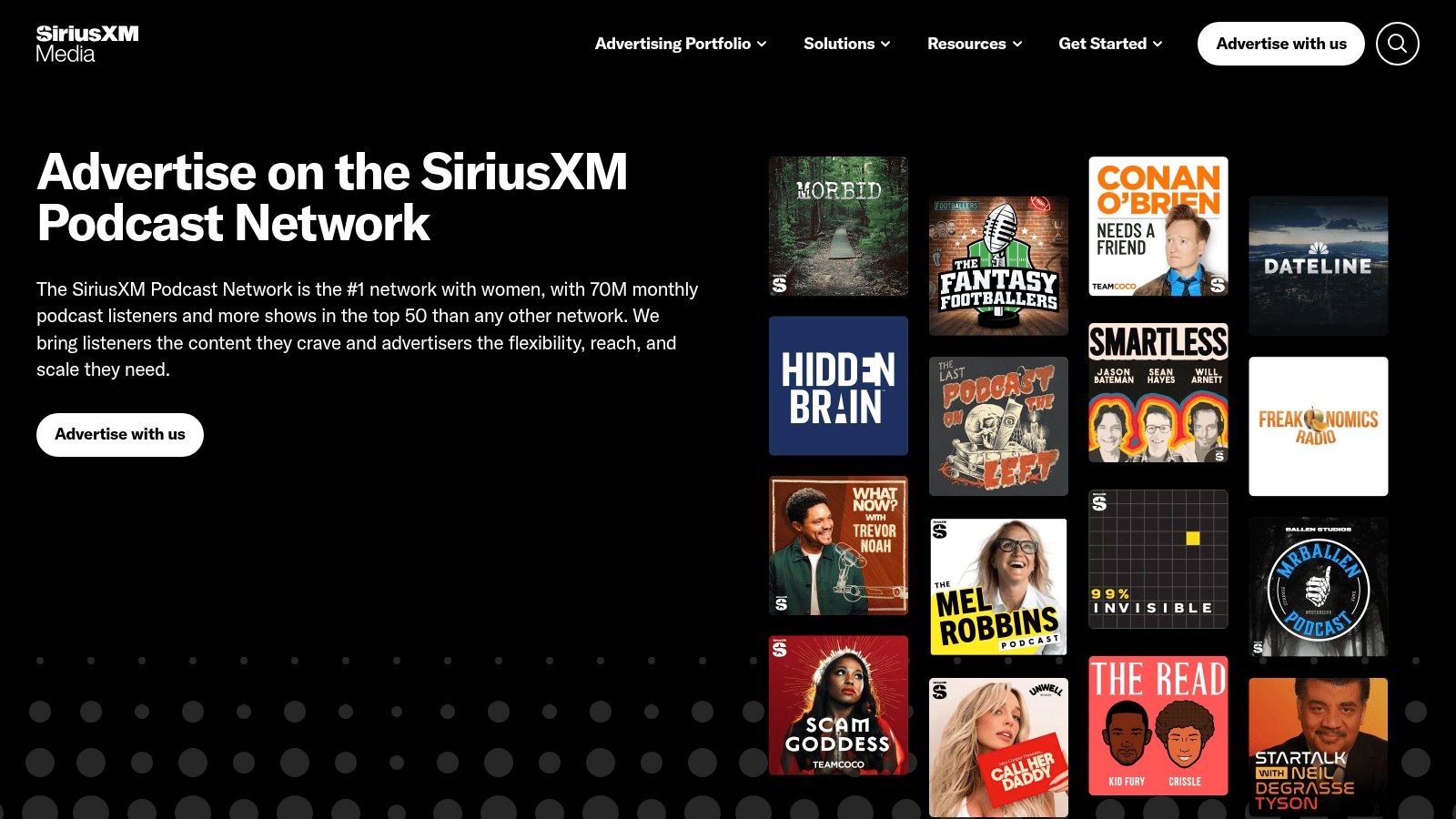
A brand needing both selected-show sponsorships and broader network delivery should consider SiriusXM Media's podcast advertising. Its options include host-read ads, announcer-read ads, custom branded content, show-specific placements, and genre-targeted campaigns.
Access can involve self-service, DSPs, or sales support. Podcast placements aren't limited to listening within SiriusXM services, an important distinction when comparing a publisher network with a single-app advertising product.
A network buy needs a precise brief #
SiriusXM Media's range is useful for campaigns that need coordination: a recognizable show for the central message, broader genre delivery for reach, and custom content for a more involved explanation. The drawback is that the buyer has more variables to separate before evaluating value.
- Strong fit: Brands that need sponsorship planning or creative collaboration beyond uploading a finished spot.
- Commercial limitation: There isn't a single standard public rate that makes every placement directly comparable.
- Planning requirement: Identify which placements are show-specific, which are audience- or genre-led, and which include an actual host-read commitment.
A useful brief specifies the intended speaker, acceptable surrounding content, approval responsibilities, and evidence required after launch. Without those details, a buyer can receive valid delivery reporting without answering whether the intended integration happened.
SiriusXM Media is therefore more compelling when network breadth and campaign coordination matter than when the only priority is an immediate, uncomplicated marketplace transaction. Sales support can help manage complexity, but it doesn't remove the need for explicit deliverables.
5. Libsyn Ads #
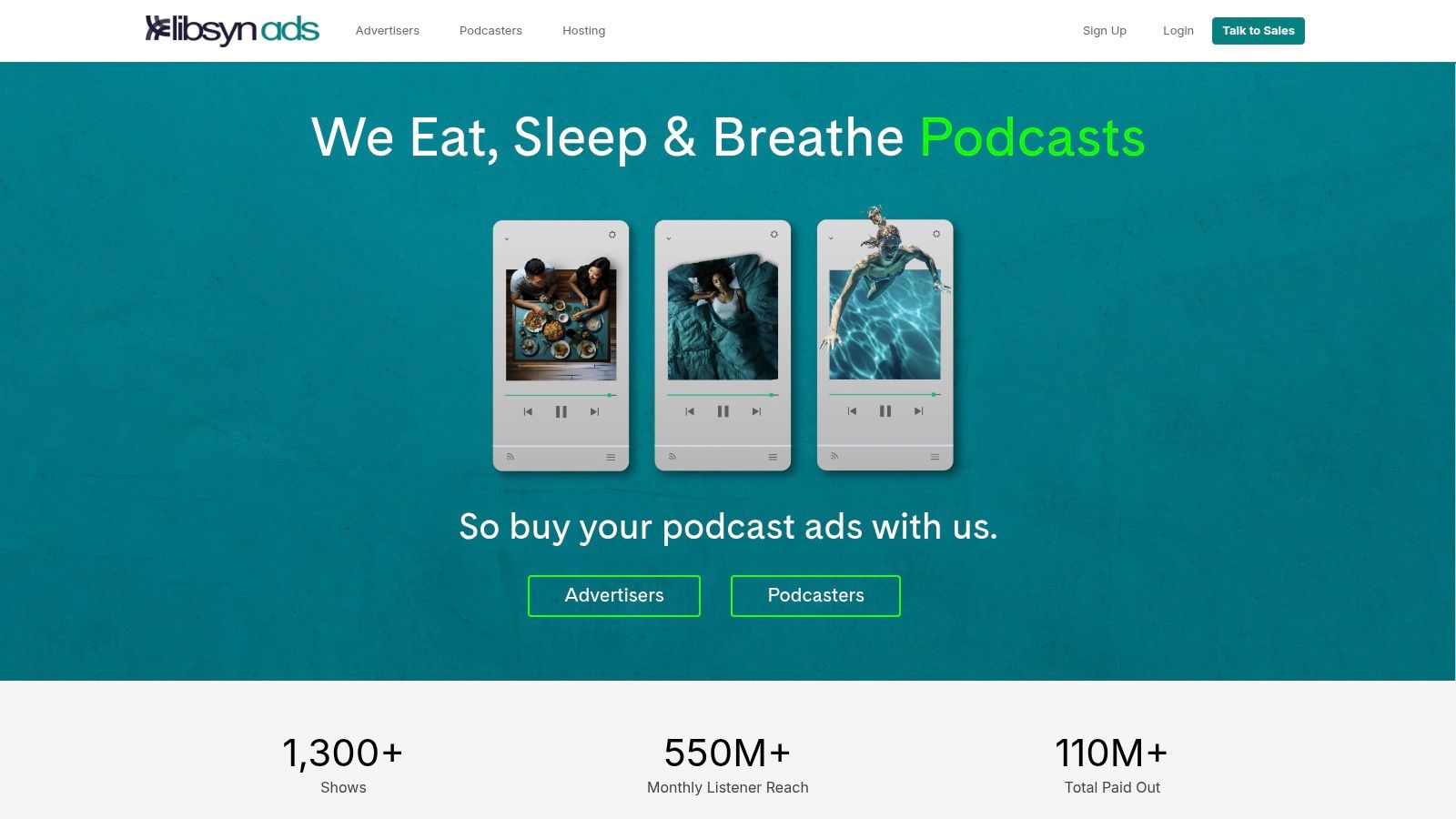
Libsyn Ads is a more natural starting point for a buyer who already believes the show matters as much as the audience segment. Its podcast advertising marketplace emphasizes individual show listings and host-read advertising, with filters supporting selection by category, budget, and potential reach.
That workflow suits products requiring explanation. A business software offer, for example, may need the host to describe the operational problem before introducing the product and its call to action.
Buy the explanation, not just the slot #
Host-read execution needs more preparation than sending generic brand copy. Buyers should give the host an accurate product description, mandatory claims, prohibited claims, pronunciation guidance, and a clear action, while allowing room for natural delivery.
- Selection advantage: Individual listings make deliberate show evaluation easier than a purchase built only around broad audience filters.
- Response measurement: Promo codes and unique URLs can connect specific calls to action with observable responses.
- Supply limitation: Availability and rates vary by show, and marketplace eligibility affects which publishers appear.
The trade-off is contextual control versus coordination effort. Selecting shows individually can improve the fit between message and program, but scripts, approvals, schedules, and reporting still need an owner.
A host-read purchase also shouldn't be confused with unrestricted endorsement. The agreement needs to establish what the host will say and whether personal product experience is part of the arrangement. Strong creative uses the host's delivery style without manufacturing enthusiasm or implying experiences that haven't occurred.
6. Gumball #
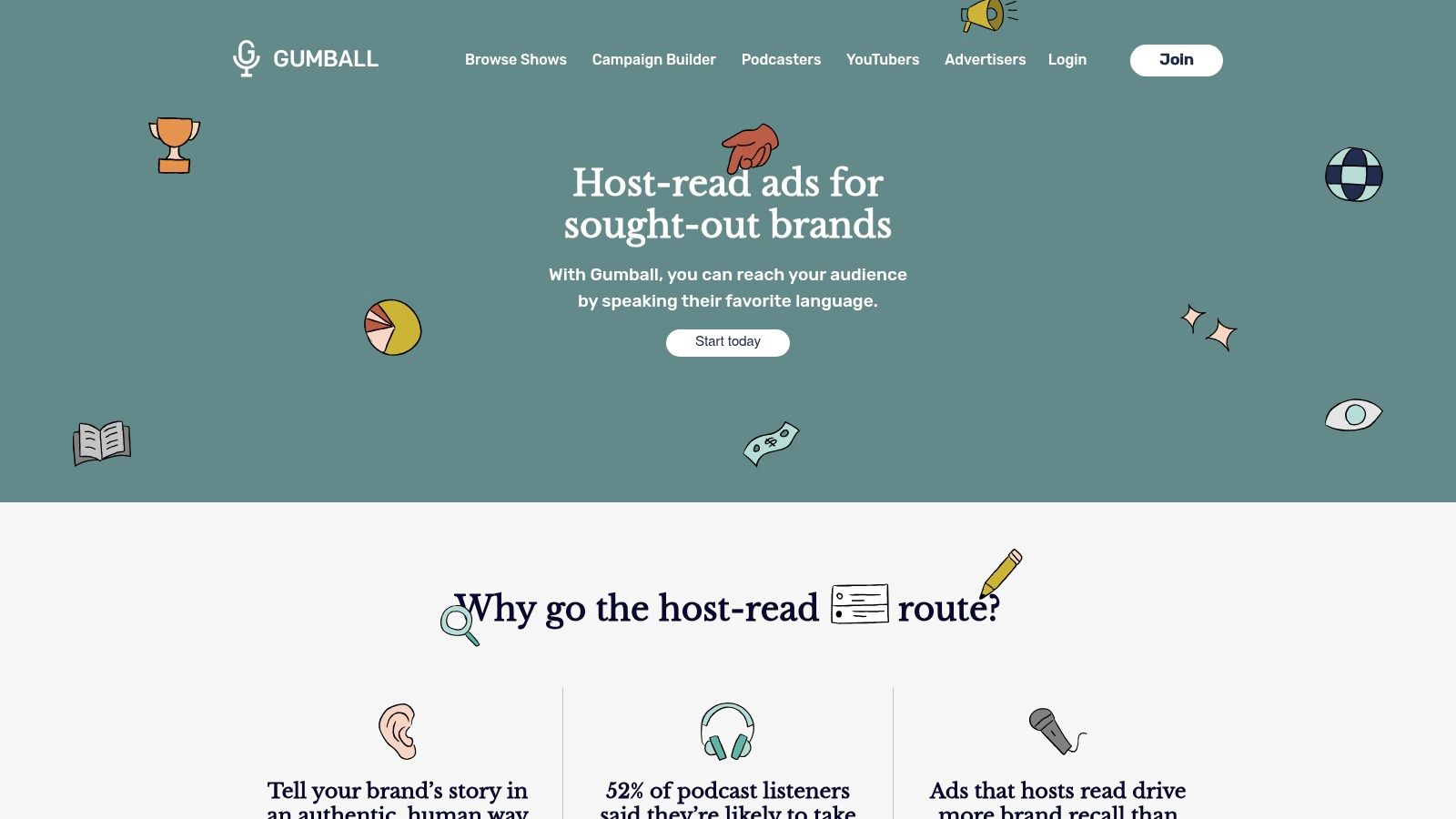
Gumball is built around creator-delivered advertising, not merely distributing a standard audio asset. Its advertiser platform supports host-read podcast and video advertising, with inventory filters for genre, audience profile, and air date.
Campaign tools cover scripts, URLs, coupon codes, and category exclusivity. Gumshoe provides airchecks and delivery tracking, making execution verification a more visible part of the buying workflow.
Advertiser access is application-based, so this isn't the best choice for a buyer expecting unrestricted signup followed by immediate purchasing. That access model matters operationally even when the creative fit is strong.
Where delivery verification helps #
An aircheck answers a concrete question: what ran? Buyers should inspect the spoken brand name, product description, offer, call to action, and surrounding context rather than treating the presence of an audio file as sufficient approval.
Creative control: Preserve mandatory facts and offer terms, but don't force every creator to sound like the same announcer.
Gumball is attractive when a team wants host-read integrations with campaign-management structure. Its selective inventory may be a constraint for campaigns needing a very specific niche or unusually broad coverage.
The strongest comparison with Libsyn Ads isn't which has more appealing shows. It's which workflow better supports the intended creator relationship, approval process, timing, exclusivity, and verification requirements. Those operational details can determine whether a promising placement remains manageable after purchase.
7. Podbean Ads Marketplace #
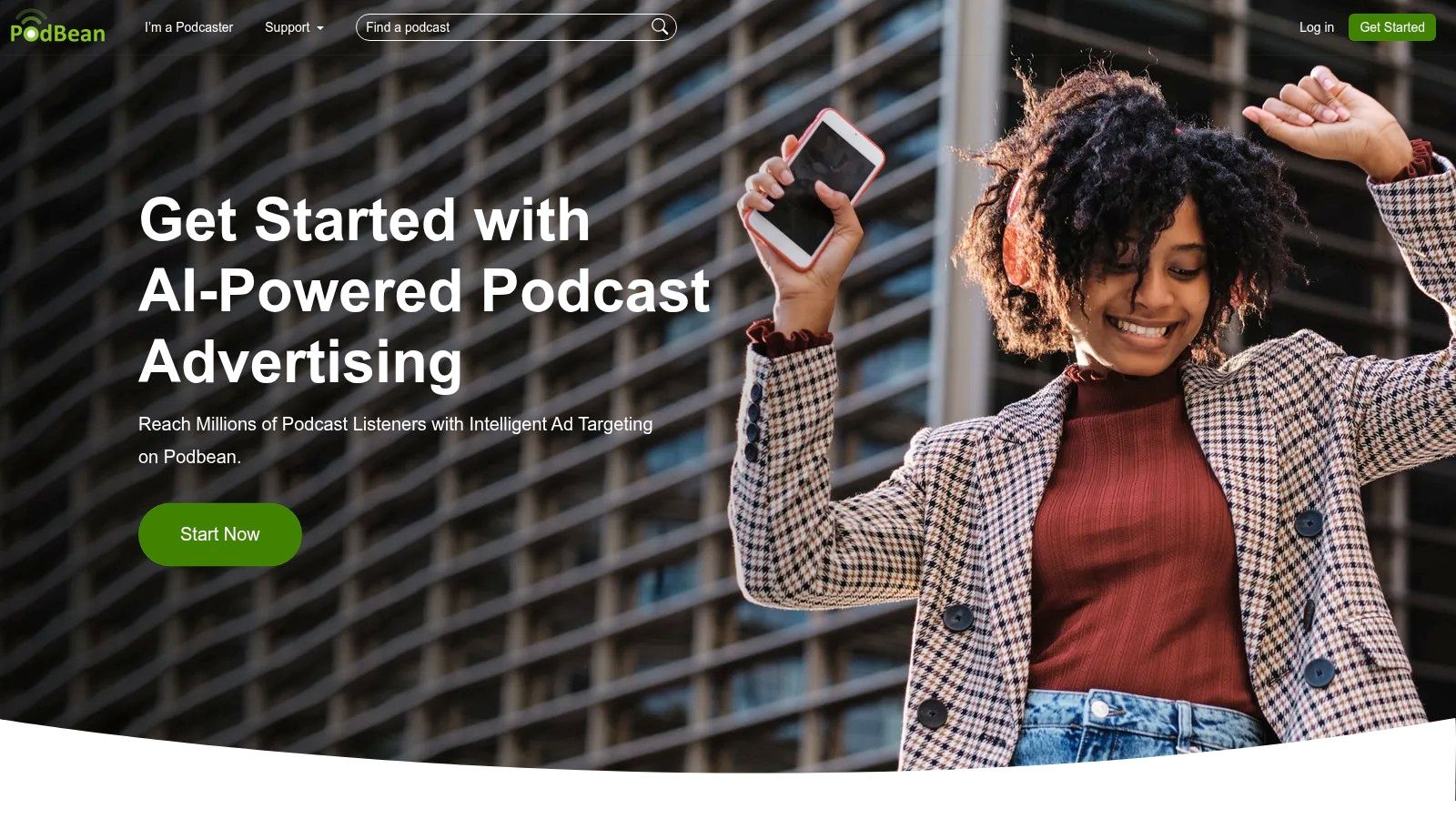
For advertisers who want to choose podcasts without beginning with a managed-sales engagement, Podbean Ads Marketplace offers a practical self-serve workflow. Buyers can set budgets and schedules, choose categories and geographies, and search for or select shows.
Campaigns can use uploaded audio or a script for ad production. Impression and spend reporting support delivery review, while campaign controls allow modifications, pauses, or cancellation through the platform.
Keep the first test interpretable #
The appeal is direct control over setup and selection. The limitation is that available inventory must still meet the campaign's requirements, and review and approval occur before launch.
- Useful control: Show selection allows the buyer to investigate program fit instead of relying entirely on a category label.
- Operational constraint: Approval requirements mean campaign creation and campaign launch aren't the same event.
- Measurement discipline: Record the selected shows, creative version, offer, and schedule alongside platform delivery.
A small test becomes difficult to interpret when the buyer changes the audience, script, offer, and schedule at the same time. A cleaner approach holds the core offer steady while testing a clearly defined placement or creative hypothesis.
Podbean is most compelling for teams that value marketplace independence and are prepared to own the campaign details themselves. It's less suitable when the advertiser needs extensive custom sponsorship development or expects the platform to make every show-selection decision on its behalf.
8. AudioGo #
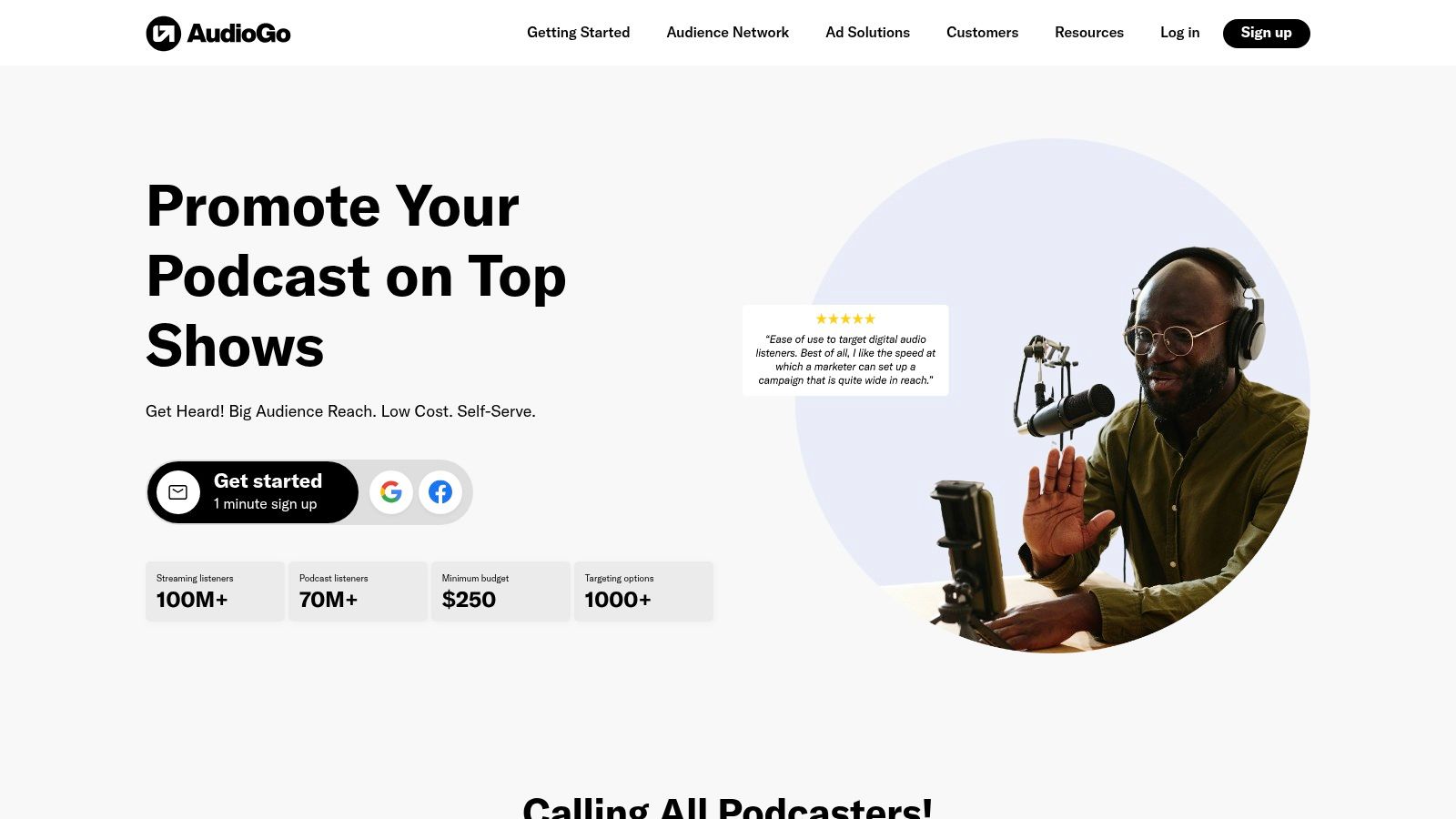
AudioGo makes the most sense when podcasts are part of a broader audio test rather than the entire media strategy. Its podcast promotion offering sits within a self-serve platform that also supports streaming audio.
Advertisers can build campaigns online, apply geographic and audience targeting, and use creative support when they don't have a finished spot. That removes some production friction, but it doesn't remove the need to confirm exactly which inventory the campaign will buy.
Podcast access isn't the same as podcast specialization #
A local service business testing audio awareness may value straightforward setup more than detailed creator negotiations. A brand seeking a particular host's endorsement will have a different requirement, and shouldn't assume that audience-targeted audio provides the same experience.
- Best use: A controlled entry into audio advertising with podcast inventory included in the plan.
- Main strength: Self-serve setup and production support reduce dependence on a traditional sales-led process.
- Main caution: Podcast and streaming-audio delivery need to remain identifiable in the campaign plan and reporting.
AudioGo's broader scope is both its advantage and its constraint. It can support an advertiser that wants to learn whether audio deserves more investment, but podcast-specific conclusions require podcast-specific evidence.
A blended campaign may perform well overall while leaving the buyer unable to identify which environment contributed. Separating inventory and outcomes where reporting permits makes the next budget decision more useful.
9. Amazon DSP #
Amazon DSP is a fit for teams that already buy digital media programmatically and want podcast inventory within that operating model. Amazon Ads provides access through a broader omnichannel environment covering media beyond audio.
The podcast workflow can involve publisher and supply-partner inventory, private marketplaces, and Programmatic Guaranteed transactions. Access, inventory, deal structure, and campaign requirements therefore matter more than a simple marketplace signup comparison.
Operational efficiency has boundaries #
For an established DSP team, consolidating buying can simplify campaign management. For a small communications team without programmatic expertise, the same workflow can introduce unnecessary setup, terminology, and reporting work.
- Strong fit: Advertisers coordinating podcasts with display, video, and streaming TV activity.
- Weak fit: Buyers seeking a simple browse-and-buy experience for a particular podcast host.
- Reporting requirement: Preserve deal, publisher, creative, and placement identifiers so podcast delivery remains inspectable.
A useful media coverage report also separates paid delivery from earned editorial attention. Agencies shouldn't present a purchased placement as independent coverage, even when both appear within the same show.
The central trade-off is integrated media operations versus podcast-specific simplicity. Amazon DSP should be shortlisted because the advertiser benefits from its buying infrastructure, not because programmatic access automatically offers better contextual fit or more persuasive creative. Those remain separate questions that require separate evidence.
10. iHeartMedia #
iHeartMedia is best evaluated as a sales-supported audio media provider, not a browse-and-buy podcast marketplace. Its advertising offering combines podcast opportunities with radio and other digital-audio activity, including national and local planning.
That's relevant when an advertiser wants a coordinated audio campaign rather than an isolated podcast placement. It's less convenient for a buyer whose main requirement is immediate show selection and a transparent checkout process.
Make the podcast component explicit #
A combined proposal should identify which placements are podcasts, which are radio or other audio, and which creative treatments apply. A buyer seeking host endorsement needs that commitment specified, rather than assuming every podcast placement includes one.
- Planning advantage: Sales support can help coordinate customized campaigns across audio properties.
- Budget limitation: Standardized public podcast pricing isn't established on the advertising page.
- Comparison requirement: Evaluate the podcast portion separately before judging the value of the full package.
The practical risk is accepting a broad audio proposal because its total reach sounds compelling while leaving the podcast objective underspecified. Different environments may serve different purposes, so they shouldn't inherit the same success metric by default.
iHeartMedia is a stronger fit when cross-audio coordination and sales support are genuine requirements. For a small, tightly controlled marketplace experiment, a self-serve platform is usually the cleaner operational choice.
10 Podcast Advertising Platforms at a Glance #
Use the buying route to build the shortlist: self-serve tools for controlled tests, marketplaces or sales teams for show-led buys, and programmatic access when podcast is one line in a wider media plan.
| Platform | Buying Route | Best For |
|---|---|---|
| Podzone | Monitoring and research via API, webhooks, and MCP integrations | Sponsor research, mention monitoring, and searchable transcripts |
| Acast | Self-serve, programmatic, or direct | Broad podcast reach with multiple ad formats and buying options |
| Spotify Advertising | Self-serve Ads Manager or Spotify Ad Exchange | Spotify podcast inventory through managed budgets or programmatic demand |
| SiriusXM Media | Self-service, DSPs, or sales team | Network-scale campaigns, recognizable shows, and custom content |
| Libsyn Ads | Marketplace with show browsing and advertiser support | Selecting individual shows for host-read ads |
| Gumball | Application-based; self-serve or sales-supported | Host-read podcast and creator campaigns |
| Podbean Ads Marketplace | Self-serve marketplace | Direct show selection and budget-controlled campaigns |
| AudioGo | Self-serve platform | Small audio tests that include podcast placements |
| Amazon DSP | Programmatic buying through publisher and supply partners | Teams folding podcast ads into broader digital media |
| iHeartMedia | Sales-assisted | Campaigns combining podcasts with radio or other audio |
Podzone is the outlier in this list: it does not sell inventory, it shows where brands already advertise and what episodes say, then pushes that evidence into the tools a team already uses.
Matching the Platform to Your Buying Model #
The right shortlist starts with the work the advertiser needs to do, not the longest feature list. Buying workflow, creative format, and measurement are separate decisions, even when a platform packages them together.
For low-budget tests, Podbean, AudioGo, and Spotify Ads Manager offer self-serve routes worth evaluating. The buyer should prioritize inventory clarity, manageable creative requirements, spending controls, and reporting that can answer the test's specific question.
Match the purchase to the objective #
When endorsement matters, Libsyn Ads, Gumball, SiriusXM Media, and iHeartMedia deserve consideration for show-led or sales-supported campaigns. The purchase must specify a host-read deliverable where that's the objective, because a network relationship alone doesn't guarantee endorsement.
When scale and omnichannel workflows dominate, Amazon DSP, Spotify Ad Exchange, and Acast's programmatic route are more natural candidates. Acast also spans other buying models, so its suitability depends on the route selected rather than the brand name alone.
- For contextual persuasion: Examine the host's style, adjacent content, competing sponsors, approval process, and actual delivery evidence.
- For audience scale: Establish inventory access, targeting, frequency controls, reporting granularity, and the treatment of overlapping audiences.
- For client reporting: Keep paid placements, organic mentions, observed responses, and modeled attribution clearly labeled.
Listener response makes measurement worth the effort. In Edison Research's 2025 Podcast Consumer study, 44% of U.S. weekly podcast listeners aged 13 and older said they had purchased a product after hearing a podcast sponsorship or advertisement. That's reported listener behavior, not a guarantee of independently verified campaign attribution.
Verify context before increasing spend #
Pre-buy research should establish whether a show fits the brand and how competitors advertise there. Agencies can incorporate monitoring findings into client deliverables, while keeping evidence of a mention distinct from evidence of business impact.
Measurement should combine delivery records with offer responses, website activity, sales or pipeline outcomes, and suitable experiments. Holdouts can help investigate incrementality, while promo codes and timestamped ad evidence answer narrower questions; none should be presented as perfect attribution.
The concrete next step is to shortlist a pair of platforms by buying model, run a small test with a defined offer and success criterion, and monitor brand mentions alongside platform reporting. Changes in organic discussion can provide useful directional evidence, but claims of causal lift need a stronger experimental basis.
Podzone helps advertising teams research sponsors, inspect timestamped transcripts, and monitor brand or competitor mentions before and after a campaign. Visit Podzone to investigate shortlisted shows and build a clearer evidence trail alongside platform delivery reports.
- podcast advertising platforms
- podcast ads
- podcast media buying
- host-read advertising
- programmatic audio