Public Relations Campaigns: A Step-by-Step Guide
Learn how public relations campaigns are planned, executed and measured, with campaign components, outcome metrics and practical examples.
Only 17% of communications professionals track revenue-related outcomes such as leads, sales or pipeline, while 86% track story volume and 79% track reach or impressions, according to GroupCaliber's review of PR campaign measurement practice. That gap is the quiet problem inside most public relations campaigns: reporting is thorough about activity and thin about effect.
A clip count proves a message was distributed. It doesn't prove anyone believed it, remembered it or acted on it.
The guide below walks through a public relations campaign the way a working team runs one, from the situation brief to the final report. Each stage is explained in plain language, with the spots where teams usually get stuck flagged as they arrive.
Table of Contents #
- How a PR Campaign Moves From Brief to Report
- Setting Goals, Audiences and Messages Before Launch
- Choosing Channels and Campaign Components
- Running the Campaign and Tracking Coverage as It Happens
- Measuring Outputs and Outcomes Without Overclaiming
- From Brief to Reported Outcome
- Reputation Risks in AI Answers and How to Respond
- Confirm Your Campaign Plan Before You Launch
How a PR Campaign Moves From Brief to Report #
A public relations campaign runs like a relay race with five legs, and the baton is a decision. Research hands a finding to planning. Planning hands objectives to execution. Execution hands raw coverage to monitoring. Monitoring hands coded evidence to evaluation. Drop the baton between any two legs and a well-funded effort slows to a walk.
The field is bigger than a single press release suggests. PRovoke Media's 2025 global agency analysis estimates the global public-relations agency business at just under $48 billion in 2024, built from fee-income data across roughly 400 agencies. Growth was close to 6% in constant-currency terms but below 1% measured in US dollars because of currency effects, and 170 of the 250 largest agencies reported fee-income growth while 58 recorded declines. Campaign capacity moves with the economy, not only with the quality of the ideas.
| Stage | Core question | Typical output | Example |
|---|---|---|---|
| Research | What is the issue and what do audiences already believe? | Situation brief and audience scan | Survey of which podcasts the target buyers already listen to |
| Planning | What must change, for whom and by when? | Objectives, key messages and timeline | Raise recommendations from target buyers within one quarter |
| Execution | Which channels will carry the message? | Pitches, events, content and spokespeople | Pitching founders to five relevant industry podcasts |
| Monitoring | Where does the message appear and how is it framed? | Coverage log and keyword alerts | Alerts on brand and competitor names |
| Evaluation | Did perception or behavior change? | Outcome report with attribution limits | Branded search compared with the pre-launch baseline |
Two handoffs break most often. The first sits between research and planning, where a finding like "buyers trust peer hosts more than advertising" gets filed as a fact instead of converted into a target with a number attached. The second sits between monitoring and evaluation, where a folder of clips reaches the client at month end and nobody has agreed in advance what would count as movement.
The handoff test: every stage should produce one document another person can act on without asking the author what it means.
An existing campaign can be mapped against those five rows in about twenty minutes. Write a name beside each stage, then write the output that stage has produced this quarter. Any row with a blank in either column is the one to fix first, because it's the row absorbing budget without returning a decision.
Setting Goals, Audiences and Messages Before Launch #
One sentence drives every decision that follows: what must change, for whom, and by when. Teams that skip it write messages first, choose channels second, and invent a purpose at reporting time.
Turn a vague goal into a measurable objective #
"Increase awareness" is not an objective. It names no audience, no measure, no deadline and no amount that would count as success. Compare it with this: get the product recommended by three industry podcasts to mid-market buyers by the end of the quarter, counted by coded host mentions.
The second version tells the team what to pitch, whom to pitch it to, and what to log when the episode airs. It also sets a bar low enough to be honest. Three shows is achievable for a small team in three months; awareness is not measurable at any team size.
Segment by trust, not just by job title #
Trust conditions vary sharply between audiences. The 2025 Edelman Trust Barometer, which surveyed more than 33,000 respondents across 28 countries, found that 61% globally reported a moderate or high sense of grievance toward institutions. Respondents with high grievance scored 36 on the institutional Trust Index against 66 for the low-grievance group, and they rated business 81 percentage points less ethical.
Same message, same market, opposite reception. Build the segment list around that divergence: who already trusts the category, who is skeptical, and where each group listens or reads. A skeptical segment needs evidence, named third parties and commitments with dates attached. A warmer tone of voice changes nothing on its own.
Design one message with a proof point attached #
A workable message has four parts: one core claim, one proof point, one outside voice, and one spokesperson the segment already believes. Write them on a single line and check that a host could repeat the claim accurately after one conversation, without a slide deck and without a qualification.
Write one objective sentence per segment before anyone drafts a pitch. A goal you can't measure is a hope with a deadline, and hope doesn't survive contact with a busy editor.
Choosing Channels and Campaign Components #
Edward L. Bernays began his US public-relations career in the 1910s and served on George Creel's Committee on Public Information during World War I, where coordinated publicity, speakers, publications and news management promoted the war as a democratic cause under the message "Make the World Safe for Democracy" (Oxford Academic's history of political communication). By 1940 he was advising William O'Dwyer, then the Brooklyn district attorney and later a major political candidate, and the distribution machinery had grown to the point that the historical literature records 250 million pieces of campaign literature in one US campaign.
Volume was never the interesting part. Coordination was. A modern campaign runs on the same logic with fewer printing presses: a few components, each doing a different job, all reinforcing one claim.
| Component | Best used for | Example | Main limitation |
|---|---|---|---|
| Media relations | Earning news and feature coverage | Briefing a reporter on a survey result | Depends on journalist interest and timing |
| News release | Announcing a dated development | Launch of a new product line | Rarely read unless paired with a real news hook |
| Podcast guest placement | Reaching listeners who trust a host | Founder interview on an industry show | Host controls framing and episode timing |
| Influencer partnership | Reaching a defined community | Expert creator reviewing a tool | Audience overlap and disclosure rules need checking |
| Events and speaking | Deepening relationships with buyers | Panel at a sector conference | Reaches only the people in the room |
| Owned content | Giving journalists and buyers a reference source | Annual industry report | Needs promotion to get attention |
| Paid amplification | Extending reach to a specific segment | Sponsored promotion of a report | Pays for exposure, not belief or action |
Two or three components that reinforce each other beat seven that run in parallel. A research report pitched to journalists, then discussed by guests on relevant shows, then promoted to a narrow segment, gives one finding three separate lives and three chances to be repeated accurately. That's why podcast PR planning belongs beside media relations rather than after it.
The selection rule is audience fit, not production ease. Name the segment, name where that segment listens or reads, then choose the component that reaches them with the least waste. A webinar is right for forty named accounts and wrong for a national consumer launch.
Rule of thumb: if you can't say which segment a component reaches and what it costs per reached listener or reader, it's a habit, not a channel.
Running the Campaign and Tracking Coverage as It Happens #
Launch day is the midpoint, not the finish line. The message is now travelling through hosts, guests, journalists and recommendation systems, and much of what happens next gets decided by people who never read the brief.
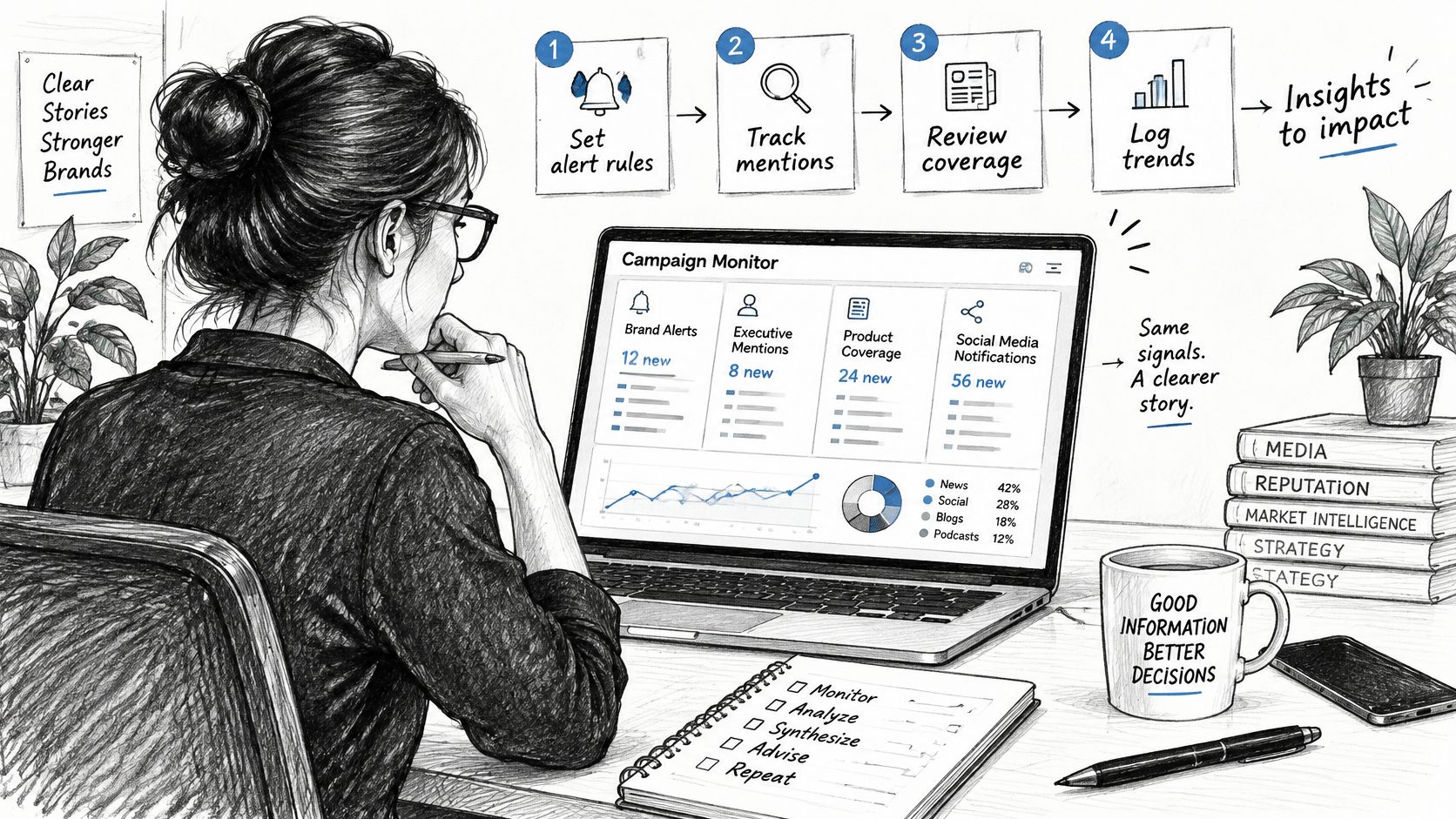
Monitoring during the campaign is a routine, not a document assembled at the end. Five steps cover it.
- Set alert rules before the first pitch. Cover the brand name, named executives, key products and the two or three competitors you'll be measured against. A relevant mention can sit forty minutes into an episode and never surface in a news-clip search, so the rules need to catch phrases a host would say out loud.
- Log every hit with date, outlet, speaker, claim and link. Building the log as mentions arrive takes minutes, while rebuilding it from memory at month end costs a day and loses the details that made the mention useful.
- Save the exact quote and its timestamp. A timestamped passage can be reviewed and forwarded without asking a client or executive to re-listen to a whole episode, which is the difference between evidence and an assertion.
- Rate accuracy and tone separately. Mark whether the host or guest repeated the key claim in recognizable terms, then positive, neutral or negative. Tone tells you how the room felt; accuracy tells you whether the message landed.
- Review weekly and change the pitch list. If guests on one show restate the claim in your words, move similar shows up the list. If a host misstates a fact, send corrected material with a source while the episode is still circulating.
That fifth step is where campaigns improve. The log isn't an archive for the client pack; it's a working input that reshapes outreach every week.
Here's how that monitoring loop looks when a team runs it alongside a live campaign:
Measuring Outputs and Outcomes Without Overclaiming #
A clip count shows distribution. It doesn't show persuasion, recall, trust or a single sale. Reports get into trouble when the first gets presented as the second, and clients work it out eventually.
AMEC's Barcelona Principles 3.0 draws the line plainly. Measurement should be planned before launch, with data sources, tracking methods, key performance indicators and benchmarks specified in advance, and the guidance separates outputs such as coverage volume and reach from outcomes such as changes in beliefs, attitudes or behavior. It also asks teams to evaluate paid, earned, shared, owned and influencer channels together, because audiences don't experience them in separate boxes.
| Metric | Type | What it shows | Main limit |
|---|---|---|---|
| Story or clip volume | Output | Coverage was distributed | Says nothing about belief or action |
| Reach or impressions | Output | Potential audience size | Does not confirm anyone heard the message |
| Share of voice | Output | Mentions against competitors in the same set | Depends on the keyword set and sources chosen |
| Message pull-through | Outcome | Audiences repeat the key claims | Needs quote coding and a sample |
| Branded search change | Outcome | Interest rose after exposure | Other campaigns can cause the same change |
| Qualified leads or sales | Outcome | Campaign contributed to pipeline | Long lag and difficult attribution |
The method that keeps a report honest is boring. Record a baseline before launch for every outcome you intend to claim later: branded search volume, referral traffic, share of voice inside a fixed keyword set, and whatever lead or pipeline measure the business already trusts. Where the audience is large enough, compare exposed groups with unexposed ones. Code quotes to see whether the key claim was repeated in your words or paraphrased into something else. Then write down what else could explain the change, including your own paid activity.
Agency reporting benefits from that discipline. Say a consultancy reports that podcast mentions rose in the quarter, shows branded search and inbound demo requests against the baseline, and then states that paid promotion ran during the same weeks. That's a credible report: it claims correlation, names the competing explanation, and lets the reader weigh it. Agencies and consultancies can use Podzone on behalf of clients and include the results in deliverables, provided those clients don't get direct access to the service, which keeps the interpretation with the account team instead of landing raw in an inbox.
The question to end every report with: what evidence would change our conclusion? If nothing could, the report is decoration.
Building a media coverage report that separates distribution from effect is the difference between a summary and an argument.
From Brief to Reported Outcome #
A finance software company wants mid-market buyers to recommend it to peers. One quarter, five stages, no shortcuts.
Research finds that buyers trust peer hosts more than vendor advertising, so the segment list puts high-trust listeners first and names the shows they already hear. Planning turns that into a fixed objective: three industry podcasts recommending the product to that segment inside the quarter, supported by one core claim, a customer-verified proof point, a third-party reviewer and the founder as spokesperson.
Execution runs three components that repeat the same claim. The founder records guest placements, a short research report goes to journalists covering the category, and a webinar serves the accounts that asked for a demo. Monitoring logs each mention with its timestamp, the exact claim and the host's framing. When two shows restate the claim in the company's own words, similar shows move up the pitch list and the outreach note gets rewritten around the phrasing that worked.
Evaluation compares branded search and inbound demo requests with the pre-launch baseline. The report shows the movement, then states plainly that a paid promotion added six weeks into the quarter overlapped the same weeks, so the change can't be credited to earned coverage alone.
A report that names its own limits is more convincing than one that claims everything, because the reader can see which conclusions are load-bearing.
Replace the company with yours, keep the structure, and mark any value you don't yet have as open rather than estimated. An honest blank beats an invented number, and it gives the next quarter something real to beat.
Reputation Risks in AI Answers and How to Respond #
Strong coverage and a wrong answer coexist comfortably. AI assistants already field many of the questions buyers once typed into a search bar, and the summary they return may not match the story your earned coverage tells. A clip count proves distribution: the message ran where you placed it. It does not show whether a synthesized answer repeats that message, distorts it, or leaves it out entirely.

An AI answer works like a briefing from a stranger who skimmed your press coverage along with every directory listing and stale page still online, then compressed it all into one confident paragraph. The failure modes are distinct, and each has a different fix. The brand can be omitted entirely, described inaccurately, built on weak sources, or anchored to a claim from a page that was outdated two years ago.
The response therefore starts with measurement, not messaging:
- Fix the question set. Choose the questions buyers ask, such as which tools solve a specific problem or whether a company can be trusted with sensitive data. Keep the wording identical between checks, because a changed question produces a changed answer whether or not anything else moved.
- Run them on the same schedule. Test across the assistants your audience uses, monthly, at the same interval, so a difference between checks means the answer changed rather than that you asked differently.
- Record four things. Whether the brand is named, how it is described, which sources are cited, and what shifted since the last check. The cited sources matter most, because they tell you where to look next.
- Trace errors to their origin. Inaccurate claims usually come from somewhere concrete: an outdated article, a directory listing nobody updated, or an old page still live on your own site.
- Correct the source, not the consensus. Publish accurate, verifiable material and fix the stale pages. A dozen posts asserting the same claim carries no evidential weight, and coordinated posting designed to shift a summary is manipulation wearing an optimization label.
The ethical line is plain: improving accuracy and discoverability is legitimate, manufacturing agreement is not. Standards for governing and validating this work are still thin, so document your method and its limits. Require human review for every factual change you publish in response, keep a record of what was checked and when, and treat a shift in an AI summary as a signal to investigate rather than a result to report. When a summary improves after a correction, the most honest claim is that your work is consistent with the change, because assistants rarely disclose which source tipped them.
Confirm Your Campaign Plan Before You Launch #
Six items, each with an owner and a date. Nothing launches until all six are filled in.
- Objectives: each one names an outcome, a segment, a number and a date.
- Messages: each segment has one core claim, a proof point and a spokesperson it finds credible.
- Components: each channel has a named owner and a stated reason it reaches that segment.
- Baseline: branded search, share of voice and any lead or sales measure recorded before the first pitch.
- Alerts: keyword rules covering the brand, senior executives, products and main competitors, tested against one known mention.
- Reporting: the review schedule and the attribution limits written into the report template, not added after the results are known.
Alerts make monitoring faster, but they don't replace outcome measures, so a campaign isn't ready just because notifications are switched on. The gate is the full list, not the easiest item on it.
Approval rule: if any one of the six has no owner and no date, the campaign waits. That single rule prevents most of the reporting problems that surface a quarter later.
Podzone transcribes podcast episodes and surfaces every mention of the keywords a team defines, with a transcript excerpt, show details and a timestamp attached to each match, so a clip can be verified before it reaches a client report. Alert latency is measured in minutes, which means coverage gets logged while an episode is still circulating rather than weeks after the pitch went out. Visit Podzone to run a search on the brand, the executives and the main competitors, and see what the shows your buyers already trust are saying.
- public relations campaigns
- PR campaign planning
- PR measurement
- campaign objectives
- PR strategy