Podcast PR Explained: How to Pitch and Measure Shows
Podcast PR explained: how to find relevant shows, pitch guests, track mentions across audio and video, and measure coverage without overstating reach.
A client asks for a podcast appearance, a team member books the biggest show that replies, and the final report lists a download number nobody can explain. That sequence wastes the true strength of podcast PR, which isn't scale on its own. It's a trusted host spending real time on a problem, in front of listeners who chose that conversation. Teams new to the work need a calmer method. Pick shows for fit, pitch a specific conversation, capture the exact mention, and report only what the evidence supports.
Table of Contents #
- What Podcast PR Means and Why Brands Use It
- Choosing Shows With Real Audience Fit
- From First Pitch to Your First Week
- Catching Mentions Across Audio, Video and Clips
- Measuring Coverage Without Overstating Reach
- Handling Delays, Cuts and Corrections
- Common Misconceptions That Waste Podcast PR Budgets
What Podcast PR Means and Why Brands Use It #
Say a founder is on a morning commute, half listening, when a host she follows describes the exact problem her product solves. The host isn't reading an ad. He's working through the problem with a guest, asking follow-ups, pushing back once, then agreeing with the answer. That listener doesn't remember a banner she saw that week, but she remembers the voice and the reasoning. Podcast PR is the work of earning that kind of moment. It means securing mentions, guest slots, and expert commentary on shows whose listeners match the brand's market.

Pitching a podcast differs from pitching a news story in three practical ways. A news hit is usually brief and tied to a date. A podcast segment is a conversation of thirty to sixty minutes, so there's room for a story, a mistake, and a number with context. The message also lives in the host's voice, not in approved copy, which raises both the credibility and the risk. Finally, the episode stays online and searchable for years through its title, show notes, and transcript, so a good appearance keeps working long after publication week.
The Three Forms Teams Usually Earn #
- Guest appearances: A founder, executive, or subject expert joins for an interview built around one clear angle.
- Expert quotes in show notes: The guest's name, title, and a short point of view appear in text that search engines and listeners can find later.
- Clipped segments: A short cut from the conversation travels on social platforms, often reaching people who never play the full episode.
The audience is large enough to justify the effort. According to Interactive Advertising Bureau research, podcasts accounted for 20% of all daily ad-supported audio listening in the United States in 2025. That figure shows scale, not that any single show will perform. The reason brands keep investing is reuse. One recorded conversation can be clipped for social posts, quoted in a sales deck, linked from a media page, and sent to a journalist as proof that a spokesperson can explain the topic clearly. The path that follows runs from choosing shows, through pitching and monitoring, to proving results without inflating them.
Choosing Shows With Real Audience Fit #
Judge a show by audience fit and host trust, not follower count. A neighbourhood bakery owner who knows the regulars sells fewer loaves than a stadium billboard reaches drivers, yet the owner's recommendation carries weight because customers know she'll hear about it tomorrow if the bread is bad. A niche podcast host works the same way. Listeners return weekly, they know the host's standards, and they notice when a guest doesn't belong.
That trust has measurable context. The National Public Media report on attention and trust found that 86% of prime podcast users recalled hearing an ad in the prior week, while 51% of prime media users considered ad-supported podcast content factual and accurate. Read those numbers carefully. They describe ad-supported podcast audiences, not earned guest mentions, so they explain why the medium feels credible. They don't prove that a specific appearance worked.
A Six Criterion Scorecard #
Score each criterion from one to five after listening to recent episodes and reading transcripts. A total under twenty out of thirty usually means the team is forcing the fit, however large the show looks.
| Criterion | Strong signal | Warning sign |
|---|---|---|
| Audience match | Listeners who buy from or influence your category | Broad audience with no link to your market |
| Host credibility | Host asks informed follow-up questions | Host reads sponsor copy without questions |
| Conversation format | Long interview with room for stories | Short ad-style read or rapid-fire questions |
| Archive depth | Dozens of episodes covering your topic | Few episodes, mostly news or promotions |
| Guest history | Recent guests in adjacent categories | Only paid sponsors or rivals' spokespeople |
| Mention context | Host discusses products in their own words | Brands appear only as sponsor reads |
Practical rule: A modest show with a trusted host and a conversational mention can deliver more communications value than a large show where the brand is a passing sponsor read.
Transcript search makes the shortlist faster to build. Podzone ingests publicly published podcast feeds, transcribes the episodes they reference, and makes the resulting transcripts searchable, so a team can see which shows already discuss a topic instead of guessing from episode titles. Look for repeated coverage of the problem, not a single keyword hit. A show that has returned to the subject across several guests has an audience that tolerates depth. That's the room where an expert earns attention.
From First Pitch to Your First Week #
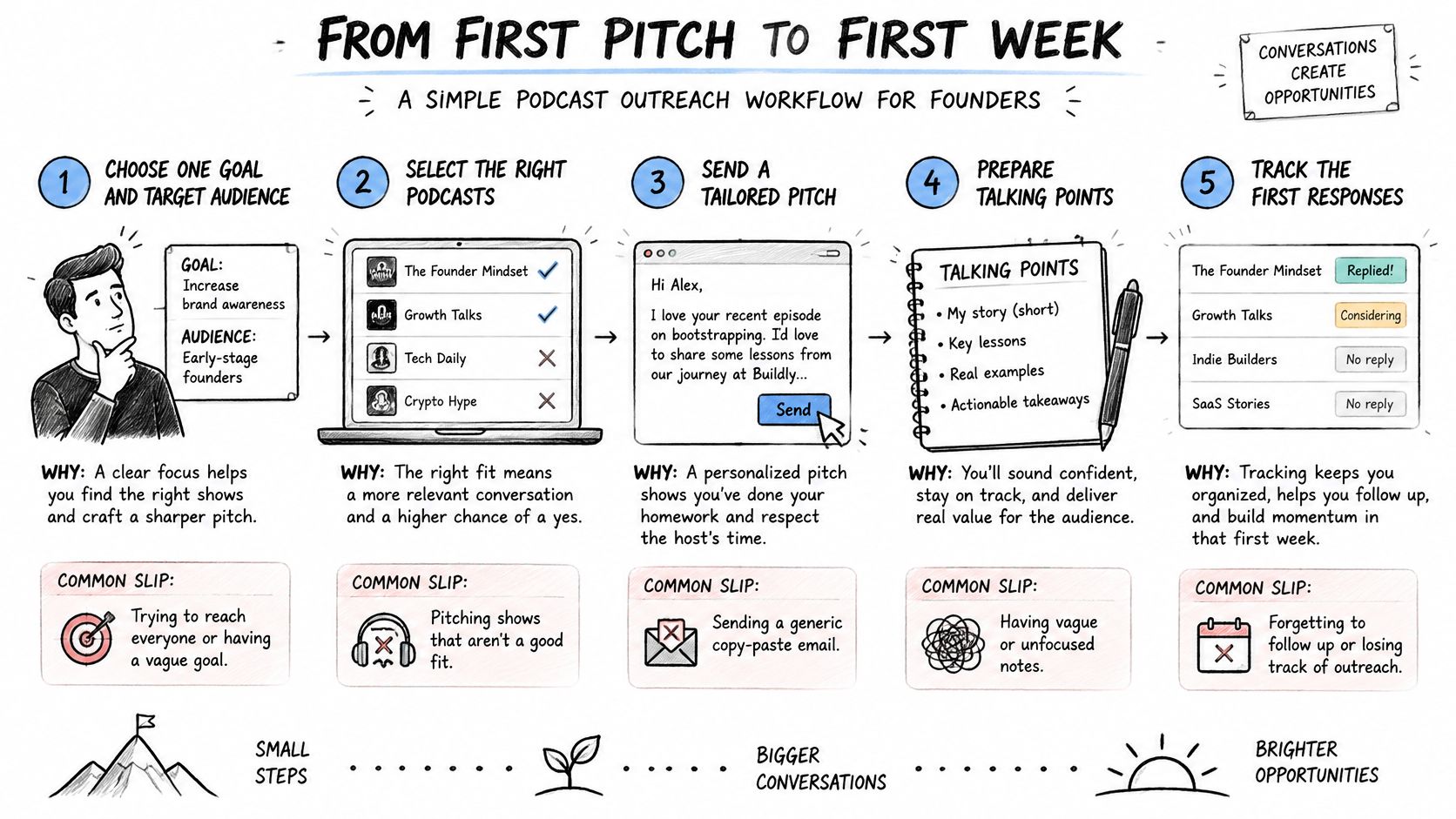
New teams often start with outreach volume because it feels productive. The workflow below runs in the opposite order, with fit and evidence decided before anyone writes an email. The visual summary shows the outreach sequence at a glance.
The Eight Steps #
- Set one goal: Name the outcome and the audience needed to reach it, because brand awareness and enterprise leads require different shows, different guests, and different proof.
- Build the shortlist from evidence: Search transcripts and guest histories for the brand's topics and competitors, so the list reflects shows that already discuss the subject. A service built for PR and publicists, podcast bookers and producers, podcast guests, and researchers and analysts speeds this step, but the judgement stays human.
- Find the booking contact: Identify the host, producer, or booker who handles guests, then listen to three recent episodes. The common slip is pitching a show nobody on the team has heard, and hosts detect it in the first line.
- Pitch one episode idea: Name a specific episode or segment and offer a concrete story the guest can tell. Don't paste a press release and hope the host finds the conversation inside it.
- Prepare for conversation, not a script: Give the guest three talking points, one story, and one number with its source ready to say aloud. Hosts follow interesting answers, so rigid messaging usually gets edited down or sounds evasive.
- Confirm the details after recording: Ask for the publication date, the show notes link, and whether a transcript will exist. Record all three in the tracker the same day.
- Capture the asset: Request the audio clip or video cut if the show allows sharing, and log the timestamp where the key mention occurs while the episode is fresh.
- Watch for the second life: Monitor clips, reposts, and related episodes, since a host may reference the guest again weeks later. Teams with technical support can use an API that pushes every alert match to their own endpoint as a signed webhook, so findings land in existing tools instead of an inbox.
The short walkthrough below shows how a focused guest pitch is framed for a host.
A Realistic First Week #
Pick three topics that tie the brand to its market, including one competitor topic worth tracking. Set keyword alerts for the company, spokesperson, and products. Score fifteen candidate shows on the six criteria and keep the top five, then listen to two episodes from each. Pitch three shows, each with one episode angle, and log every mention found along the way with its timestamp, publication date, and transcript excerpt.
A strong first pitch fits in three sentences. It names the segment the writer listened to, offers one story only this guest can tell, and states what listeners will be able to do differently afterwards. Anything longer usually means the angle isn't clear yet.
Catching Mentions Across Audio, Video and Clips #
A single guest spot rarely stays inside the RSS feed. The same conversation resurfaces as a full video upload, a short clip cut for social feeds, a quote pulled into the show notes, or a repost by a guest whose following dwarfs the show's own. Each version reaches a different audience and needs its own record. Judge each one by the discussion it starts rather than the size of the channel carrying it, since a repost that draws replies and questions often matters more to a brand than a quiet upload with a bigger view count.
Platform data explains why audio-only monitoring falls short. Edison Research findings reported in 2025 identified YouTube as the leading platform for podcast consumption among U.S. weekly consumers at 32%, ahead of Spotify at 25% and Apple Podcasts at 15%, and named YouTube a major discovery route for Gen Z. A team watching only the podcast apps will miss the largest slice of that viewing.
| Platform | Share of U.S. weekly podcast consumers | Source |
|---|---|---|
| YouTube | 32% | Edison Research 2025 |
| Spotify | 25% | Edison Research 2025 |
| Apple Podcasts | 15% | Edison Research 2025 |
Matching Versions Before Counting Them #
Before logging two hits, confirm whether the audio episode and the video upload are the same editorial event by comparing the guest, the opening minutes and the segment order. Matching all three means one piece of coverage living on two platforms, not two wins. Record each platform's own publication date either way, because a clip released weeks later can drive a second wave of responses. This cross-format checking pairs naturally with broader social listening tools that follow where clips travel after release.
Set alerts broadly enough to catch how people talk:
- Company and product names: Include shortened versions listeners would say aloud.
- People: Add the spokesperson and founders by full name.
- Competitors: Track rival names to spot comparison segments.
- Misspellings and soundalikes: Transcripts render spoken names imperfectly, so add common variants.
Scale makes manual checking unrealistic. Podzone ingests the world's podcast feeds, tracks over 4M feeds and adds about 30,000 new episodes daily, transcribing what's said and alerting customers when their company, competitor or topic is mentioned. That's how a three-minute mention inside a sixty-minute show gets flagged within minutes of publication instead of surfacing in a quarterly review.
Every logged mention should carry its timestamped excerpt. A link to the exact moment separates "an episode exists" from "these words were said," which keeps a clip report honest when it reaches a client or an executive.
Measuring Coverage Without Overstating Reach #
Treat downloads as potential exposure, not proof of listening. That single habit prevents most inflated podcast reports. The image below shows the filtered server data behind download counts, which is useful context and also the limit of what those counts mean.
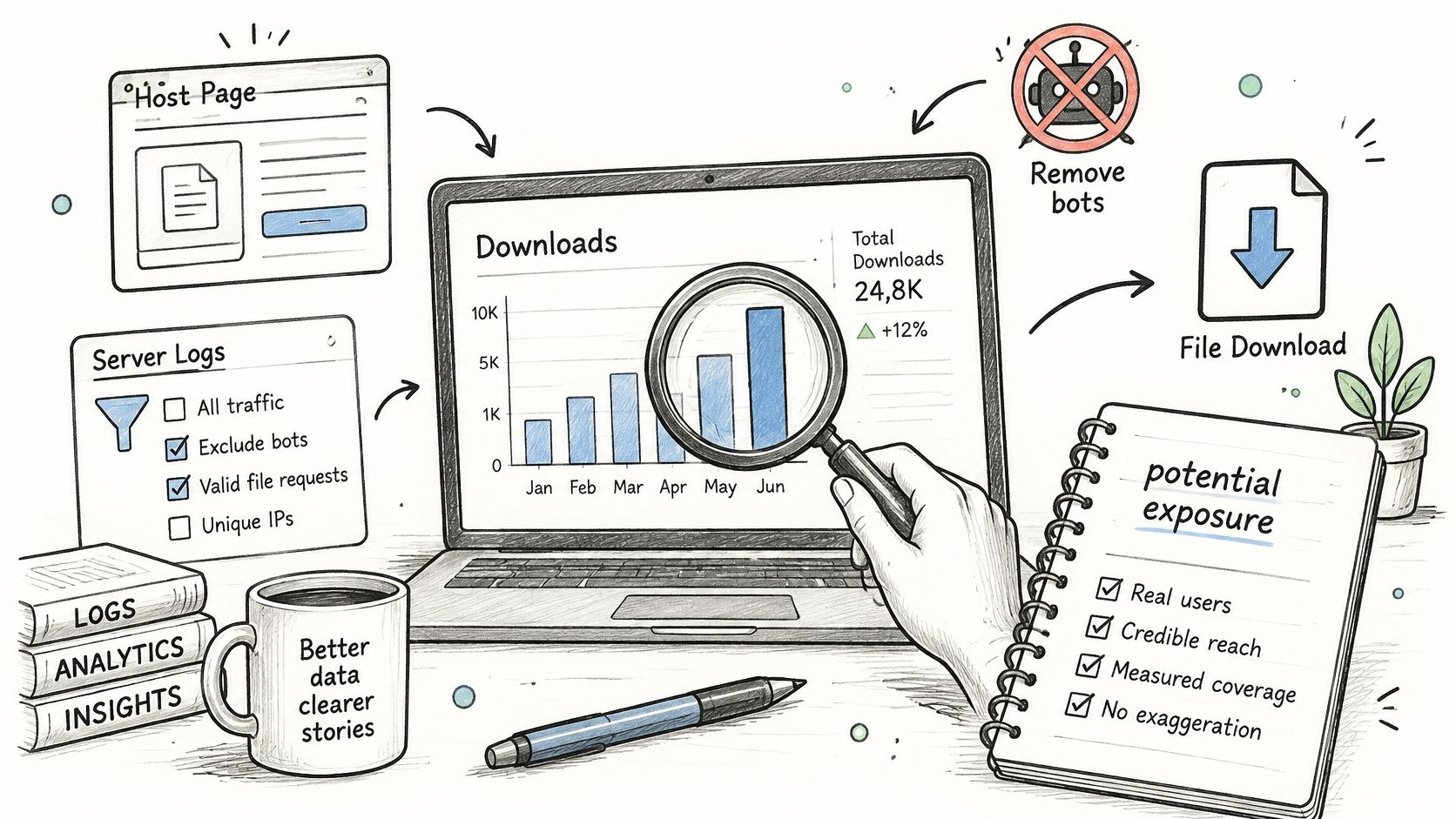
The IAB Audio Measurement Guide defines a legitimate podcast download using server-log filtering, typically removing bots and other invalid traffic, applying a minimum audio-file threshold, and deduplicating requests using identifiers such as IP address and user agent within a stated time window. The same framework distinguishes download or ad-delivery metrics from playback. A valid download does not confirm that an episode was played, and an ad-delivery count does not necessarily prove that the ad was heard.
What Each Metric Can and Cannot Support #
| Metric | What it can show | What it cannot prove |
|---|---|---|
| Episode downloads | Potential exposure after bot and duplicate filtering | That anyone pressed play or heard the mention |
| Timestamped mention | Exact words, host attribution and the moment in the episode | How many people heard that passage |
| Publication date | When coverage went live for the reporting window | Whether the episode was consumed afterwards |
| Referral traffic | Visits from show notes or links in the episode | Brand trust or purchase intent on its own |
| Branded search lift | Rise in brand searches after the episode date | Which episode caused the rise without other context |
| Promo code redemptions | Direct response from listeners who used the code | Earned mentions, unless the code was given in the episode |
Separate technical distribution from verified consumption in every report, and clients stop asking why two shows with similar downloads produced different results.
A defensible report pairs a conservative exposure figure with hard evidence. Include the exact transcript excerpt, who said it, the show and episode details, and the publication date, then add referral traffic, branded-search movement, or conversion signals where they exist. Each Podzone alert includes a linked timestamp that points to the moment the subject is said in the podcast, which lets a client hear the passage in context. Podzone does not host or serve podcast audio, and its references to an episode link to the publisher's own source, so reports should link there too. Structuring that evidence well matters, and a clear media coverage report format keeps claims consistent across clients. Agencies and consultancies may use Podzone on behalf of their clients and include results in deliverables, provided the clients do not get direct access to the service.
Handling Delays, Cuts and Corrections #
Confirmed bookings still go sideways. Each problem below needs a fix in the moment and a matching entry in the coverage log, because the log is what a client report is later built from.
Publication delays happen when a host's schedule shifts or a news peg overtakes the episode. Confirm the release date in writing before recording, and if the episode slips, update the log with the new date. Never report the planned date as coverage. Cut segments are the sharper risk. Ask before recording which parts may be trimmed for length. If the client's mention is removed in the edit, record the placement as not published and claim no credit for it, however good the conversation felt on the day.
Misspelled names or wrong product details usually appear in show notes or auto-generated transcripts. Ask the host or producer to correct both, since show notes are what search engines index, then log the correction date beside the original entry. Clip rights need asking, not assuming. Request written permission before sharing a clip on owned social channels, and follow any licensing terms, credit lines, or time limits the show sets.
Replays and Misrepresentation #
A rebroadcast or re-upload creates a new publication date, so log it as a separate event with its own link. That prevents double counting and also captures genuine second exposure. If a host frames the client inaccurately, respond privately with the correct facts and the timestamp, and don't repost the segment. Public arguments with hosts travel further than the original error.
One week after each episode goes live, run a short check. Confirm the episode is still public, the show notes link works, names are spelled correctly, the timestamp in the log matches the audio, and no clip has appeared that the team hasn't recorded. Five minutes of checking protects months of reporting.
Common Misconceptions That Waste Podcast PR Budgets #
Say a team pays to place a client on a large show. The host spends most of the interview asking about a rival brand's recent launch, the guest answers politely, and the client's own mention lasts forty seconds near the end. The report still leads with the show's audience size. Nobody lied, yet the budget bought a rival's talking points. Five beliefs produce outcomes like that.
The biggest show always wins. Score fit first using the six criteria, because relevance and trust decide whether listeners act. Placement counts equal impact. Count only mentions backed by timestamped evidence of what was said. Download numbers prove listening. Label them potential exposure and pair them with behaviour signals before claiming attention.
Two Beliefs That Need Fuller Correction #
One appearance builds lasting awareness. A single episode spikes briefly, then the feed moves on. The fix is a series of appearances across related shows, supported by a clip strategy that keeps the strongest thirty seconds circulating on social channels, in newsletters, and on the brand's media page. Repetition across trusted voices is what turns a mention into recognition.
Podcast PR is only guest booking. Booking is one transaction, but hosts are relationships. A host who enjoyed the conversation may invite the guest back for a panel, quote the earlier segment in a later episode, or accept a sponsor read with genuine familiarity behind it. Teams that send a useful follow-up, share the episode properly, and offer future help without pitching immediately get those second chances. Teams that vanish after publication don't.
Plan for the smaller, trusted show before the pitch goes out. Decide in advance what a conversational mention from a credible host is worth to the campaign, and the team stops apologising for modest audience numbers that were the right choice all along.
Podzone transcribes podcast episodes at scale and alerts teams the moment a company, competitor, or spokesperson is mentioned, with the exact timestamp and transcript excerpt needed to report coverage accurately. For PR teams that want to choose shows on evidence and prove results without overstating reach, visit Podzone to start monitoring the conversations that shape a brand's reputation.
- podcast pr
- podcast publicity
- podcast guest pitching
- PR measurement
- podcast media relations