Best Podcast Database Tools in 2026: 10 Options Compared
Compare 10 podcast database options by episode coverage, search filters, host and guest data, transcripts, and API access to pick the right fit.
Which podcast database do you need? A catalog of show names will not tell a communications team whether a brand was named eighteen minutes in, and a transcript box will not hand a booker a usable host record. There is no single best podcast database, because tools split on what they index, how far host and guest records go, and whether they offer programmatic access instead of a search page you check by hand.
The split started with the feed itself. In the early 2000s, Dave Winer and Adam Curry adapted Really Simple Syndication so directories could pick up audio enclosures automatically, which is why a serious index has to track feeds, episodes, metadata, and media links that change. Industry compilations citing Listen Notes put the worldwide total above 4.42 million podcasts in 2025, while one dataset counted about 3.57 million active podcast accounts and 177.5 million published episodes, as summarized by Async. Those totals disagree because providers define a show, an active feed, and a duplicate differently. The scale is still the point.
Before you compare logos, answer four practical questions. How much of the episode graph do you need, including dormant shows? Must search reach the words inside the audio, or are titles and descriptions enough? How much people data do you require for pitches and guest histories? Do you need alerts, an API, or webhooks, or is manual lookup fine?
The ten options below are grouped by the job they do best: mention monitoring, guest booking, transcript search, ad intelligence, and open developer data. Match the job, then test the tool on queries you already know the answer to.
Table of Contents #
- 1. Podzone
- 2. Podchaser
- 3. Listen Notes
- 4. Rephonic
- 5. Tapesearch
- 6. Podcast Index
- 7. PodParley
- 8. Podscan
- 9. Podchaser API
- 10. Podscribe
- Podcast database comparison at a glance
- Matching the Database to the Job
1. Podzone #
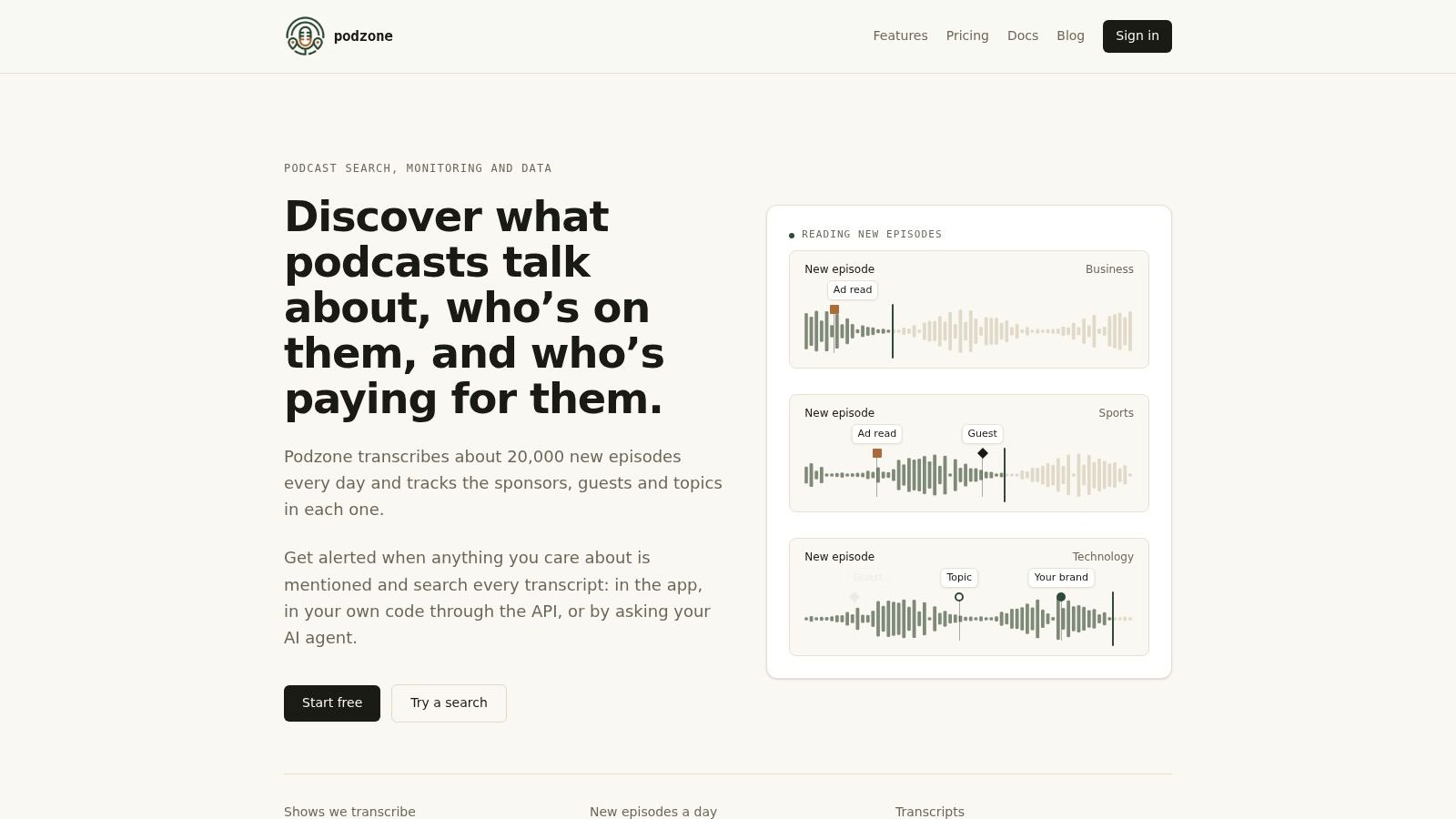
Podzone is built for teams that use a podcast database as a monitoring system. It ingests publicly published feeds, transcribes the episodes those feeds reference, and makes the transcripts searchable across brands, people, sponsors and topics. Search covers episode titles, descriptions and transcripts, so teams can see what is being discussed across podcasts in real time. Episode references link to the publisher's own source; Podzone retrieves audio only to transcribe it.
What you can wire into a workflow #
Search, transcripts, sponsors, people and alerts run in the app, through the API, and through an MCP connection for Claude, Cursor or VS Code. Podzone transcribes about 20,000 new episodes each day and reads each transcript and show notes for sponsors, ad reads, hosts and guests. A brand search shows the episodes and shows it sponsored, how many reads it has, and when it was first and last heard; a person record follows someone across the shows they host and the shows they have been on. Alert matches stay available in the app and API for 60 days, and webhook deliveries arrive as signed JSON without the transcript body.
What holds up in daily use:
- Verification speed: Word-timed excerpts and linked timestamps let you confirm a mention without playing the whole episode. Each result carries the episode ID, its podcast, and short passages around the match.
- Delivery choice: Email alerts and signed webhooks both carry the matched context, which fits agency reporting and internal tools.
- One record, several jobs: Sponsor products, offer codes, guest histories and topic mentions sit next to the episode, so ad research and mention checks share the same evidence.
Practical rule: Treat a transcript hit as proof the words were said, not as proof of audience reach. Export the timestamped excerpt, and keep delivery metrics in a separate system.
The trade-off is scope versus convenience. Podzone is a strong default when monitoring, sponsor context and developer access have to live in one place. Automated transcripts will contain errors, so quote from the excerpt and open the publisher source before a client deck. Try it at Podzone and run last month's known mentions before you commit budget.
2. Podchaser #
Podchaser earns its place when the question is who was on the show, not only what the show is called. Public pages cover a large searchable catalog of podcasts and episodes, and the distinctive layer is credits for hosts, guests, and other contributors. That people graph is what booking and PR research usually lack in a plain RSS index.
Business products add audience information, demographics, contacts, charts, sponsors, transcript search, mention alerts, and API access. Public browsing is enough to see whether a guest has a footprint before you request a demo.
Where the people data helps #
- Guest mapping: You can trace which shows a person has been credited on, which is the right starting point for a pitch list.
- Stacked research: Discovery, contacts, and sponsor context sit in one professional product instead of a spreadsheet you maintain yourself.
- Open inspection: Public show pages let you spot thin credits before you trust them in a client deck.
Podchaser Pro pricing is not listed publicly, so budget a demo rather than a self-serve checkout. Credit data can be incomplete, especially where it depends on user contributions. Use it for booking and relationship research. Do not treat every audience figure as a verified download report.
See the catalog at Podchaser.
3. Listen Notes #
Listen Notes is a podcast search engine with an API, aimed at finding shows, episodes, topics, and people, plus building that lookup into an app. It is not a full monitoring desk and it is not a sponsorship ledger.
In October 2025, Inside Radio reported that Listen Notes counted 605,122 shows with at least one episode that year, above the prior active-show record, against roughly 3.6 million podcasts created worldwide and about 185 million episodes. Active and cumulative are different databases. If your job is "what exists, including shows that went quiet," you need the larger catalog. If your job is "what published this year," filter hard.
Transcript search works where transcript data exists, which is only a portion of episodes. There is a free API tier. Paid API pricing is usage-based, with a stated $200 base fee once paid requests are made. Public show pages let you inspect results before you integrate anything.
It is the right pick for discovery inside a product and for one-off research. It is not a substitute for ongoing real-time brand alerts. Details are on Listen Notes.
4. Rephonic #
A booker needs ten shows in a category, a way to reach the host, and a rough sense of who listens. Rephonic is built for that outreach job: guest pitches, sponsorship shortlists, and contact research on a database of millions of podcasts.
You can filter shows, then layer listener estimates, charts, demographics, social details, and host or publisher contacts. The API goes further than a directory export, covering show information, transcripts, episode analysis, guests, and sponsors. The site offers a trial, so test your real pitch criteria against live results rather than trusting a demo query.
Audience and listener figures are estimates, not publisher-verified download reports. That distinction matters when a plan has to survive scrutiny. The IAB digital-audio media-mix framework lists impressions, clicks, reach, frequency, platform, and delivery geography as separate fields, and notes that reach is not always available for podcast products. More sponsor rows do not create a fair ranking if the metric type is unlabeled.
Keep an explicit "unknown" on reach when the vendor only modeled an audience. A false comparison is worse than a gap.
Paid access can be costly for occasional research, so check current database-plan limits before an annual commit. For how appearance monitoring fits a pitch workflow, see this guide to podcast PR. The product site is Rephonic.
5. Tapesearch #
Tapesearch is the transcript-first podcast database. You search words and phrases across a large spoken catalog and land on passages, which is what journalists and researchers need when the fact lives in the audio rather than the show notes.
Paid tiers add keyword email alerts, AI-assisted queries, and API access. The API tier also includes a hosted MCP server. Public pricing makes the step from search to alerts easier to judge than a quote-only tool.
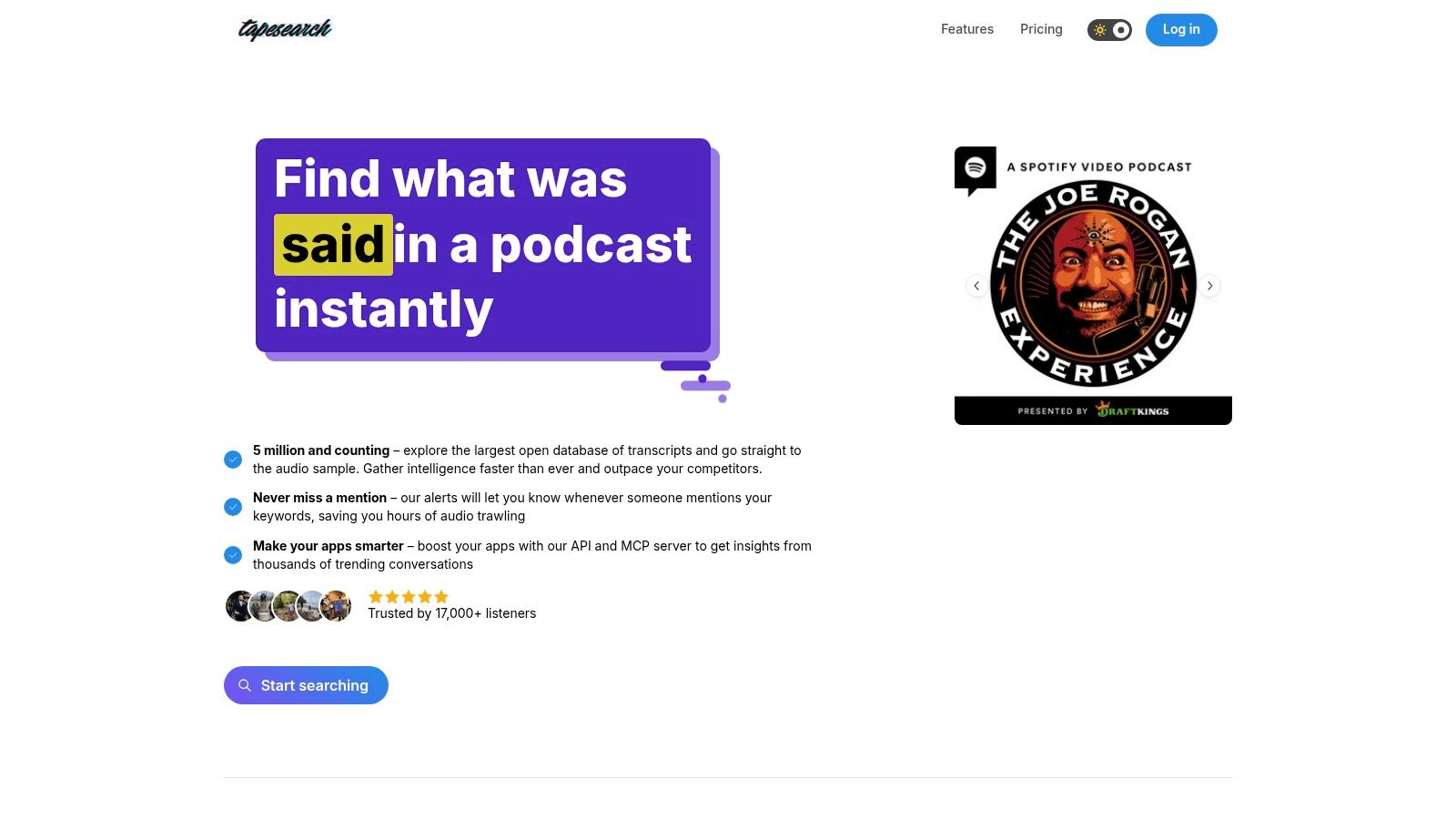
Downloads come timestamped in TXT, SRT, VTT, and JSON, which is useful when you have to file a clip citation or hand a producer a cue. Accuracy still depends on the source transcript and on automated speech recognition. Coverage is not universal.
It does not try to be a contact file, a demographic panel, or a sponsorship history. If those are the brief, pair it with a booking database rather than forcing this one to stretch. A closer look at passage-level lookup is in this note on podcast transcript search. Start at Tapesearch.
6. Podcast Index #
Podcast Index is the open, community-oriented index of podcast RSS feeds. You get API search over podcasts and episodes, feed and episode metadata, and a downloadable database of active feeds. The published export is updated daily. The broader ecosystem includes Podcasting 2.0 data.
Who should build on it #
- Developers: Open data fits independent apps and internal indexes without renting a commercial research seat.
- Analysts with their own stack: A daily database download beats calling an API for every lookup when you are doing custom joins.
- Feed discovery: It is a clean base layer for RSS-based products that only need the feed graph.
It is less turnkey for nontechnical business users. It does not focus on transcript search, PR monitoring, or rich audience and contact intelligence. API limits and terms apply, including for commercial use, so read them before you ship a product on top. That is the honest trade: you own the pipeline, and you also own deduplication, language detection, and anything that looks like business intelligence. The project lives at Podcast Index.
7. PodParley #
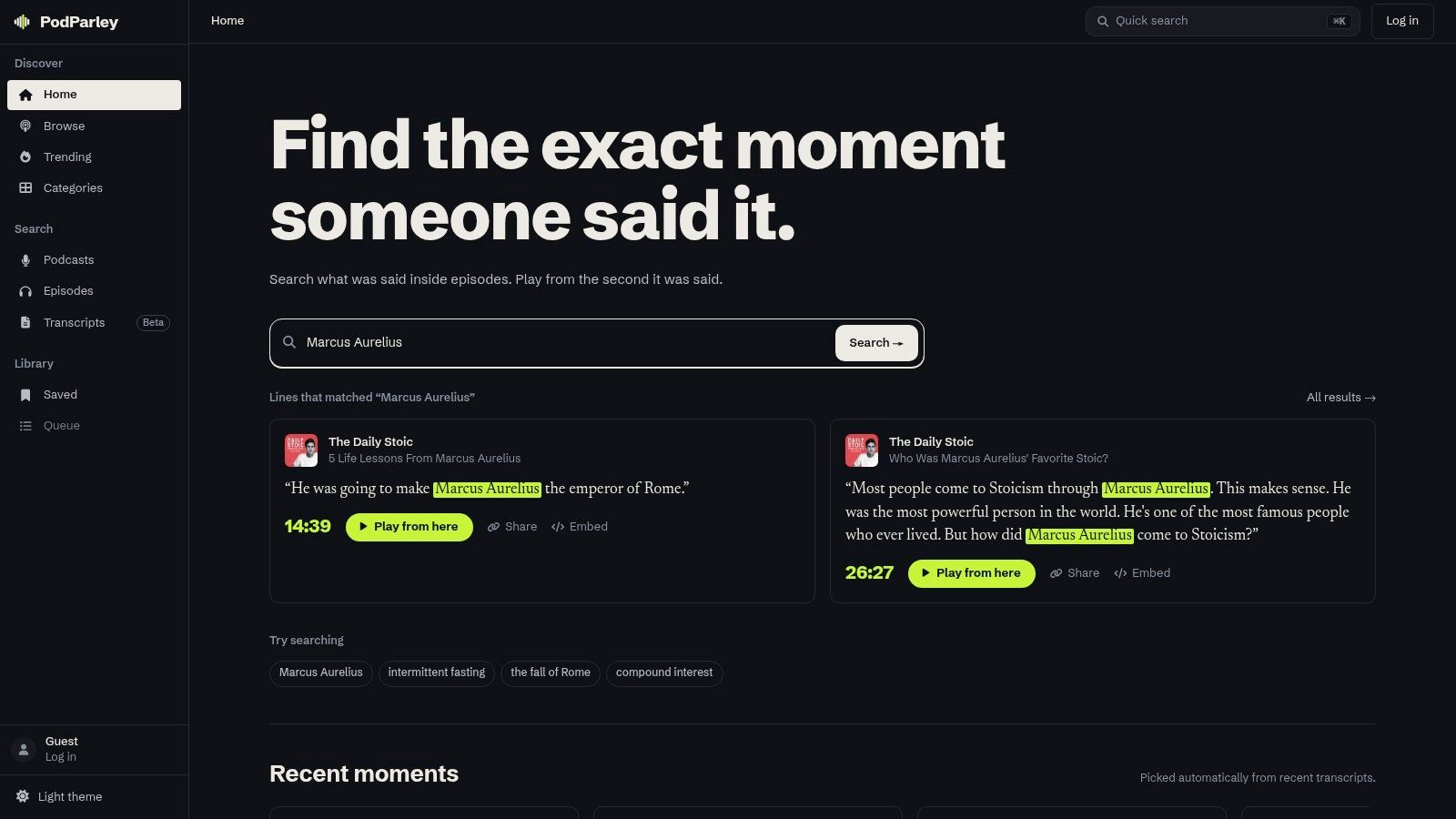
PodParley is a large directory with spoken search on a subset of episodes. The site describes a catalog of 4.8 million podcasts, with 228,000 episodes searchable by transcript. Where a transcript exists, you can jump to the matching moment and play it, which speeds a first-pass check.
You can also request a transcript for episodes that do not have one, according to the site. That request flow is handy for occasional research. It is not the same as a monitoring pipeline that transcribes the firehose every day.
Automated transcripts can contain errors, so quote from the audio when the line will appear in a report. Pricing and business-grade alert features are not clear from the public information, which makes this a poor place to anchor a client SLA. Use it for casual discovery and preliminary spoken-word search. Move to a monitoring platform when you need reliable alerts, people data, or sponsor history. Browse it at PodParley.
8. Podscan #
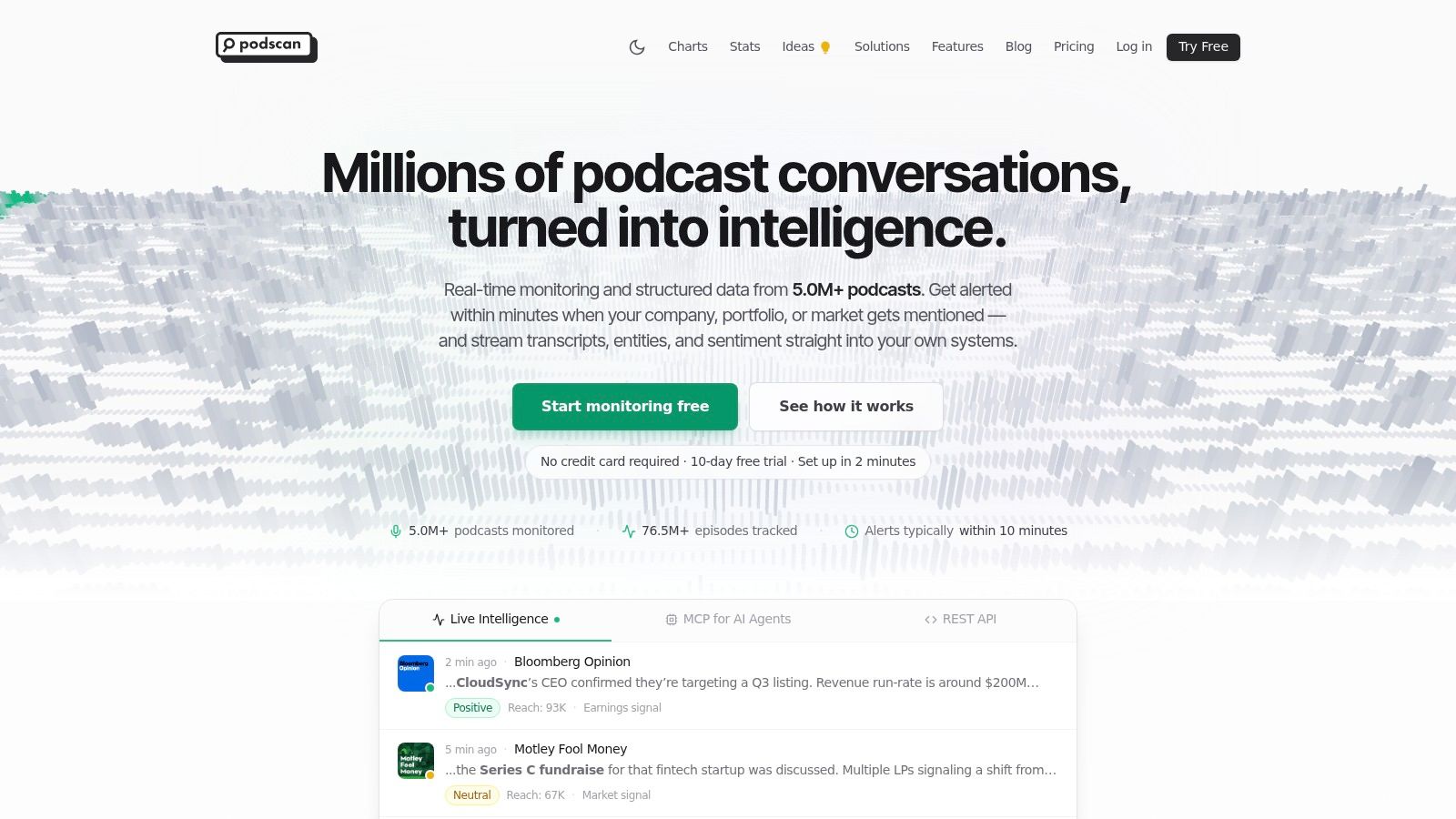
Podscan sits in the same monitoring category as a full podcast intelligence stack. Teams track mentions of companies, people, topics, and sponsors, search available transcript history, and push results through the app, email, exports, webhooks, API, MCP, or a Firehose. Enterprise plans can be shaped around coverage, throughput, team seats, and delivery method.
The listening base is large enough that popularity filters miss the mentions that matter. Edison Research reported that 55% of Americans aged 12 and older consumed podcasts monthly in 2025, and weekly listening among people 13 and older reached 773 million hours. Episode-level ingestion, not a hand-curated top list, is what covers that graph.
Monitoring output is evidence of words in an episode. It is not a verified audience measurement, and it should not be labeled as one in a post-buy report.
Enterprise access is expensive and can be more system than an individual researcher needs. Confirm coverage, volume limits, and which delivery methods are included before you sign. The platform is at Podscan.
9. Podchaser API #
The Podchaser API is the developer door into the same people-and-show graph, meant for products, CRMs, and internal research tools rather than for an analyst clicking through profiles. Search covers podcasts, episodes, transcripts, networks, creators, and sponsors. Fetches can return metadata, charts, credits, demographics, contacts, and sponsor information. REST docs include machine-readable OpenAPI references, which shortens the first integration.
Self-serve and enterprise options both exist, and published Starter pricing gives you an entry point without a sales cycle. Higher-value fields and usage levels change by plan. Commercial use and how you display the data are subject to Podchaser's terms. Enterprise pricing is custom.
Choose the API when you already know Podchaser's data model is the one you want inside another system. Choose the website when a researcher needs to browse credits this week and nobody is writing code. Do not buy API capacity to replace a monitoring webhook if your real need is "tell me within the hour." Documentation starts at the Podchaser API.
10. Podscribe #
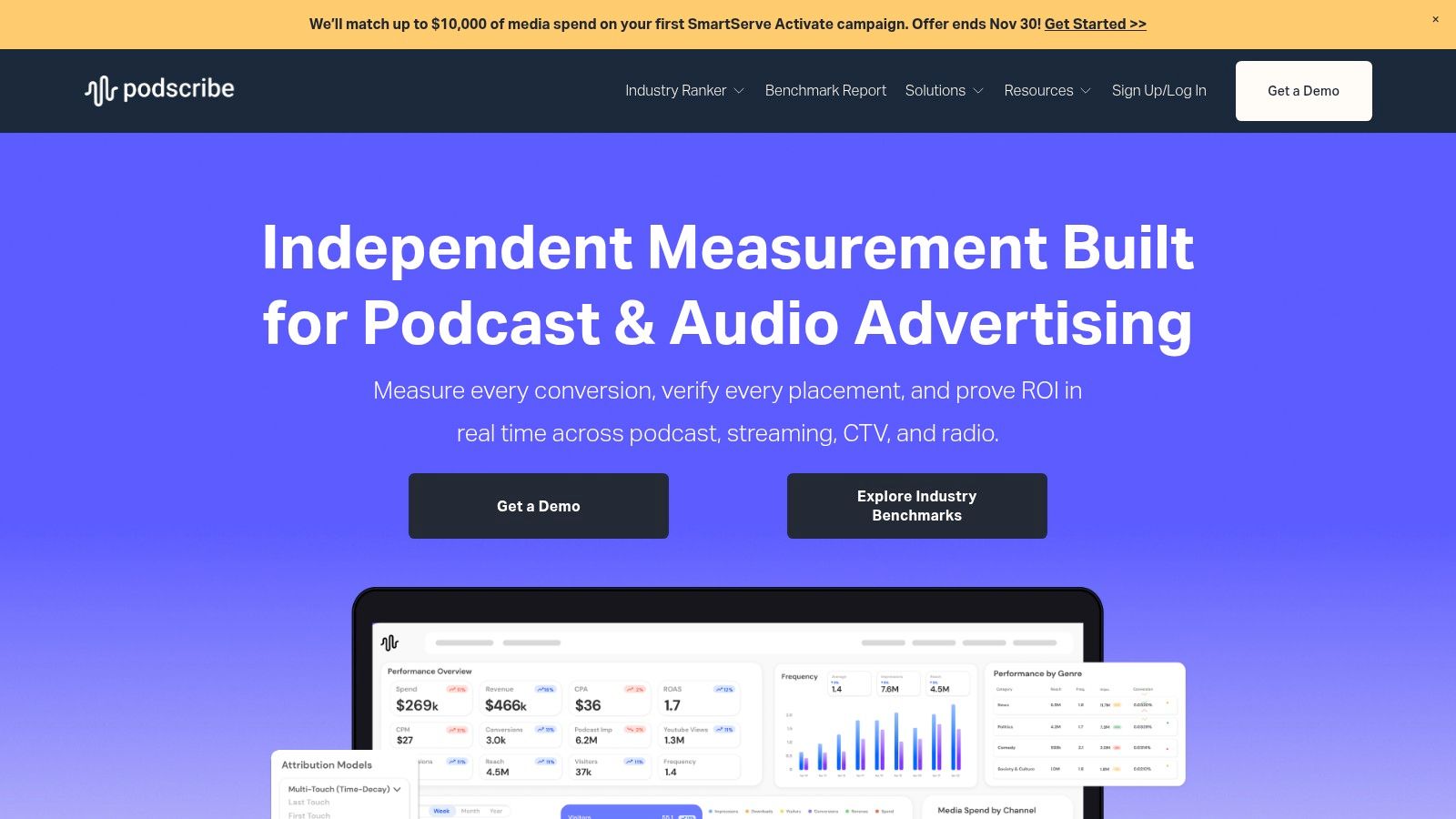
Podscribe is podcast advertising intelligence and measurement, not a general directory. The company says it offers research on more than 25,000 shows, plus demographics, ad placements, historical ad loads, renewals, advertiser activity, audience overlap, and campaign planning and verification tools. It is aimed at advertisers, agencies, and publishers.
That specialization matches the money in the medium. Podcast News Daily, covering IAB and PwC, reported that U.S. podcast advertising revenue grew 26.4% in 2024 to more than $2.4 billion. A show list does not answer which brands renewed, how heavy the ad load was, or whether two podcasts share an audience. Podscribe tries to.
Its measurement business appears in IAB Tech Lab podcast measurement materials, which is a relevant trust signal for buyers who must document method. Pricing can be significant once research and planning tools are included. Advertising intelligence is not keyword monitoring across all spoken content. If the job is "did anyone say our product name," use a monitoring database. If the job is planning and proving podcast ads, start at Podscribe.
Podcast database comparison at a glance #
| Tool | Primary strength | Transcript search | Host/guest data | API access | Best for |
|---|---|---|---|---|---|
| Podzone (recommended) | Podcast monitoring and advertising intelligence | Searchable, timestamped transcripts | Tracks hosts, guests, sponsors, and offer codes | API, webhooks, and MCP | Brand monitoring, PR research, and sponsor tracking |
| Podchaser | Podcast discovery and professional research | Available through business products | Detailed host, guest, and contributor profiles | Available | Researching people, shows, and professional contacts |
| Listen Notes | Podcast and episode discovery | Available where transcripts exist | Searchable people data | Available, with free tier | Podcast discovery and app development |
| Rephonic | Guest booking and sponsorship research | Available through its API | Host and publisher contacts; guest data | Available | Finding shows for pitches and advertising |
| Tapesearch | Transcript-focused search | Search transcripts and download timestamped files | Limited focus on people data | Available on API tier | Finding and reviewing spoken passages |
| Podcast Index | Open podcast feed discovery | Not a core focus | Basic feed metadata | Open API and downloadable database | Developers building RSS-based tools |
| PodParley | Podcast directory with spoken-word search | Available for a subset of episodes | Basic directory information | Not specified | Casual discovery and preliminary transcript research |
| Podscan | Podcast monitoring and structured intelligence | Search available transcript history | Tracks people and sponsors | API, webhooks, MCP, and Firehose | Team monitoring and integrated reporting |
| Podchaser API | Podcast data for apps and research systems | Searchable transcript data | Creator, credit, and contact data | REST API; self-serve and enterprise options | Building products with podcast and contributor data |
| Podscribe | Advertising research and measurement | Not focused on broad transcript search | Show and audience data | Not specified | Advertisers, agencies, and publishers |
Matching the Database to the Job #
Pick by the question you have to answer on Monday, not by which logo shows up most often in roundups.
Monitoring with a path into your own tools points to Podzone or Podscan. Podzone ingests publicly published podcast feeds, transcribes the episodes they reference, and makes the resulting transcripts searchable. It transcribes about 20,000 new episodes every day and tracks the sponsors, guests, and topics in each one. Its MCP server lets an AI assistant search podcasts, read transcripts, follow sponsors, hosts, and guests, and manage alerts. Podscan is the enterprise alternative when you need configurable throughput and several delivery routes, including a firehose, and you can justify the seat cost.
Guest booking and audience research points to Podchaser or Rephonic. Podchaser is stronger when credited people are the asset. Rephonic is stronger when estimated audience, demographics, and contacts have to travel with the shortlist. In both cases, label estimates as estimates.
Transcript-first search points to Tapesearch when you need downloads, alerts, and a public price, and to PodParley when you need a quick public lookup and can tolerate a much smaller transcribed subset.
Open developer data points to Podcast Index when you want feeds and a daily database you control. Use the Podchaser API or Listen Notes when you would rather rent a maintained search index than operate one. Listen Notes fits discovery inside an app. The Podchaser API fits products that need creators and credits.
Ad intelligence points to Podscribe when the workflow is planning, overlap, and measurement. Use a monitoring tool's sponsor layer when you need evidence of a read, an offer code, and a timestamp, and you will not pretend that evidence is reach.
A practical sequence beats a big annual commit. Start on a free plan or a short trial. Run five queries you already answered by listening: a known guest, a known sponsor read, a rare product name, a dormant show, and a topic that only appears mid-episode. Keep the tool that returns the right episode with evidence you can forward. Drop the one that only returns a popular show with a thin profile.
Discovery is also fragmenting across video and social, so a larger RSS catalog is not automatically a better answer to "where did the audience find this." Edison Research's Infinite Dial found that 33% of weekly podcast listeners used YouTube most often for listening. If your stakeholders care about that path, ask whether the database can tell audio episodes from video versions and clips. If it cannot, say so in the report instead of implying the index is the whole market.
Podzone turns public podcast feeds into searchable transcripts, timestamped mentions, sponsor and guest records, and alerts you can pull through an API, signed webhooks, or an MCP connection. If the podcast database you need is the one that shows what was said, who said it, and which brands showed up, start with a real query on Podzone.
- podcast database
- podcast search
- podcast research tools
- podcast monitoring
- podcast API