Measurement of PR: What to Track and Why It Matters
A practical guide to measurement of PR: objectives, metrics, attribution methods and client reports that hold up under scrutiny.
Every measurement guide in public relations opens with the same instruction. Stop counting mentions, start measuring outcomes. It sounds disciplined, and it's the advice repeated in their own reporting templates. It's also why so many podcast reports fall apart in a client meeting. A team that deletes its mention count doesn't replace it with proof. It replaces it with reach estimates, sentiment scores and survey figures that nobody can trace back to a specific episode, a specific sentence or a specific date.
The advice isn't wrong. It's incomplete. A count on its own proves that something happened, and a business outcome proves that something changed, but the link between the two only exists if someone preserved the evidence that makes it visible. Deleting the mention throws away the one artifact you can check.
This guide treats every mention as auditable evidence. Each claim gets labelled by strength, either associated with a result or caused by it, and the newer question of how a company appears inside an AI answer gets the same treatment. Most measurement guides stop at "track outcomes". That advice leaves a team without a method.
Table of Contents #
- Why Mention Counts Mislead PR Teams
- Measurement Frameworks and the Barcelona Principles
- The Three Levels of PR Metrics
- How to Set Measurable Objectives
- Attribution Methods That Link Mentions to Results
- Measuring AI Visibility Without Overtrusting It
- Reporting Results Clients Can Verify
- Build Your Measurement Plan This Quarter
Why Mention Counts Mislead PR Teams #
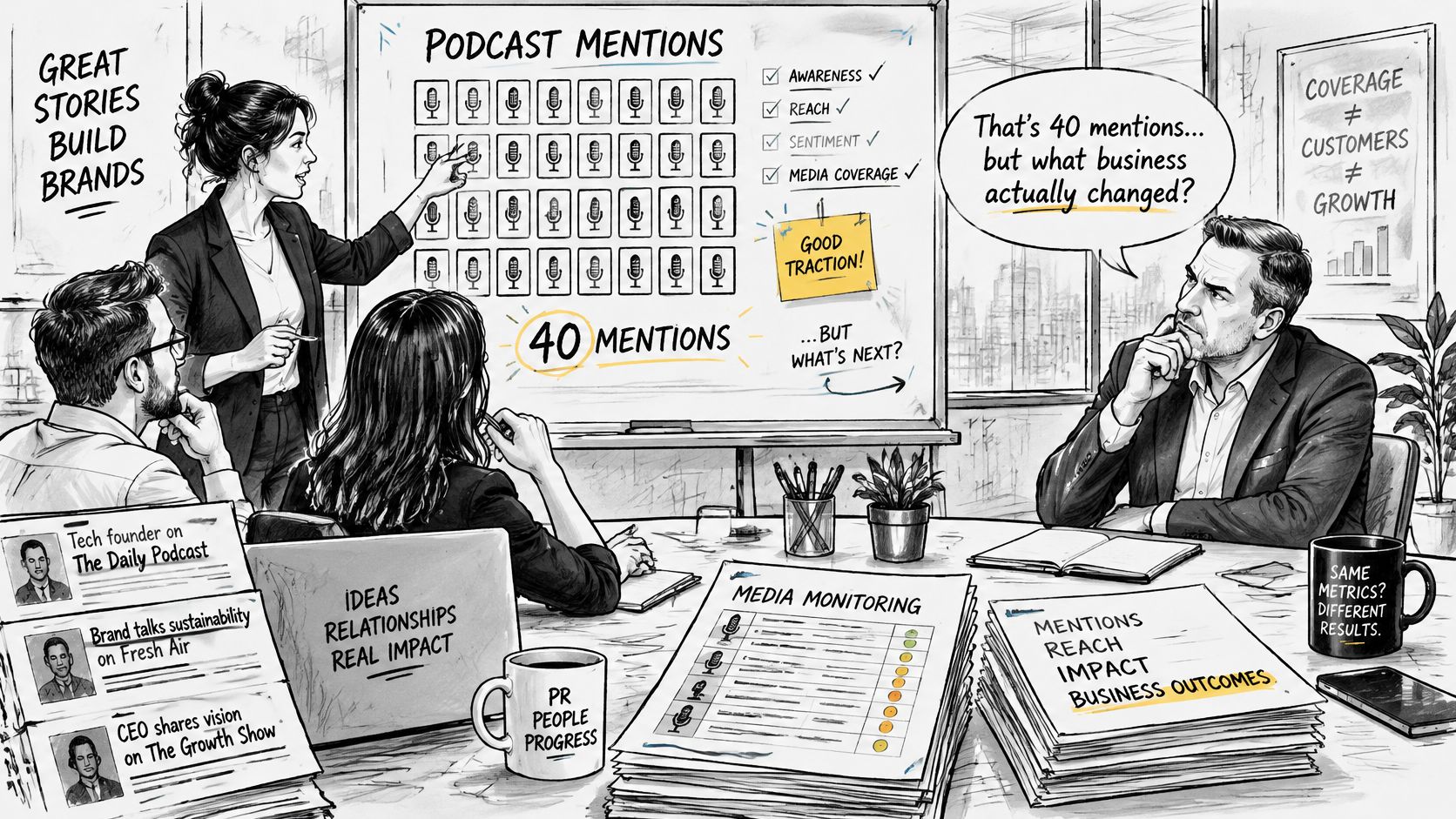
The quarterly review is going well until the client asks the obvious question. Forty podcast mentions, a reach figure in the millions, a slide of logos. Then: which of these changed anything for the business? The room goes quiet, because a count can't answer that.
Counting is an old habit, and a documented one. Media monitoring and publicity measurement trace back to the late eighteenth century, and systematic measurement tied to press agentry was recorded in the first decade of the twentieth century, according to a historical review of PR evaluation_The_evolution_of_evaluation_(IHPRC).pdf). Academic work on evaluation expanded through the late 1960s and 1970s, which moved the field from informal clipping counts toward something more systematic. The habit survived because a count is easy to produce and easy to defend.
It also survived because it's still the default. In 2025, 86% of PR professionals identified the number of stories placed as a metric they use, while 79% used reach or impressions, according to Muck Rack's State of PR Measurement survey. Volume isn't a fringe practice. It's the centre of most reports.
Here's the cleaner way to think about it. Measurement is evidence that links communication activity to a stated objective. A mention count is like counting the cars that pass a shop window. It proves traffic existed. It says nothing about who slowed down, who walked in, or who bought anything. The count isn't false, it's just answering a question nobody asked.
Practical rule: a number earns its place in a report only when you can name the objective it serves and the evidence behind it.
That's why a useful record for each mention preserves five things: the publication or show, the audience context (who listens), the message quality (was the point made accurately), the timestamp, and the objective it serves. Drop any of those and the mention becomes a tally again.
Measurement Frameworks and the Barcelona Principles #
A framework earns its place when two people who disagree can still read the same report and reach the same conclusion. That's what the Barcelona Principles do, and it's why they come before any discussion of which metrics to pick.
The framework was adopted in June 2010 by the International Association for Measurement and Evaluation of Communication and partner organisations, and the current version is set out in AMEC's Barcelona Principles 4.0. It replaced a loose collection of local habits with a shared standard, and it's the reference point most measurement arguments now resolve against.
What the principles ask of a podcast programme, in plain terms:
- Set measurable objectives first. Name the audience, the change you expect, the timeframe and the size of the change before a single episode airs. Without that, no metric can be right or wrong.
- Separate outputs from outcomes. An episode published is an output. A listener who can repeat your message is an outcome. The two get different slides.
- Connect activity to business and social effects where you can measure them. Where you can't, say so rather than substituting a proxy and calling it impact.
- Combine quantitative and qualitative evidence. A sentiment score reads a transcript's tone; a human reads whether the host was being sarcastic.
- Report with evidence you can check. Every figure keeps its source record.
Principle 5 rules out one widely used shortcut: advertising value equivalency is not the value of public relations, because a media-space price isn't a communication result. A year after the principles were adopted, the Institute for Public Relations, the Council of PR Firms and AMEC formed the Coalition for Public Relations Research Standards to push common practice further.
Why the framework matters in a client conversation: when someone asks for proof, a team with a framework can point to an objective, a level and an evidence trail. A team without one can only point at a bigger number.
The Three Levels of PR Metrics #
Every metric in a communications report sits on one of three levels, and mixing them up is the most common source of bad reporting. Sort each number before you present it.
| Level | Typical metrics | What it shows | What it cannot show |
|---|---|---|---|
| Outputs | Stories placed, episodes, mentions, reach, impressions | Activity and potential exposure | Whether listeners heard, understood or acted |
| Outputs (monetary) | Advertising value equivalency, earned media value | A cost-based estimate of coverage | Audience response or PR's own contribution |
| Outcomes | Message pickup, sentiment, share of voice, recall | Whether audiences noticed and interpreted the message | Whether behaviour or revenue changed |
| Business impact | Referral visits, inquiries, sign-ups, sales, reputation shifts | Change tied to commercial or organisational goals | Causation without a controlled comparison |
The monetary row deserves a longer look, because it's where reports mislead. Advertising value equivalency multiplies the size of print coverage, or the duration of broadcast exposure, by the corresponding advertising rate. Earned media value applies similar logic with a reach multiplier. The practice is old: references to AVE in the United States appear by 1947 and in the United Kingdom by 1949, and a review of AVE in PR measurement notes that despite the criticism formalised in the Barcelona Principles, industry studies found AVEs were still used by up to one-third of PR and corporate-communication practitioners worldwide in 2017.
None of that makes the arithmetic dishonest. It makes it a priced guess about media space, not a measure of what the audience did with the message.
Take one podcast mention and watch it move across levels. The episode airing is an output. A listener using the promo code read out at the twenty-two minute mark is a business signal. A measurable lift in recall among the target audience, picked up in a survey, is an outcome. Same mention, three different claims, three different strengths. If you're working through where awareness fits in that chain, Podzone's breakdown of measuring brand awareness covers the survey side in more detail.
The test for any number: ask which level it sits on, and which question it answers. If the answer is "it shows people might have seen it", label it that way and move on.
How to Set Measurable Objectives #
Objectives are the part teams skip, and the omission surfaces months later when nobody can say whether the campaign worked. A measurable objective is seven recorded decisions, written down before the work starts, in this order.
- Name the audience as a group, not a mass. "Small-business owners who listen to finance podcasts in the UK" tells you which shows to target and which survey panel to use. "Listeners" tells you neither.
- State the change you expect. Awareness, comprehension, attitude, behaviour or reputation. Pick one per objective, because each needs different evidence.
- Set a timeframe. Two quarters is realistic for awareness work on podcasts, where episodes accumulate listeners over months rather than days.
- Set a magnitude against a baseline. "Lift unaided recall of the product name among that audience by a stated amount, measured against the pre-campaign baseline." A magnitude without a baseline isn't a target, it's a wish.
- Map each channel to an outcome. Every podcast placement needs a written reason to exist, such as reaching finance-minded founders before a funding announcement.
- Record the baseline before the first episode airs. Use survey results, branded search volume or site visits, captured before launch. A baseline reconstructed afterwards is a guess with a date on it.
- Decide the evidence to store for each mention. Show, episode, air date, speaker, transcript excerpt, timestamp, and the objective it serves. File it so anyone reviewing the campaign can open the excerpt, check the timestamp and see why that mention counted. This takes minutes at the time and saves hours in the review.
The payoff reaches beyond the PR report. An objective written this way can be tied to a business indicator, because the indicator is named in the objective itself rather than searched for afterwards. A recall target connects to brand tracking. A behaviour target connects to sign-ups or demo requests. Measurement that links to the numbers the business already reports gives PR a defensible line in the budget conversation; measurement that doesn't leaves the team arguing with mention counts.
Sanity check: if you can't fill in one of the seven fields, the objective isn't measurable yet. Rewrite it before you brief the agency or book the show.
Attribution Methods That Link Mentions to Results #
Attribution is where podcast PR stalls hardest. The Meltwater State of PR report records that nearly four in ten teams lack a formal method for connecting PR activity to outcomes, that 46% cite difficulty making that connection, and that 39% lack access to business-outcome data.

Audio makes the gap wider than most channels. A mention sits inside a forty-minute episode, the audience is unknown, and the effect arrives weeks later as a vague sense that the brand keeps coming up. Teams trained on clicks find that uncomfortable, and advertisers themselves name measurement as the sector's growth barrier: limited performance data holds spending back, and budgets would grow if audio attribution were easier to trust.
The fix starts with language, not tooling. Use associated with when a result follows a mention and you can't rule out other causes. Reserve caused by for a controlled comparison that survives the obvious alternatives. Most PR results belong in the first category, and labelling them that way makes a report more credible, not weaker.
Each method answers a different question, so read the table as a set of witnesses rather than a menu. No single row carries the case on its own.
| Method | What it shows | Strength | Limitation |
|---|---|---|---|
| Timestamped mention evidence | Exact passage, speaker, show, episode and time | A verifiable record of what was said | Proves exposure, not effect |
| Referral and web lift | Site visits in the days after an episode airs | Measurable traffic trend | Indirect, with many competing causes |
| Promo code or landing page | Conversions tied to a unique code or URL | Direct response signal | Captures only listeners who use the code |
| Branded search lift | Change in searches for the brand name | Reflects awareness building | Influenced by other campaigns |
| Brand-lift survey | Change in recall or awareness among the target audience | Tests what listeners remember | Costly and dependent on sample size |
| Pre/post or matched-market comparison | Metric change before versus after, or against comparable markets | Simple baseline or stronger controls | Other events may explain the change |
Two of those limitations deserve a second look, because they trip up first-time reports. A promo code counts only the listeners who act on it, so treat redemptions as a floor rather than a total. A pre/post comparison assumes nothing else changed between the dates, which a busy quarter rarely guarantees.
Here's how a claim gets built from weak signals. A host mentions a product at the twelve-minute mark of an episode released on a Tuesday. In the following week, branded search for the product name rises, and a promo code read out in the same segment is redeemed forty times. Each signal alone is arguable. Together they support a claim that the episode was associated with a measurable lift in interest, while still stopping short of proof. If a later matched-market check shows the search rise only where the episode found its audience, the wording moves closer to caused by. If a rival campaign launched that same week, it stays associated.
A short walkthrough of the combined-signal logic in practice:
The quarterly combination that holds up in front of a sceptical client is narrow: one timestamped record, one direct response signal, and one awareness signal, each labelled by strength. Three checkable lines beat a page of reach, and every one of them traces back to evidence the client can inspect.
Measuring AI Visibility Without Overtrusting It #
Picture a bank that appears in an AI answer to the question "which lender offers the best business loan for a small company". The bank's name shows up. Its visibility score rises. The answer also repeats a discontinued interest rate the bank stopped offering months ago. The brand is present and the representation is harmful, and a single "AI visibility" number records neither the win nor the damage.
This is a fast-growing measurement question. Muck Rack research reported through Ritzau found that 55% of professionals had begun measuring LLM visibility, up from 28% the prior year, with another 23% planning to start, and 54% already using AI or AI-enabled tools in measurement and reporting. Confidence hasn't kept pace: 72% cite accuracy of AI results as a concern, alongside ethical risks, privacy and limited transparency.

The mistake is treating AI visibility as a single score. Break it into four dimensions and measure each separately.
- Presence: does the organisation appear in the prompts that matter to real stakeholders, phrased the way those stakeholders ask?
- Factual accuracy: are dates, prices, product names and leadership claims correct against primary sources?
- Message alignment: is the answer describing the organisation in the terms it would choose, or in a competitor's terms?
- Sentiment and recommendation quality: is the brand mentioned as a recommendation, a neutral option or a cautionary example?
Then apply the controls. Choose prompts from real stakeholder questions gathered from sales calls and search logs, not invented ones. Decide which languages and markets to sample, because an answer in one market often differs from another. Fix a sampling frequency and keep it, so month-to-month change isn't an artefact of a change in method. For each result, store the prompt, date, model version, cited sources and whether a human verified the answer against primary evidence.
A search result is a billboard you rent. An AI answer is a spokesperson who may misquote you. Measuring the spokesperson means checking every quote.
Reporting Results Clients Can Verify #
An agency team builds its first quarterly podcast report for a client. The draft leads with 120 mentions and a reach figure with eight digits. The client reads it, thanks the team, and asks a question the deck can't answer: which episodes changed anything? The report looked large and proved little.
The revision is smaller and harder to argue with. It follows a fixed structure: objectives and baseline, outputs, outcome evidence, business signals, limitations. Each mention carries an evidence record.
Evidence record, per mention: show, episode, air date, speaker, transcript excerpt, timestamp, link, whether the message matched the brief, and who rated the sentiment. Verified facts (a quote, a timestamp) sit separately from estimates (reach).
That separation matters because reporting pressure pushes the other way. When a deadline lands and a stakeholder wants growth, teams reach for the largest available number, and figures nobody can defend end up in client decks. Keeping verified and estimated data apart gives the team something to point at when a figure is challenged. The timestamp is the line of defence. A client can open the episode, jump to the moment and hear the sentence, and that single check either confirms the claim or ends it.
The pre-send checklist:
- Label every number by level, so outputs, outcomes and business signals never share a heading.
- Label every claim by strength, as associated with or caused by. A rise in branded search after a sponsored series is associated. A sign-up traced through the campaign's promo code is closer to caused.
- Add a data-limits note, naming what the monitoring couldn't see, such as private podcasts or unlisted feeds.
- Name an owner for each figure, the person who can explain where it came from.
Agencies and consultancies can run monitoring on a client's behalf and include the results in deliverables, provided the client doesn't get direct access to the service, which is how Podzone's own terms describe agency use. For a worked template of the reporting structure, see Podzone's guide to building a media coverage report.
Reports are judged on whether they can be checked, not on how large they look. A client who can open an episode, jump to the timestamp and hear the sentence will trust the next report before reading it.
Build Your Measurement Plan This Quarter #
Start with three objectives, not a dashboard. Build each one using the seven fields above, so every objective names an audience, a change, a timeframe, a magnitude and a recorded baseline. Three is enough for a quarter and few enough to defend.
Next, pick two attribution methods that fit your channels. Timestamped evidence plus a promo code is a workable pair for a sponsored series. Timestamped evidence plus branded search lift suits an earned-media campaign with no code to redeem. Write down which signal is associated with the result and which, if any, could be caused by it.
Then build one report in the five-part structure and check every figure against its evidence record before it leaves the building. Before you rely on any monitoring service for a client deliverable, run a month-long test with your own keywords and see how it behaves. Podzone states that its coverage figures and alert latencies are targets, not commitments, which is a useful reminder to validate a tool's output against episodes you already know.
One decision for this week: choose the three objectives and assign a named owner to each. Everything else follows from that.
Podzone is a podcast monitoring and search service that ingests feeds, transcribes episodes and returns a transcript excerpt with a timestamp for every keyword match, which is exactly the evidence record an auditable mention needs. If you're rebuilding a podcast report around evidence instead of volume, start with the timestamps and work outward from there. Visit Podzone to see how the monitoring, sponsor tracking and alert data fit into the reporting structure above.
- measurement of PR
- PR metrics
- PR attribution
- media measurement
- PR reporting