How to Measure Brand Awareness: Metrics and Tracking
Learn how to measure brand awareness with unaided and aided metrics, sound survey design, sample sizes, and podcast mention tracking.
Brand recall accounted for 38.7% of brand lift in emerging media in Nielsen's 2023 Brand Lift Report, according to Nielsen's analysis. That finding makes the distinction between appearing in front of an audience and being remembered by that audience worth taking seriously.
Teams that measure brand awareness need more than a percentage. They need a defensible definition of the audience, questions that don't supply the answer, and a way to separate sampling variation from meaningful change. Podcast monitoring adds another layer: a transcript can establish that someone mentioned a brand, but it can't establish that a listener remembers it.
Table of Contents #
- Brand Awareness Metrics and How to Calculate Them
- How to Run a Brand Awareness Survey in the Right Order
- Sample Size and Reading Real Change Without Overclaiming
- Tracking Brand Mentions Inside Podcast Episodes
- Set Your First Brand Awareness Baseline This Month
Brand Awareness Metrics and How to Calculate Them #
51.9% of brand marketers reported using brand awareness as an effectiveness-tracking metric in 2025, according to Marketing Week's Language of Effectiveness survey with Kantar and Google. Before that number reaches a reporting dashboard, the measurement lead needs to specify which kind of awareness it represents.
Brand awareness metrics, formulas and what each shows
| Metric | Question it answers | Calculation | What it shows |
|---|---|---|---|
| Top-of-mind awareness | Which brand comes to mind first in the category? | Qualified respondents naming the brand first ÷ all qualified respondents × 100 | First position in spontaneous recall |
| Unaided awareness | Which brands can respondents name without a prompt? | Qualified respondents naming the brand unprompted ÷ all qualified respondents × 100 | Spontaneous availability in memory |
| Aided awareness | Has the respondent heard of this brand when it is shown? | Qualified respondents recognizing the brand after prompting ÷ all qualified respondents × 100 | Familiarity when prompted |
| Total awareness | Does the respondent recall or recognize the brand at all? | Unique qualified respondents recalling or recognizing the brand ÷ all qualified respondents × 100 | Combined recall and recognition |
The core distinction is between unaided recall and aided recognition, as described in Sprig's brand awareness survey guide. Someone may recognize a name on a list without retrieving it independently when thinking about the category.
Keep the denominator and the interpretation aligned #
Every formula needs a defined pool of qualified respondents. If an aided question reaches only part of the sample, the analyst must document that base rather than using the full survey total.
For a hypothetical worked example, suppose 240 of 800 qualified respondents name a brand without prompting. Applying the unaided-awareness formula gives 30%. That result describes spontaneous recall within the defined sample, not the percentage of the entire population that understands the product or would consider buying it.
Total awareness requires particular care. Respondents who both recall and recognize the brand count once, so adding the unaided and aided percentages would double-count overlapping respondents.
The metrics also answer different management questions. Top-of-mind awareness identifies the brand named first, while any unaided awareness captures retrieval even when another brand comes first. Neither establishes preference, satisfaction, or purchase readiness.
Practical rule: Use unaided awareness as the headline when the question concerns spontaneous memory. Use aided awareness when the immediate question is whether a launch registered at all.
The most useful dashboard preserves those distinctions instead of compressing them into a single unlabeled awareness score.
How to Run a Brand Awareness Survey in the Right Order #
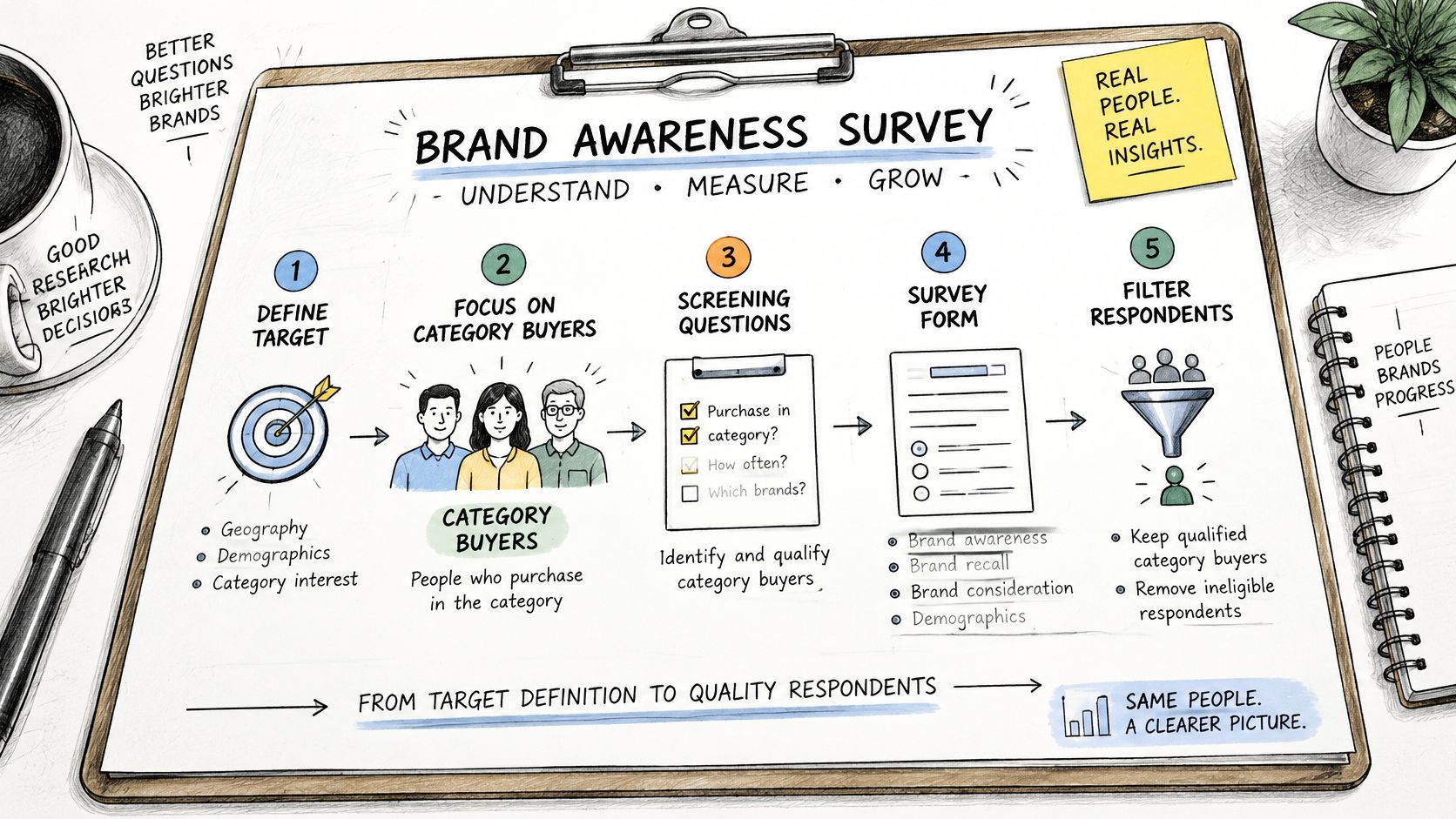
A survey brief should lock down the measurement procedure before fieldwork begins. Otherwise, a well-intentioned change to recruitment, wording, or presentation can make the next result difficult to compare with the baseline.
The sequence should protect spontaneous recall before introducing any brand cues.
-
Define the target audience. Specify category buyers, relevant markets, and the buying roles the study will represent. Recruiting only existing customers answers a customer-awareness question, not a market-awareness question.
-
Screen for eligibility without revealing the sponsor. Ask about category participation before introducing company names. The common slip is writing a screening question that effectively announces which brand the survey concerns.
-
Collect unaided recall first. Present an open category question with no names, logos, examples, or branded interface elements. Record all brands named and preserve their order so the analyst can distinguish first mention from any mention.
-
Introduce the aided list afterward. Randomize the presentation of the brand and its competitors, and consider plausible fictional brands as an overclaiming check. Recognition of a fictional name should trigger a predefined quality review, not an improvised decision after results arrive.
-
Give competitors equivalent treatment. Use the same recognition question, visual treatment, and response options for each real brand. A prominent logo for the sponsor alongside plain-text competitor names creates an avoidable comparison problem.
-
Freeze the tracking instrument. Preserve wording, scales, category framing, and list-design rules across waves. Even a small wording change deserves review because it may change how respondents interpret the question.
-
Record the fieldwork specification. Keep field dates, recruitment rules, weighting decisions, exclusions, and subgroup bases with the results. The reporting team shouldn't have to reconstruct those details after someone challenges a chart.
Approve the brief before recruitment #
The final check is whether another researcher could reproduce the procedure without asking the original author what was intended. Ambiguous instructions about category eligibility or acceptable brand-name variants leave too much discretion during analysis.
A finished survey brief should contain:
- Audience rules: Included markets, buyer eligibility, customer-status definitions, and exclusions.
- Question specification: Exact wording, order, response options, and randomization instructions.
- Coding rules: Treatment of misspellings, parent brands, product names, and ambiguous responses.
- Analysis plan: Headline metrics, competitor comparisons, subgroup reporting, and quality checks.
The brief should also name the owner who can approve changes. If fieldwork requires a deviation, that owner should document it before anyone interprets the result as a change in brand performance.
Sample Size and Reading Real Change Without Overclaiming #
A higher percentage invites the most tempting mistake in awareness reporting: reading it as proof of progress. Sampling uncertainty and measurement validity are different problems. A larger sample can narrow an interval without fixing an unrepresentative audience or a leading question.
Margin of error by completed sample size (95% confidence, worst-case proportion)
| Completed responses | Approximate margin of error |
|---|---|
| 100 | ±10 percentage points |
| 385 | ±5 percentage points |
These figures assume a simple random sample and the most variable case, a true proportion near 50%. Weighting, clustered panels and nonrandom recruitment all widen the interval, so read them as a floor on uncertainty rather than a guarantee of accuracy. A completed-response target only becomes meaningful alongside the recruitment method, expected variability and intended comparisons.
Zoho's guidance on brand awareness surveys covers the separation of recall and recognition within a defined survey audience. The analyst's second job is making the uncertainty and the limits of that audience visible in the same deliverable.
A single percentage should never travel alone.
Assess the change, not just each estimate #
For a simple random sample, the conventional calculation for a proportion's uncertainty uses the estimated proportion and the sample size. A comparison between independent waves has to absorb uncertainty in both estimates, which is why wave-on-wave differences so often disappoint.
Take a movement from 34% to 39%. That is a rise of five percentage points, but subtraction alone says nothing about reliability. With roughly 385 completes per wave, each estimate carries about ±5 points of sampling uncertainty, and the interval around the difference widens to roughly ±7 points. The observed gain sits inside the noise, so describing it as progress would overclaim what the design can support.
A useful reporting distinction:
- Observed movement: The percentage changed in the completed samples.
- Statistical evidence: The estimated difference is evaluated against sampling uncertainty.
- Practical importance: The size of the change matters enough to affect a decision.
- Causal evidence: The study can distinguish campaign effects from alternative explanations.
Those judgments aren't interchangeable. A precisely estimated movement may be too small to justify a budget change, while an important-looking movement may remain too uncertain to support one.
Subgroup results need their own bases and intervals. A market or age segment carved from the full sample doesn't inherit the precision of the overall estimate: 100 completes in a single segment puts you back in the ±10-point row, however clean the headline looks.
Check what the interval cannot fix #
A confidence interval accounts for sampling error and nothing else. Existing-customer recruitment, nonrepresentative panels, early brand prompts and respondents claiming recognition without meaningful familiarity are design and quality problems that more completions cannot repair.
For global reporting, inspect results by market, language, age and customer status before producing an aggregate. If the composition shifts between waves, apply an explicitly defined weighting approach rather than reading the raw average as brand growth.
Podcast exposure adds a further comparison problem. Listeners who choose a relevant show may already know more about the category than nonlisteners, so a matched exposed-versus-unexposed comparison should be labeled association unless randomization or a credible quasi-experiment supports causal lift.
The exposure log and the survey must cover compatible dates. A media coverage report should preserve the relevant passages and publication timing alongside the survey findings, without presenting coverage volume as evidence of memory.
An aided-only increase warrants investigation. It may reflect emerging recognition, though it cannot establish stronger spontaneous recall on its own.
A rising estimate identifies a possible change. An exposure log identifies passages worth investigating. Only an appropriate study design can support a claim about what caused the change.
Tracking Brand Mentions Inside Podcast Episodes #
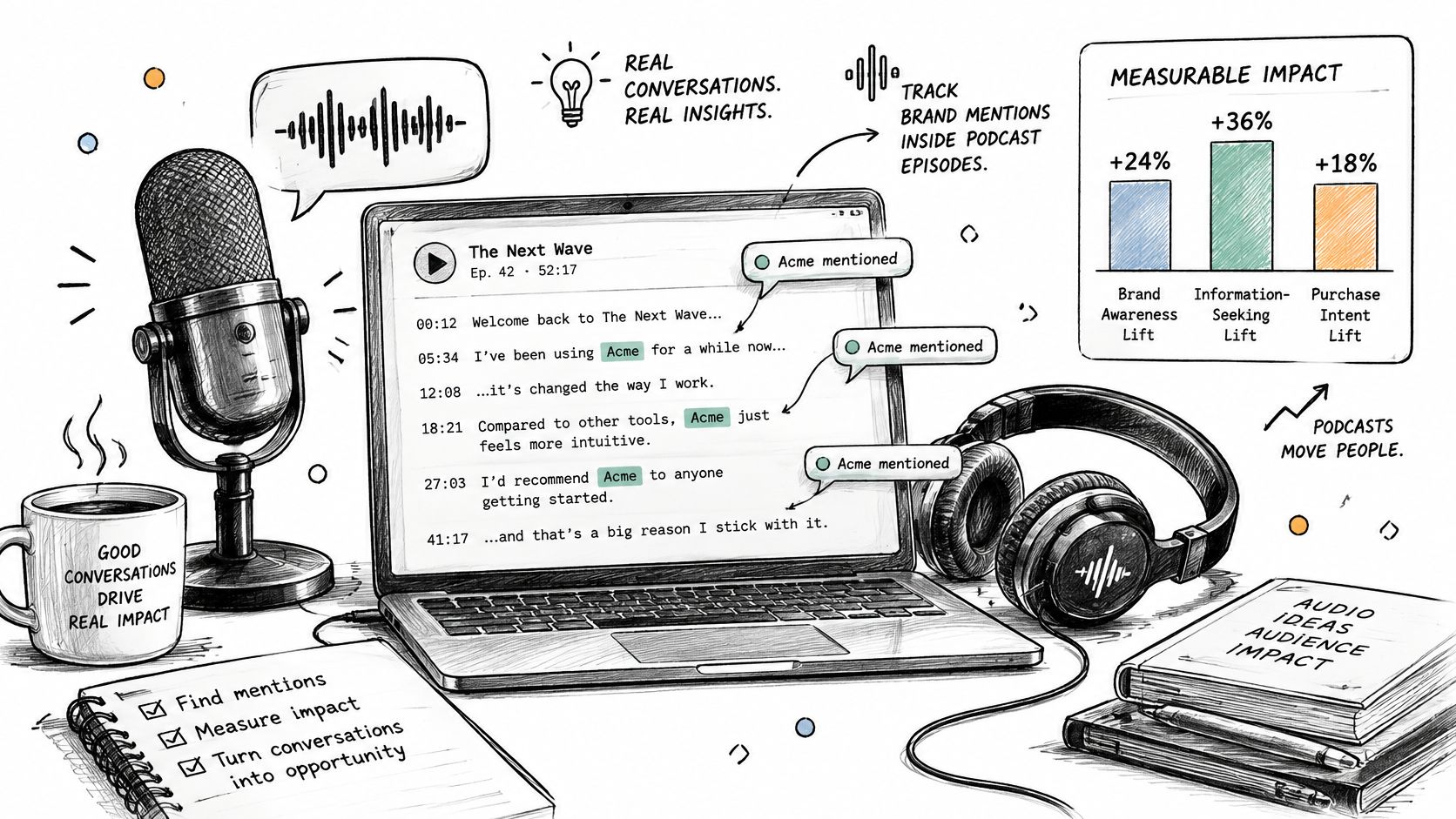
Podcast campaigns generated an average 10-point lift in brand awareness, alongside an 8-point lift in information-seeking behavior and a 6-point lift in purchase intent, according to Nielsen findings reported by Radio Ink. Those campaign averages provide a reason to measure outcomes, not permission to assign the same effect to every detected mention.
A mention can be a passing reference, a mispronounced name, a criticism, or a detailed recommendation. Treating those exposures as equivalent removes the context needed to investigate why listeners might remember one and overlook another.
Exposure factors to log for each podcast mention
| Exposure factor | What to record | Why it matters |
|---|---|---|
| Speaker role | Host, guest, or sponsor ad read, with paid status recorded separately | Speaker identity alone doesn't establish whether a mention is editorial or sponsored |
| Episode position | Timestamp and opening, middle, or closing placement | Locates the passage within the listening experience |
| Mention context | Recommendation, comparison, criticism, or passing reference | Separates materially different forms of discussion |
| Brand prominence | Brief naming or sustained discussion | Allows analysts to test whether depth relates to recall |
| Offer code or link | The promotion or destination stated | Connects the passage to a trackable response without equating response with awareness |
| Frequency | Relevant episodes and repeated mentions across the study window | Supports analysis of repeated exposure and persistence |
Build an auditable exposure record #
Podzone ingests podcast feeds, transcribes what is said, and alerts customers when their company, competitor, or topic is mentioned. Timestamped passages let analysts review the surrounding discussion rather than relying on a keyword match alone.
The workflow should move from detection to verification to classification. A shared log should retain the show, episode, publication date, excerpt, timestamp, and exposure tags, with paid sponsorship separated from editorial and guest discussion.
Podcast monitoring complements social listening tools, but each channel needs evidence appropriate to its format. A transcript identifies what was said; it doesn't identify everyone who heard it.
For a hypothetical example, a guest recommends a competitor midway through an episode. The analyst records the recommendation and checks surrounding episodes for repeated discussion, then compares subsequent recall among relevant listeners and a carefully matched comparison group.
Evidence boundary: A published passage establishes an opportunity for exposure. Confirmed listening, remembered exposure, and changed awareness are separate measurement questions.
Baseline, post-exposure, and delayed measurement can help distinguish immediate recognition from persistent memory. The study should also examine downstream information-seeking or consideration without assuming awareness guarantees either.
Set Your First Brand Awareness Baseline This Month #
A useful baseline is a documented starting point, not a retrospective attempt to prove a campaign worked. The measurement lead should approve the audience, instrument, analysis rules, and exposure-recording process before interpreting any movement.
The initial plan should be achievable without sacrificing the details needed for a defensible follow-up.
-
Select the reporting hierarchy. Make unaided awareness, aided awareness, and top-of-mind awareness the primary measures. Keep total awareness secondary so a broad recognition measure doesn't obscure differences in spontaneous retrieval.
-
Write the audience and competitor specification. Define category buyers and the markets the report will represent before drafting questions. Resolve parent-brand and product-name treatment at this stage rather than during response coding.
-
Commission the baseline wave. Choose a completed-sample target based on the precision needed for the overall result and the segments that will influence decisions. Require the fieldwork partner to explain how recruitment and weighting affect the proposed uncertainty estimates.
-
Publish a baseline record. Attach field dates, sample definition, subgroup sizes, intervals, and the approved questionnaire to the results. Preserve a versioned copy so later analysts can identify genuine methodological changes.
-
Start the exposure log immediately. Configure keyword monitoring for the brand, competitors, and relevant spokespeople. Assign an owner to verify matches and classify the context before the log becomes a collection of unreviewed notifications.
-
Schedule the follow-up around the decision. Choose timing that captures the campaign's relevant exposure window and allows a later persistence check. Keep the instrument consistent and record other activity that could plausibly explain a change.
Prepare a review that separates findings from unknowns #
The next review should include the baseline table, the exposure log, and a short list of unanswered questions. That list might cover whether respondents heard the relevant episodes, whether recognition persists, and whether any observed difference can be attributed to the campaign.
The recommendation should match the strength of the evidence. Sometimes the defensible decision is to continue measurement rather than announce a lift.
Podzone offers podcast mention alerts, search, and transcripts that help teams build a timestamped exposure log alongside brand awareness surveys. Teams can visit Podzone to set up monitoring for brand names, competitors, and spokespeople, then review the exact passages behind each relevant mention.
- brand awareness metrics
- measure brand awareness
- brand awareness survey
- unaided awareness
- podcast brand mentions