8 Market Intelligence Software Tools Compared for 2026
Compare 8 market intelligence software tools by data sources, podcast and media monitoring, analysis, and workflow integrations, with honest limits for each.
The most repeated advice about market intelligence software is to buy the platform with the largest source count, the busiest AI layer and the longest connector list. That advice collapses on contact with real questions. The tools below don't see the same evidence, so the platform with the most sources can still be blind to the one thing you needed to know.
A stack can cover news, web traffic, competitor pricing pages and broker research, then miss what buyers, sponsors and guests say out loud in podcasts. A founder explains on a show why they switched vendors. A media buyer names the rate they'll pay. A host recommends a rival product to an audience made up of exactly the people you sell to. None of that has a crawlable page.
The eight tools here are grouped by the data each one sees, and every entry states the blind spot that comes with it. Spend the evaluation on the blind spot, not the feature grid. The category isn't new. Gartner put worldwide business intelligence and analytics software revenue at $14.4 billion in 2013, up 8% from 2012, with SAP holding 21.3% of a market built on dashboards and licensed data rather than transcripts.
Podzone is one of the eight, described with the same limits as the rest. Start from the source your question depends on and choose by which blind spot you can live with.
Table of Contents #
- 1. Podzone
- 2. Contify
- 3. AlphaSense
- 4. Brandwatch Consumer Intelligence
- 5. Klue
- 6. Crayon
- 7. Similarweb
- 8. Mintel
- How the eight tools differ by data source, monitoring, integrations, and pricing model
- Matching Market Intelligence Software to the Data You Need
1. Podzone #
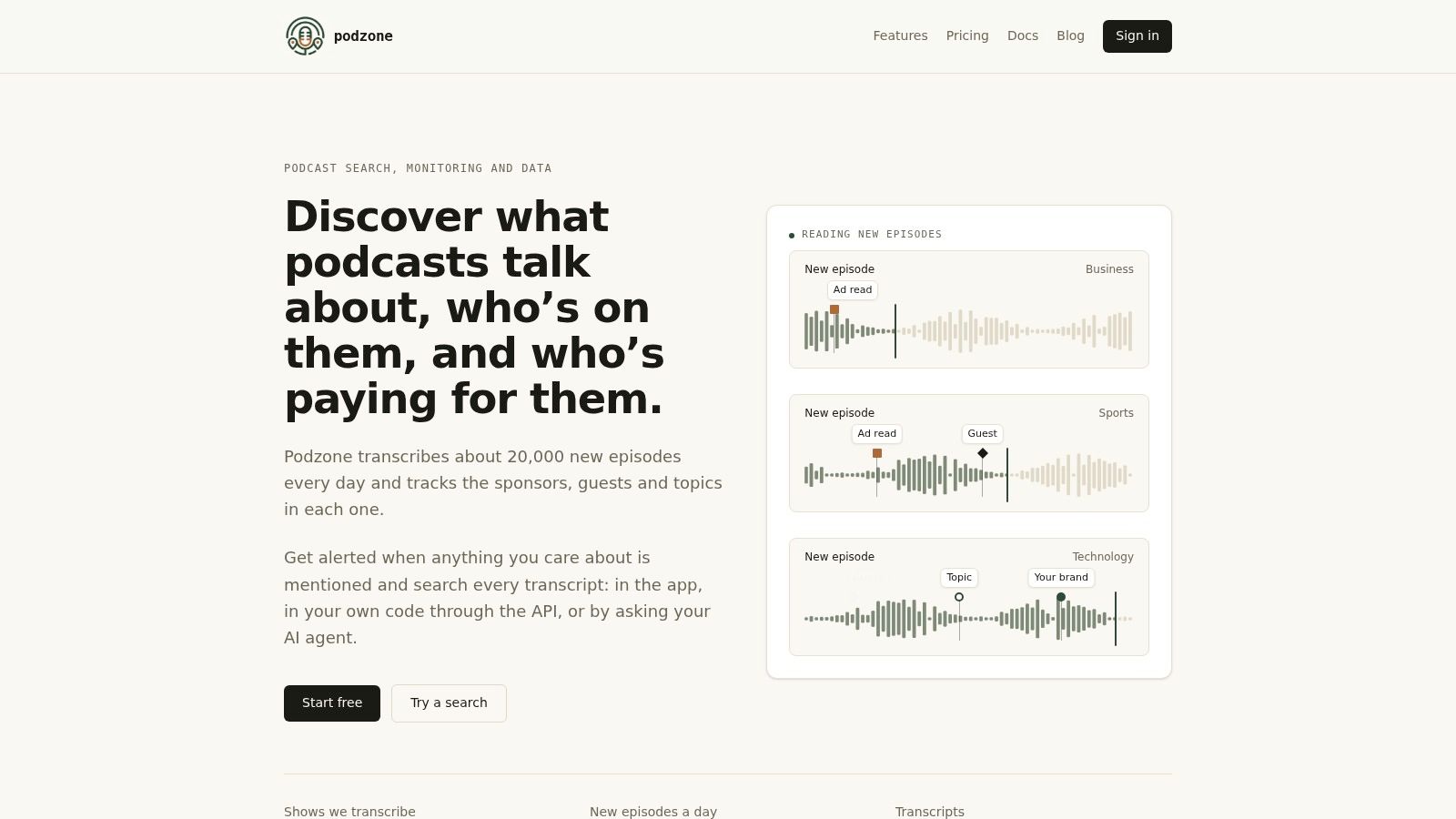
Podzone is the only tool in this comparison whose primary input is spoken audio. It ingests publicly published podcast feeds, transcribes the episodes and indexes the text, so a question about what a rival's customer said on a show returns a passage with a link to that moment rather than an episode you have to sit through.
What the transcripts let you do #
Keyword rules track a brand, a person or a competitor, and each match returns a quote, the show and episode details, and a timestamp. Notifications arrive by email or as signed webhooks sent to your own endpoint, typically within minutes of a matching episode being processed. The same search, transcript, sponsor and people data is exposed through the API, or to an AI assistant through the MCP server that supports Claude, Cursor and VS Code. Of the MCP tools, only create_alert and update_alert change anything; the rest are read only, so a connected assistant can query the data without altering it.
The website reports tracking more than four million podcast feeds and ingesting about 30,000 new episodes a day. Sponsor tracking follows a brand across every show it buys ads on, recording ad reads, offer codes and the first and last time it was heard. A sponsor named in the show notes is counted even when no ad read mentions it, and is marked as named in the show notes only. That distinction matters, because it keeps a heard read separate from a listing. Together this answers an advertising question that no traffic or keyword tool can reach.
Where it stops #
Two limits define the blind spot.
Public feeds only. Video-only shows, live radio, private calls and paywalled audio never enter the index, so a mention inside any of them is invisible.
No written sources. A competitor's pricing page change, a Reddit thread, a trade-press article and a broker note all sit outside it. Teams that need those need a second tool.
Two further constraints shape who the service fits. A transcript excerpt is evidence only once someone checks it against the audio before it reaches a client deck. And the data cannot be used to train machine learning models without a separate written licence, though agencies may include results in client deliverables as long as clients never get direct access to the service itself.
The traceability point: 32% of organizations in the 2025 ISG Market Lens Data and AI Program Study identified data quality, accuracy and consistency as a major AI challenge. A summary that can't be traced back to a moment in a recording is exactly the failure that number describes.
Every plan, including the free one, carries alerts, search, transcripts, sponsors, people, topics and API access. Paid tiers raise the request ceilings, with Starter at 10,000 API requests a month and Pro at 90,000, and full pricing is listed on the Podzone site.
2. Contify #
Contify watches the written web. Company sites, industry and regulatory publications, news, social posts and other sources feed a curated stream that the platform sorts into feeds, alerts, newsletters and dashboards. Athena, its assistant, answers questions against that curated collection rather than the open web, which matters when a finding has to survive an executive's follow-up question.
Broad monitoring platforms such as this one compete in a category with a long history behind it. Gartner forecast worldwide business intelligence and analytics software revenue at $18.3 billion in 2017, 7.3% growth on 2016, and projected $22.8 billion by the end of 2020, after the modern BI segment grew 63.6% in 2015 and was expected to decelerate to 19% by 2020. Rapid adoption followed by moderation is the pattern that pushes buyers toward usability, integration and governance instead of raw source counts.
The blind spot that comes with text #
Anything without a published transcript is out of reach. A podcast interview, a conference call or a webinar stays invisible until somebody writes it up, and even a published transcript arrives without a link to the audio moment.
Configuration decides whether the tool earns its price. Custom sources and taxonomies are what make cross-functional monitoring useful, and they're also what needs tuning before the feeds stop returning noise. Budget a few weeks of setup before the first clean briefing.
Distribution is the stronger half of the product. Newsletters, alerts and dashboards reach people who never log into the platform, which is usually the difference between an intelligence program that gets read and one that doesn't.
Pricing is quote-based and not published, so run the comparison against a defined monitoring scope rather than a seat count.
3. AlphaSense #
AlphaSense answers a different question: what has already been written, filed or said on the record. It searches licensed and proprietary business content, including company documents, regulatory filings, broker research, news and expert-call transcripts, and it's the tool finance, strategy and consulting teams reach for when a claim needs a citation attached to it.
The economics of that model show up in market estimates. Dataintelo valued the global market-intelligence platform market at USD 8.6 billion in 2025, with software at USD 5.36 billion, or 62.4% of total revenue. The share that isn't software is the part that pays for content, data and analyst time, which is roughly what a licensed research subscription is.
Where it falls short #
AlphaSense reads documents. It won't tell you that a competitor rewrote its pricing page this morning, and it won't surface the podcast where a customer explains why they left. Social conversation and web traffic sit outside its remit, so a communications team tracking sentiment finds the library deep and the coverage narrow.
Cost is the second constraint. Subscriptions are quoted, content access and integrations depend on the plan, and a team that only needs light competitor monitoring ends up paying for a research library it rarely opens.
The integrations that matter for research workflows, the PowerPoint and Excel add-ins, are present. API and MCP availability varies by tier, so confirm it in writing if your analysts work inside another system.
Reports and filings tell you what a company said it would do. They rarely tell you what its customers say when nobody from the company is in the room.
4. Brandwatch Consumer Intelligence #
Say a pricing change starts drawing complaints in public. Brandwatch is built for that moment. It searches and analyzes conversations across social networks and other sources, runs queries on brands, products, topics and competitors, and uses AI-supported tools to surface trends and patterns. Selected text data, such as call logs or survey responses, can be uploaded to sit alongside the social data.
Growth in this segment is real but unevenly distributed by buyer size. One assessment values the competitive-intelligence tools market at USD 0.59 billion in 2025 and USD 1.46 billion by 2030, a 19.96% CAGR, with large enterprises accounting for 63.18% of 2024 market value and SMEs as the faster-growing segment at a projected 21.53% CAGR through 2030. Enterprise requirements centre on governance, scale and defensible evidence; the SME end rewards setup speed and transparent pricing. Brandwatch sits on the enterprise side of that split.
What it cannot see #
Audio evidence. There's no podcast transcript search and no timestamped link to a moment in a recording, so the interview where a spokesperson contradicts the official line stays out of the dashboard.
Uniform platform access. Availability of social data depends on the source and the access arrangement in place, so coverage isn't identical across networks.
Pricing isn't published on the product pages, which slows budget work. Teams weighing the wider listening category can use this breakdown of social listening tools to see where source coverage diverges between platforms.
5. Klue #
Klue's user is a seller mid-deal, not an analyst building a market map. It tracks competitor websites, pricing, product changes, news and reviews, turns what it learns into dynamic battlecards and competitor profiles, and pushes them into Slack, Teams and Salesforce. A win-loss suite adds buyer interviews and deal notes to the same picture.
Category size is a useful reality check. Spherical Insights & Consulting estimated the global competitive-intelligence tools market at USD 482.36 million in 2024 and projected USD 1.8543 billion by 2035. Measured that way the segment is a fraction of the analytics market, and it's defined by competitor-facing signals rather than general market data.
The blind spot is breadth #
Anything outside competitive positioning is out of scope. Regulatory shifts, category trends, consumer research and share-of-voice analysis need a different platform, and a podcast episode where a prospect names the rival they chose never enters the feed.
Content decays. Battlecards are current only while someone owns them, so the return tracks the team and process behind the licence more than the software itself.
Pricing isn't listed publicly and evaluation typically starts with a demo. Teams comparing it against rival enablement platforms can see how the field divides in this guide to competitive intelligence tools.
6. Crayon #
Crayon starts from the same public competitor signals and pushes into production. It collects product launches, messaging and positioning changes, folds in internal sources such as sales calls and win-loss notes, then generates battlecards, sales emails and competitor analysis for go-to-market teams.
Deployment expectations have shifted under platforms like this one. One assessment estimates that cloud-based deployment represented 67.8% of competitive-intelligence tool revenue in 2025 and expects it to grow at an 11.5% CAGR through 2034. That pushes evaluation toward connector coverage, webhook reliability, authentication controls, export completeness and processing latency rather than the number of sources indexed.
Where the evidence thins #
Generated analysis is a draft. AI-written battlecards and competitive summaries need review before anyone repeats them to a buyer as fact. A wrong claim in a sales email costs more than a slow one.
Public sources dominate. Broad consumer or industry research sits outside the collection scope, and so does anything spoken aloud on a podcast.
Practical rule: treat every AI-generated battlecard claim as unverified until it links back to the page, filing or call it came from.
Governance belongs in the evaluation. Retention policies, audit logs, tenant isolation and encryption matter more once intelligence is piped into a CRM and a chat tool, and buyers operating across several markets should ask for documented controls in writing.
Pricing isn't published. The vendor quotes on request, which makes a scoped trial the only honest way to compare it with Klue.
7. Similarweb #
Similarweb answers questions about digital presence. It benchmarks website traffic and digital market share, breaks out audience, referral sources and channels, and supports competitor and keyword analysis. A limited free version exists alongside the paid packages, which makes the entry tier easy to inspect before a sales call.
The use case is narrow and useful. Where do a competitor's visitors come from, which channels carry them, and how do two sites compare on the same measure.
What the numbers are and aren't #
Traffic figures are modelled estimates, not a competitor's verified internal analytics. They're directionally sound for spotting a channel shift and unsuitable as a number in a board deck without a caveat attached.
No offline view. Events, retail distribution, hiring and pricing decisions don't appear.
No audio or conversation. A podcast mention that drives traffic to a landing page shows up as a referral bump at best, with no way to read what was said or who said it.
Tiering changes the answer. Higher packages cost substantially more than the entry plan, and the depth of channel and audience data tends to follow the tier you buy.
A traffic tool is the right first purchase for a team whose question is about acquisition and the wrong one for a team whose question is about reputation.
8. Mintel #
Mintel sells conclusions rather than feeds. It publishes market research on industries, categories and consumer behaviour, covering consumer trends, product innovation and competitors, with premium platform access for deeper category work. Strategy, proposition development and new-product planning are the jobs it's built for.
Reports aren't monitoring #
A report tells you what the category looked like when it was written. It won't tell you that a rival cut prices this week, that a host recommended a competing product last night, or that sentiment turned in a forum thread this morning. Teams needing continuous alerting need a monitoring tool alongside it.
Coverage varies by category and geography, and depth follows the subscription, so a thinly researched category stays thin regardless of budget. Pricing is customised, which means the scope of the reports you need drives the quote.
Where it earns its place. Category sizing, consumer attitude shifts and innovation scanning are hard to assemble from alerts alone. Researched context is what lets a team interpret a spike instead of just reporting it.
For a consumer-facing brand team, the pairing that works is a monitoring tool for the signal and a research subscription for the context. One tells you something moved. The other tells you whether it matters.
How the eight tools differ by data source, monitoring, integrations, and pricing model #
Read the first column as a boundary. Each row monitors only the source it can ingest, so the pricing model matters less than whether a missing channel would change the decision.
| Item | Primary data source | Alerts and monitoring | Workflow integrations | Pricing model |
|---|---|---|---|---|
| Podzone | Transcripts of publicly published podcast episodes, searchable and linked to timestamps | Keyword alerts with transcript context and timestamped links; signed webhooks push matches to external endpoints | API, signed webhooks, MCP server for AI assistants | Free plan and paid plans available |
| Contify | Company, industry, regulatory, news, social, and web sources | Feeds, alerts, newsletters, and dashboards | Newsletters, dashboards, custom sources; integrations may require configuration | Quote-based; not publicly listed |
| AlphaSense | Licensed and proprietary business documents, filings, research, news, and expert transcripts | Company, market, and industry alerts and monitoring | PowerPoint and Excel add-ins; API and MCP vary by plan | Sales-led subscription; pricing not public |
| Brandwatch Consumer Intelligence | Social networks and other online conversation sources | Social listening and analysis of brands, products, topics, and competitors | Upload selected text data, such as call logs or surveys | Not publicly listed |
| Klue | Competitor websites, pricing, product changes, news, and reviews | Competitor activity tracking and profiles | Slack, Teams, Salesforce, and sales battlecards | Demo-led; pricing not public |
| Crayon | Public competitor signals and selected internal sales sources | Monitors product launches, messaging, and positioning changes | Sales and marketing distribution; battlecards and sales content | Contact vendor; pricing not published |
| Similarweb | Website traffic, audiences, referrals, and digital channels | Competitor, traffic, and keyword analysis | Digital marketing and strategy workflows | Limited free version and paid packages |
| Mintel | Market research reports on consumers, categories, products, and trends | Research reports rather than real-time mention monitoring | Supports strategy, proposition development, and product planning | Typically customized |
The columns separate capture from delivery: source limits what can be seen, alerts decide speed, integrations decide where evidence lands, and pricing decides how predictable access is. Strong alerting still fails when the evidence lives outside the tool's source.
Matching Market Intelligence Software to the Data You Need #
Start with the source, not the brand. Write the question down, then name the evidence that would answer it. Five buckets cover the eight tools here.
- Spoken audio. Podcast episodes, ad reads, host and guest commentary. One tool covers it, and no other option in this list reads it at all.
- Written news and social conversation. Contify and Brandwatch, split by whether the need is cross-functional monitoring or consumer listening at scale.
- Sales-facing competitor signals. Klue and Crayon, split by whether the team needs maintained battlecards or generated content.
- Web traffic. Similarweb, for acquisition and digital presence questions.
- Licensed research. AlphaSense and Mintel, split by document depth versus category research.
Then test the shortlist against the live source. Run the same live question through two tools with your own topics and a deliverable your team produces, and count the manual steps left over. That test exposes more than any feature matrix.
Governance deserves a place in the same conversation. Procurement research on AI-enabled intelligence identifies fragmented data systems, poor data quality, change management, ethical oversight, regulation, security and vendor selection as practical barriers, and warns that unverified or outdated data can generate misleading alerts, as this analysis of AI agent market intelligence sets out. Faster alerting isn't automatically better if it amplifies unchecked claims or moves sensitive material into a pipeline nobody can audit.
Usage terms matter before anyone shares a finding externally. Agencies may use Podzone on a client's behalf and include results in deliverables, provided the client doesn't get direct access to the service. Transcripts, search results and catalogue data can't be resold or redistributed in bulk to anyone outside the organisation, and training a model on that data needs a separate written licence. For teams comparing running costs, the Starter plan includes complete sponsorship data, 10,000 API requests a month and up to 60 requests a minute.
Put these questions to every vendor on the shortlist.
- Which sources are crawled first-party, and which are licensed? The answer decides how fast a change appears and who is accountable when it's wrong.
- What does a match look like when it arrives? A quote with a timestamp is shareable. A summary without one is a claim you have to defend alone.
- How is it delivered, and how fast? Email digests, signed webhooks, API pull and chat integrations suit different workflows.
- Who can see the data, and how long is it kept? Role-based access, retention policy, audit logs and deletion rules belong in the contract.
- What breaks first? Ask for connector limits, request ceilings and the escalation path when an integration fails mid-quarter.
Teams often end up with two tools, not one. The budget decision is which source you refuse to be blind to.
Podzone searches timed transcripts across more than four million podcast feeds, sends keyword alerts with a quote and a link to the exact moment, and tracks which brands sponsor which shows. If part of your intelligence question lives in audio that nothing else in this list can read, start with a search on the shows your buyers and competitors appear on. Visit Podzone to see how the alerts, sponsor data and API fit the workflow your team already runs.
- market intelligence software
- competitive intelligence tools
- podcast monitoring
- media monitoring software
- competitor analysis tools