10 Competitive Intelligence Tools Compared for 2026
Compare 10 competitive intelligence tools on monitoring, research, and analysis. Honest limits, real use cases, and who each suits in 2026.
Most buying guides still tell teams to pick one competitive intelligence platform and roll it out company-wide. That advice is how programs stall. The software is rarely the first failure. The failure is buying a battlecard system when the job is traffic benchmarking, or buying a social feed when sellers needed a card they would open.
The mismatch is old. Competitive intelligence became a formal discipline during the 1980s, after business intelligence entered management discussions in the 1960s, and the Society of Competitive Intelligence Professionals was founded in 1986. A 1988 study in that historical account found the practice had become more widely known over the previous three years, yet systems stayed underdeveloped. A survey of 308 firms in the same account reported that price was the most sought competitive information, sellers were considered the best source, and only 3% of companies had fully developed CI systems.
Modern competitive intelligence tools still split along those jobs, not along a single score. One cluster builds battlecards and pushes them into the CRM. Another estimates digital traffic, keywords, and share of search. A third watches media, social posts, and podcasts, or searches filings when the decision is strategic rather than a live deal.
The list below is a decision map, not a leaderboard. Each entry names the job it fits, the condition under which it earns its cost, and the piece it does not cover. Start with the workflow that is already breaking, then ignore every feature that serves a different team.
Table of Contents #
- 1. Podzone
- 2. Crayon
- 3. Klue
- 4. Kompyte
- 5. Contify
- 6. AlphaSense
- 7. Similarweb
- 8. Semrush
- 9. Brandwatch
- 10. Meltwater
- How the 10 competitive intelligence tools differ on focus, fit, and trial access
- Matching Your Competitive Intelligence Stack to the Job at Hand
1. Podzone #
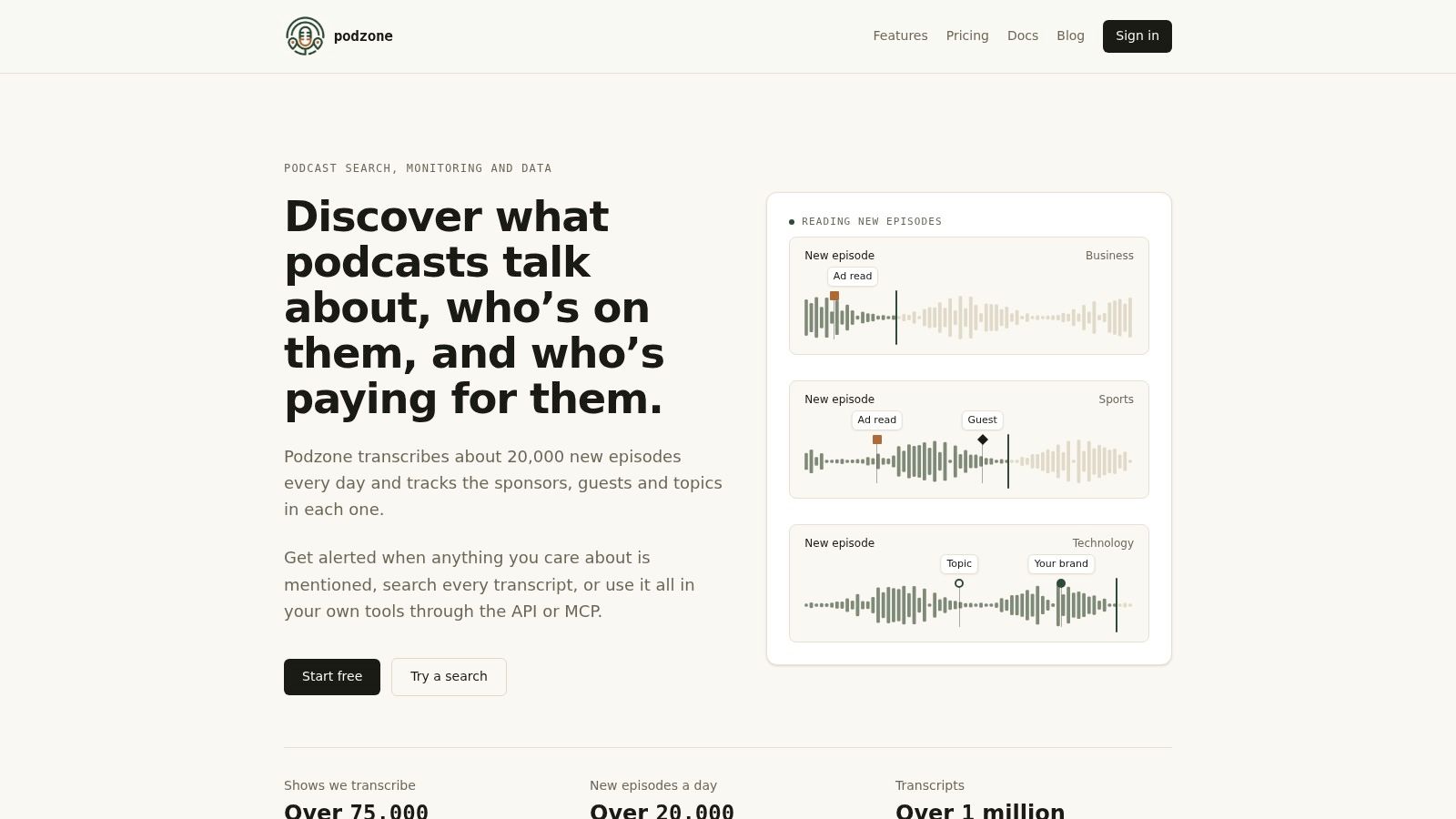
Podcast audio is where rivals get recommended, sponsors get named, and executives speak without a press release. Podzone turns that audio into searchable text with timestamps, so a brand or competitor mention can be checked in the passage itself rather than a vague summary.
The monitoring job is keyword alerts. Teams set rules for a company, person, or rival and get the matching episode with a linked timestamp. Signed webhooks push each alert match to an endpoint the team already uses, and an optional AI check can filter mentions before they land in that queue. Full-text search covers transcribed episodes, and transcripts can be read or downloaded.
What a find has to include #
A hit is not a client-ready citation.
- Passage and time: Excerpt, timestamp, show, and episode, so an executive can audit the line.
- Sponsors: Which brands buy which shows, including ad reads, offer codes, and names that appear only in show notes.
- People and topics: Hosts, guests, first and last seen dates, and rising topics that can be narrowed to a category such as technology or business.
- Access: Web app, REST API, and an MCP server for Claude, Cursor, or VS Code. The server exposes 38 tools. Only alert create and update change data, no tool deletes anything, and each call runs under the customer's API key, so the assistant sees only what that key allows.
Every plan, including the free plan, includes alerts, search, transcripts, sponsors, people, topics, and the API. Calls for most sponsor routes, guest trends, and topic trends are premium and draw on the plan's premium requests. Coverage targets are more than four million feeds and about 30,000 new episodes a day, stated as targets rather than commitments. The boundary is just as clear: this is audio monitoring, so anyone needing traffic benchmarks or CRM battlecards needs a different tool for that job.
Practical rule: Treat a podcast alert as unfinished until someone opens the timestamped passage. A 2025 life-sciences CI survey found that 53% of respondents were concerned about AI quality and hallucinations.
Agencies may include results in client deliverables if those clients do not get direct access to the service. Bulk resale of transcripts or catalogue data outside the organization is not allowed.
2. Crayon #
Sales teams don't lose deals because nobody saw a pricing page. They lose them because the card in the CRM is three quarters old. Crayon is built for that enablement job. It tracks competitor websites, pricing, product updates, reviews, and news, then combines those public signals with sales conversations and win/loss research.
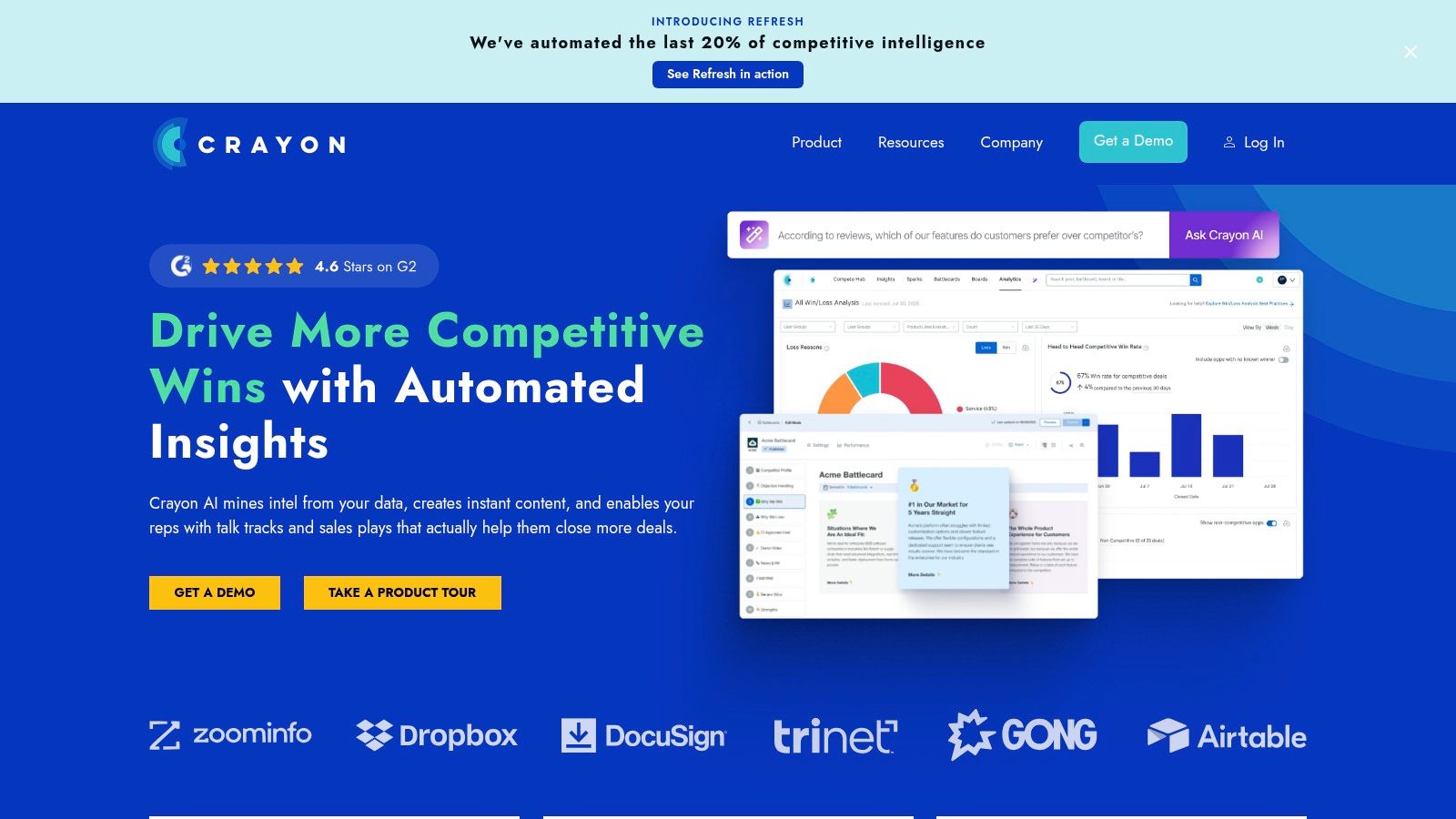
AI summarization is meant to rank what changed. The output is battlecards and guidance for sales and marketing, delivered through Salesforce, Slack, Microsoft Teams, Highspot, and Seismic. Crayon's 2024 State of Competitive Intelligence reporting names two leading challenges for CI leaders: keeping content such as battlecards fresh, and gathering intelligence in a timely way. The same reporting says 60% of respondents share CI updates through Slack or Microsoft Teams, a 13-percentage-point increase from the prior year.
That distribution stat is the buying test. A central library helps only if someone owns the refresh and sellers already live in those channels. Reviewers often praise ease of use, support, and integrations, and they also cite irrelevant alerts plus limits on battlecard editing. For a team that only needs a news clip, the sales-enablement layer is more product than the job requires.
3. Klue #
Say a rep hears a rival's name on a discovery call and has nine minutes before the next meeting. The useful artifact is one current card, not a dashboard of every website change. Klue connects public monitoring, including websites, pricing, and product changes, with win/loss analysis and cards that land where sellers work. AI-supported answers are aimed at competitive questions during those conversations.
The volume behind that job is large. Crayon's 2024 State of Competitive Intelligence survey, based on more than 700 CI, product-marketing, and sales-enablement leaders, found that 78% of CI professionals provide sales teams with battlecards, while 59% maintain at least 10.
A stack of ten cards that nobody updates is a filing cabinet, not enablement.
Review commentary tends to highlight centralized intelligence, battlecards, and support. The trade-off is participation. Win/loss workflows stay useful only if deals get coded and product marketing keeps editing. Klue is a poor substitute for web-analytics benchmarking or a broad media desk. Buy it when competitive deals are frequent and a named owner will keep the cards tied to outcomes.
4. Kompyte #
Breadth is the pitch, and breadth is also the risk.
- Sources: Kompyte watches competitor websites, media, blogs, reviews, job postings, app stores, and related public pages.
- Outputs: Alerts, AI summaries, reports, and battlecards, plus win/loss and battlecard-adoption reporting.
- Where it lands: Salesforce, HubSpot, Slack, Microsoft Teams, Highspot, and Showpad.
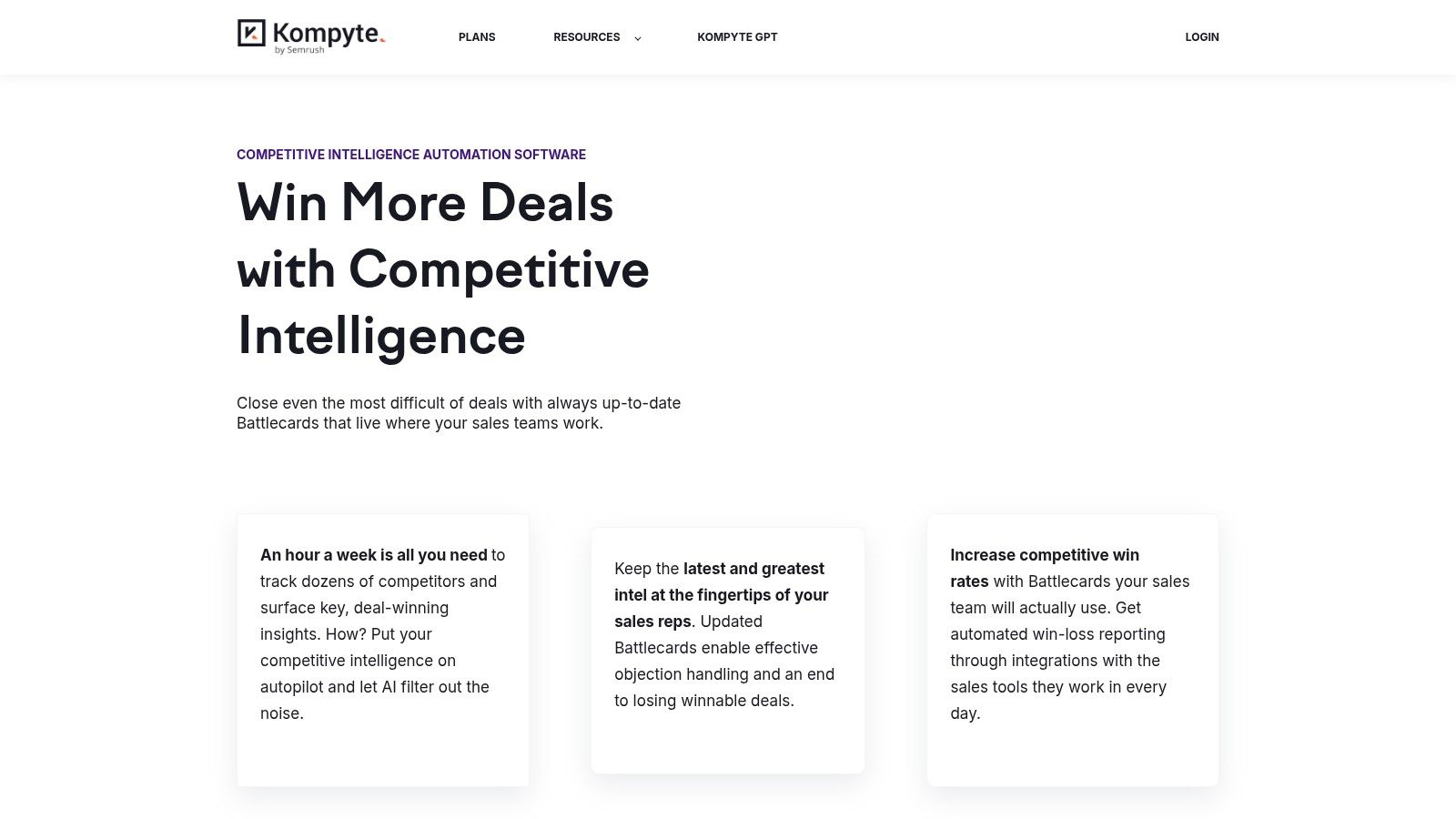
Plans include onboarding and a dedicated customer success manager, and published tiers make scope easier to compare than a blank enterprise quote. Pricing is still quote-based, and plans are annual by default. Shorter subscriptions may cost extra. That commercial shape fits a product-marketing team that already knows its rival set.
It fits poorly as a first experiment. Wide source lists produce noisy alerts until keyword rules, competitors, and page types are cut back. If nobody will spend the first weeks on that configuration, the adoption report will show cards that exist and sellers who never opened them.
5. Contify #
Contify is the broad-coverage option. The company says it monitors more than one million listed external sources and supports more than 117 languages, covering competitors, markets, industries, customers, and key accounts. Internal inputs such as sales-call and collaboration data can sit beside those external signals. AI summaries, answers, battlecards, and insight drafts feed dashboards, newsletters, and alerts, with integrations that include Slack, Teams, Salesforce, and HubSpot.
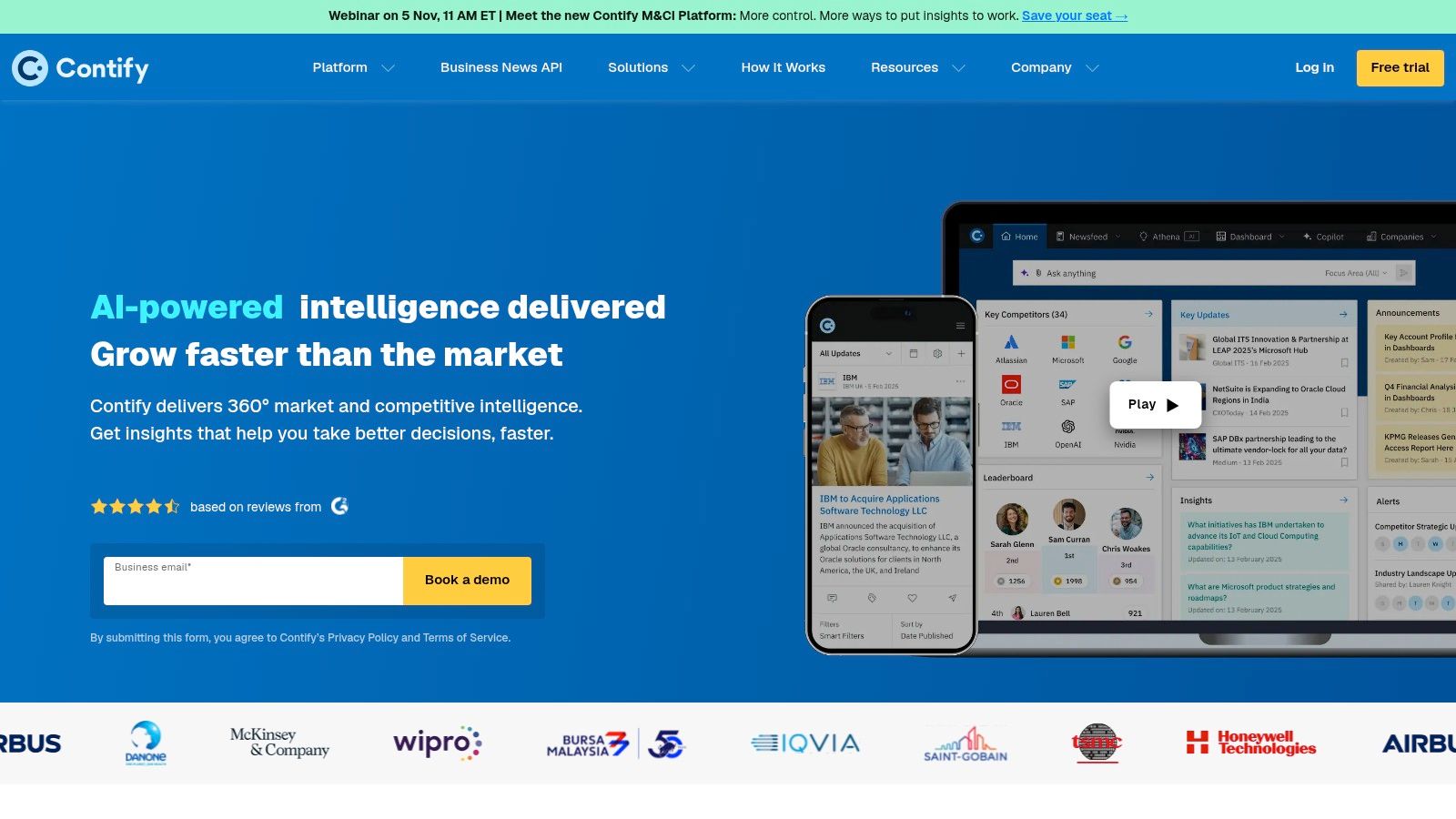
Strategy, product, marketing, and sales can each get a view built for their own needs, which is the point for a global program and the reason onboarding takes time. A 7-day free trial is advertised. Pricing is not laid out in public detail on the pages typically used for a first look, so a trial has to be scoped to a real question, such as one region and five rivals, or the feed will look complete and decide nothing.
This is not a lightweight alert inbox. Teams that only need English web changes will pay in configuration for coverage they will not read.
6. AlphaSense #
When the question is what a public company told investors, a battlecard vendor is the wrong desk. AlphaSense searches company documents, broker research, independent research, and related business content, with watchlists and alerts when those sources move. AI search and summarization sit on top of that library. PowerPoint and Excel add-ins matter for strategy, consulting, and finance teams who already build the deck in those files.
The commercial model is per-seat or a broader organizational subscription. Pricing is not published and starts with a sales conversation. That opacity is acceptable when one earnings transcript changes a recommendation. It is a poor fit for a communications manager who needs a same-day mention of a product name.
Depth here does not replace seller workflow, podcast timestamps, or traffic estimates. Use it for company, market, and investment research. Skip it if the weekly job is "tell me when the pricing page changes."
7. Similarweb #
Digital share is a different question from deal support. Similarweb estimates website traffic, engagement, audience, marketing channels, and search activity. Teams use it to see who the online rivals are, where visits come from, and which keywords or content gaps show up in the estimates. Paid search, audience behavior, and ecommerce views sit in the same family of analysis. Company plans add heavier data access, dashboards, and integrations.
A self-service package and a free trial make a first benchmark possible without an annual enablement contract. Some business and enterprise packages still need a custom quote, so the trial should use the exact domains and countries the team will defend later. Estimates are not server logs. Treat channel mix as a comparison, not as a finance number.
Similarweb will not store win/loss notes or push a talk track into a CRM. If leadership asks why a rival's site suddenly draws more demand, this is the job. If leadership asks what a seller should say on Thursday, it is not.
8. Semrush #
Search acquisition is narrower still, and that narrowness is useful. Semrush compares domains on keywords, backlinks, paid search, content, and visibility, with position tracking, site audits, and ranking reports. Higher plans raise limits and add Share of Voice. Current plan details list API access on the Business plan and MCP access for teams that want search data inside an assistant.
Subscriptions are self-service, so a content lead can run a one-off gap analysis or a recurring rank track without an enterprise security review. The limit shows up when the brief drifts. Semrush does not run win/loss research, sales battlecards, or a full newsroom monitor. API access and the larger data caps sit on the more expensive plans, which means a cheap seat can answer a keyword question and still block the integration a data team expected.
Pair it with a battlecard platform only after both owners agree who updates positioning when rankings move.
9. Brandwatch #
Consumer conversation is evidence of mood, not of a product roadmap. Brandwatch monitors social and online discussion, including competitor keywords, then segments those queries for benchmarking. Volume, sentiment, themes, and shifts can be compared across brands. AI-supported analysis is aimed at unstructured posts rather than at a pricing table.
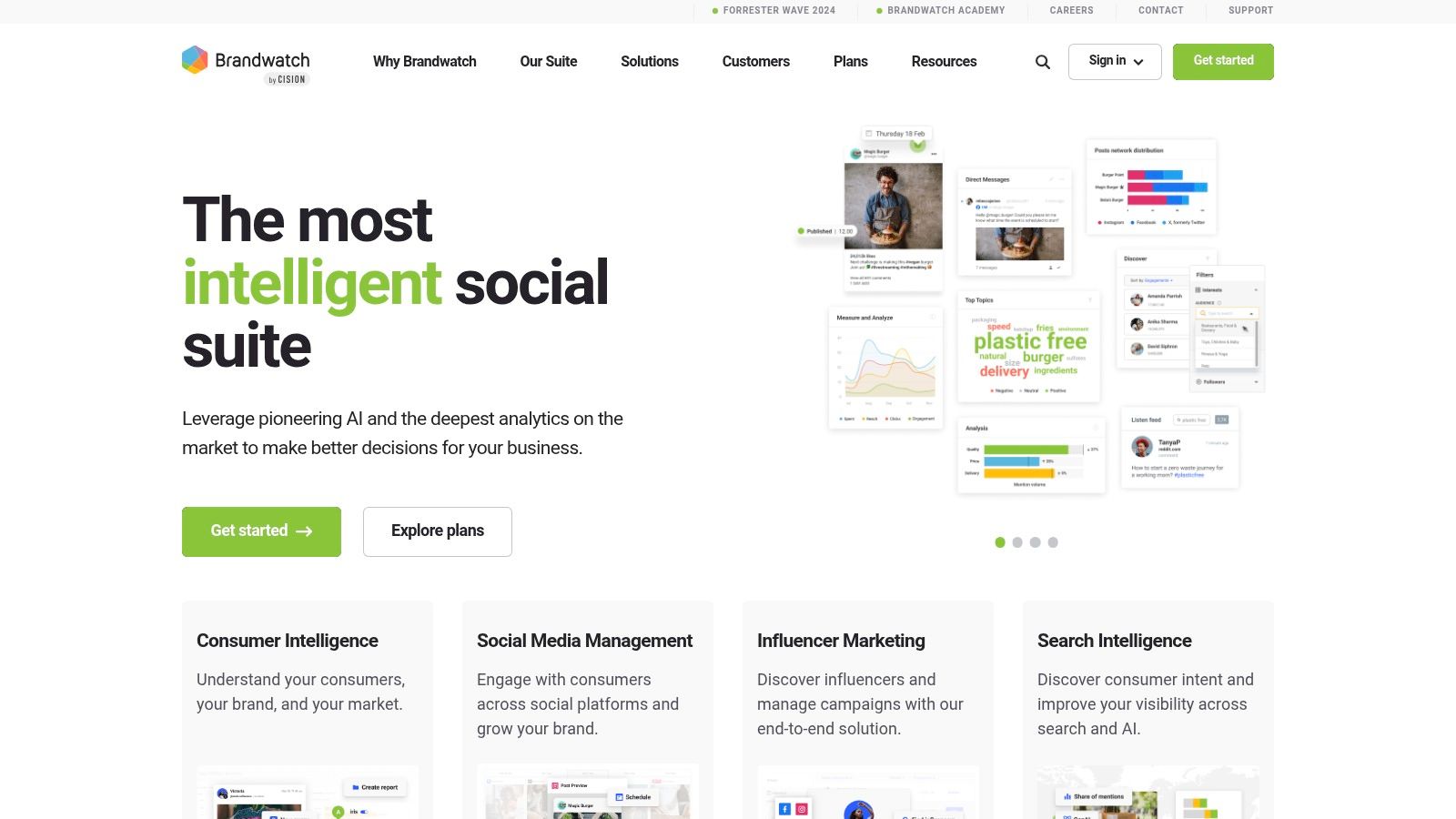
The company describes its social-data coverage as extensive, which helps a brand team explain a spike that mention counts alone would flatten. It does not show a rival's discount page, a lost deal reason, or a sponsor read. Teams comparing listening suites should also read a focused guide to social listening tools before treating one dashboard as the whole market.
Pricing is not posted publicly, so evaluation is sales-led. Go in with a query set, a language list, and a rule for what counts as a competitor mention. Without that, the theme chart will be busy and the weekly briefing will still be anecdotal.
10. Meltwater #
Communications teams usually need earned media in one place, not a seller card. Meltwater covers online news, social, print, broadcast, and podcasts, with alerts, dashboards, summaries, sentiment, and share of voice. Multilingual monitoring and tiered packages can combine media monitoring, social listening, and AI visibility tracking. Podcast mentions sit next to other coverage, which helps a share-of-voice report and hurts anyone who needs the spoken line at a precise moment.
Pricing is custom and depends on coverage, regions, data volume, users, and selected modules. That is normal for a broad desk and awkward for a pilot. A smaller team can start on a narrower tier. A global PR account will pay for markets it must report.
It is not a dedicated battlecard or win/loss system. For broadcast-heavy programs, compare scope against specialized broadcast monitoring services before assuming one contract includes every clip type the client will ask for.
How the 10 competitive intelligence tools differ on focus, fit, and trial access #
Read the table by job first: battlecards for sellers, digital benchmarks, public conversation monitoring, or deep research. The last column tells you whether a fast pilot is realistic or procurement starts the evaluation.
| Item | Primary focus | Best for | Free plan or trial |
|---|---|---|---|
| Podzone | Podcast monitoring, search, sponsors, people, and alerts | Podcast mentions, sponsor tracking, and PR research | Free plan available |
| Crayon | Competitive intelligence and sales enablement | B2B teams creating competitor battlecards | Sales-led pricing |
| Klue | Competitor monitoring, win/loss analysis, and sales support | Sales teams sharing current competitive insights | Sales-led pricing |
| Kompyte | Competitor monitoring, reporting, and battlecards | Product marketing and sales teams tracking competitor activity | Quote-based pricing |
| Contify | Market and competitive intelligence | Organizations monitoring competitors, industries, and markets | 7-day free trial |
| AlphaSense | AI-powered financial and professional research | Teams researching companies, markets, and sectors | Pricing starts with sales |
| Similarweb | Digital-market and website intelligence | Teams comparing traffic, audiences, and digital channels | Free trial available |
| Semrush | SEO and digital marketing research | Teams analyzing competitor search performance and keywords | Self-service plans |
| Brandwatch | Social and consumer intelligence | Teams analyzing brand conversations and sentiment | Quote-based pricing |
| Meltwater | Cross-media and social monitoring | Communications teams tracking coverage and share of voice | Quote-based pricing |
A free plan suits narrow monitoring jobs. A sales-led contract usually means the buyer must define scope, seats, sources, and markets before seeing real output.
Matching Your Competitive Intelligence Stack to the Job at Hand #
Shortlist by the broken workflow, not by a category badge. If sellers cannot answer a rival on a call, start with Crayon, Klue, or Kompyte and ignore traffic charts. If the argument is digital share, start with Similarweb or Semrush and do not buy win/loss software to decorate a keyword report. If the gap is what people say in public, split the work. Brandwatch and Meltwater cover social and broader earned media. A timestamped podcast workflow covers spoken mentions, sponsors, and guests. AlphaSense or Contify belong when the reader is a strategist working from filings, research, or a multi-market newsfile.
The staffing picture explains why one login fails. The 2020 State of Competitive Intelligence survey collected more than 1,000 responses and found that 57% of businesses had CI teams with at least two dedicated professionals, up from 37% two years earlier. The same survey reported that 90% of organizations believed their industries had become more competitive over the preceding three years. Competitive research was still the largest time draw.
How to run the trial #
Pick three real rivals and one live question for each job you claim to need. Run two weeks, not a demo.
- Noise: Count alerts a human marked useful versus alerts deleted. A high source count that fails this test is a cost.
- Definitions: Write down what "visit," "mention," "sentiment," and "battlecard used" mean in that product before you compare vendors.
- Freshness: Time the path from a known change, episode, or article to a message in Slack or the CRM.
- Owner: Name who edits cards, who checks excerpts, and who kills a feed that stays noisy.
A second tool is justified only when the first cannot produce the artifact the other team must defend. Stacking four logins on day one recreates the old problem: plenty of information, and no repeatable way to use it.
Podzone monitors podcasts for competitor names, brand mentions, sponsors, hosts, and guests, with timestamped transcripts, keyword alerts, and signed webhooks that drop matches into the workflow a CI or PR team already runs. That is the spoken-media job the battlecard platforms and traffic suites do not cover. See how the alerts and sponsor records work at Podzone.
- competitive intelligence tools
- competitor monitoring
- sales battlecards
- podcast monitoring
- market intelligence