Competitor Monitoring Tools: 8 Options Compared for 2026
Compare 8 competitor monitoring tools for mentions, podcast ads, and market shifts. See where each fits, what it misses, and how to choose in 2026.
A rival's founder appears on a niche podcast, explains a new product strategy, and challenges the category's usual buying criteria. The episode goes live, but the communications team hears nothing until a customer forwards a clip weeks later. By then, sales representatives are already answering questions about claims nobody has reviewed.
The problem isn't a lack of competitor information. It's the gap between publication, discovery, and a useful response. Competitor monitoring tools should close that gap, but different products handle very different jobs.
The practical distinction is between mention alerts, advertising intelligence, market activity and share of voice, and change over time. A transcript match can establish what someone said. A sponsorship record can identify an advertising placement. Neither, by itself, establishes audience reach, market share, or commercial results.
- Podcast-first services suit teams investigating spoken mentions, guest appearances, and ad reads.
- General media-monitoring platforms consolidate podcast findings with news, broadcast, and online coverage.
- Enterprise social-listening suites support broader conversation analysis, segmentation, and competitive benchmarking.
Podzone is the publisher's product and appears first. It's assessed against the same practical limitations as the alternatives, including coverage, evidence quality, delivery timing, and plan restrictions.
The right starting point isn't the longest feature list. It's the missing evidence that prevents a communications, advertising, or competitive-intelligence team from making a decision.
Table of Contents #
- 1. Podzone
- 2. Podchaser Alerts
- 3. Critical Mention
- 4. Meltwater
- 5. Brand24
- 6. Brandwatch Listen
- 7. Talkwalker
- 8. Awario
- How the Eight Competitor Monitoring Tools Differ on Core Criteria
- Matching a Monitoring Tool to the Job You Need Done
1. Podzone #
Best for podcast mention evidence, sponsorship research, and integration into internal workflows.
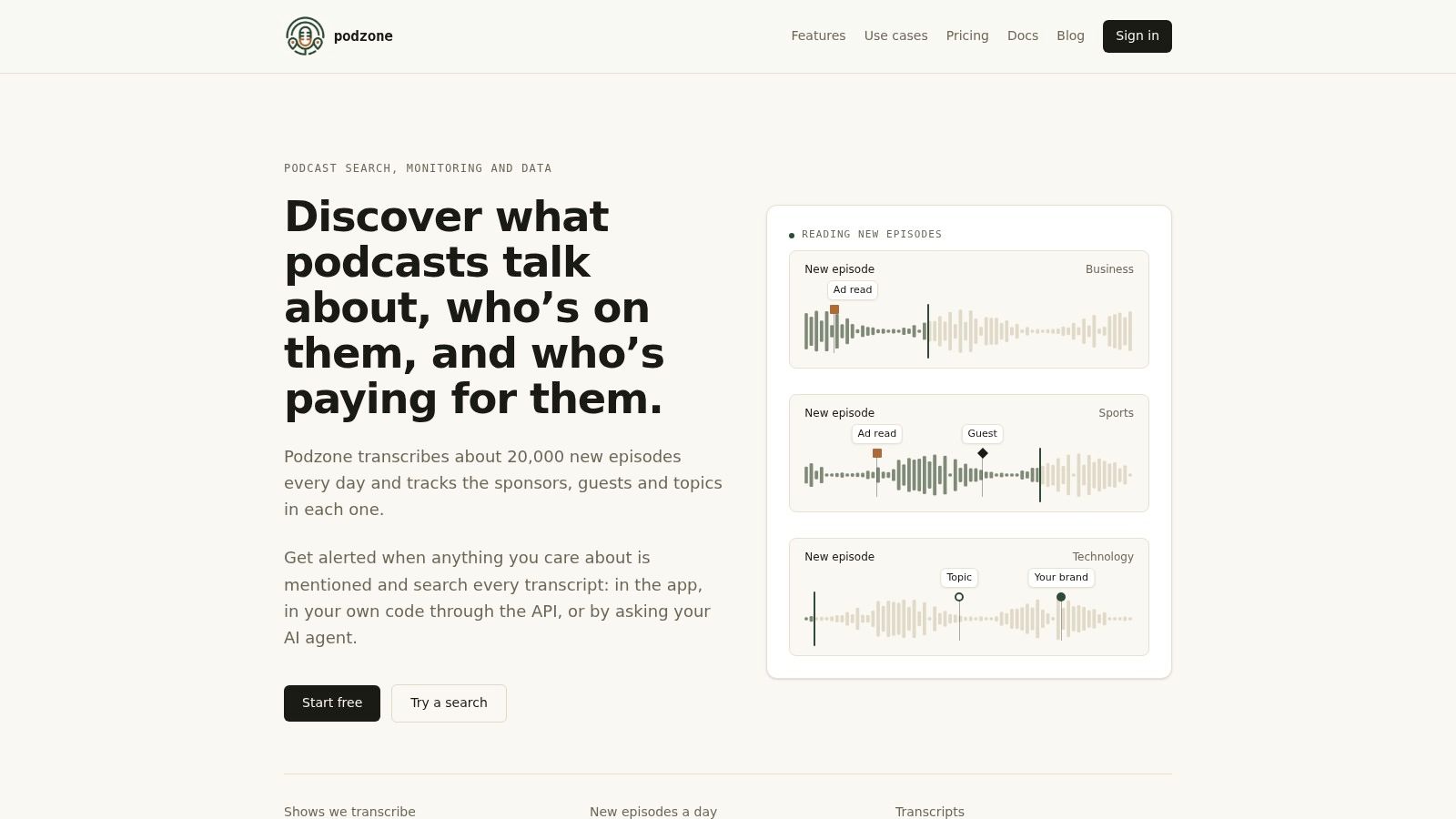
A competitor's name in an episode description is easy to find. A comparison buried inside a founder interview needs full-text transcript search and a linked timestamp. This service packages matches with the transcript excerpt, show information, and episode details, so an analyst can verify the passage before sharing it.
Keyword rules monitor brands, competitors, people, and topics, with an optional AI check to help filter matches. Reported coverage targets are more than four million podcast feeds and approximately 30,000 new episodes daily, not commitments that every relevant show or episode will be available. Publication-to-alert timing also remains a target rather than a guarantee.
Evidence Beyond a Mention #
Sponsor tracking records ad reads, offer codes, and advertising history. Brand-name variants are matched to the company behind them, while a sponsor found only in show notes is marked accordingly. That distinction matters when an agency must separate an audible placement from a publisher's written acknowledgement.
Evidence rule: A sponsor record establishes observed activity, not campaign effectiveness, total spending, or delivery to every listener.
The IAB Australia Audio Advertising State of the Nation report identifies fragmentation and lack of standardization in podcast measurement as barriers to confident planning and evaluation. A defensible report should retain the passage, show identity, episode date, offer code, and recurrence, rather than converting mention counts into assumed results.
- What works: Searchable transcripts, downloadable evidence, host and guest histories, and sponsor trends support related research without requiring separate manual listening projects.
- Integration advantage: The API and MCP server expose podcast data to internal tools. Signed webhooks push alert matches seconds after they're found, which is different from promising detection seconds after publication.
- Commercial limitation: Every plan includes core data categories and API access, but sponsor tools beyond name lookup and guest or topic trend tools require premium requests.
It's a podcast-focused service, not a replacement for news monitoring, social benchmarking, or direct measurement of advertising performance. Teams monitoring other languages should validate actual transcript availability rather than infer it from feed coverage.
2. Podchaser Alerts #
Best for a straightforward podcast discovery and email-alert workflow.
Podchaser Alerts suits a communications team that wants to discover relevant episodes without building a data integration. Alerts can track brands, people, competitors, and topics, using episode titles and descriptions across its database and transcript search for a subset of shows.
The important distinction is metadata coverage versus spoken-word coverage. A founder named in an episode title may be discoverable even when the underlying conversation isn't searchable. A competitor mentioned briefly during an interview may depend entirely on transcript availability.
A Discovery Tool, Not Universal Audio Coverage #
A practical test should include a known guest appearance and an incidental mention that never appears in the episode description. Those searches test different capabilities. Finding the appearance doesn't establish that the tool can locate passing product recommendations or an unannounced comparison.
- Useful strength: The free alert workflow provides a relatively simple way to begin podcast monitoring.
- Coverage limitation: Transcript search covers only part of the database, so a show's presence doesn't automatically establish searchable audio.
- Delivery trade-off: Daily email delivery suits routine discovery better than an urgent response workflow.
- Expansion path: Pro features add podcast insights, but teams should distinguish research functionality from the alert service itself.
For podcast bookers, metadata-based discovery can still be valuable. Episode descriptions often identify the guest, subject, and interview angle, providing a starting point for outreach research.
For competitive-intelligence teams, the standard should be stricter. A useful result needs enough surrounding context to distinguish the host's view, the guest's claim, and an advertiser's script. An episode match is a lead for investigation, not automatically a verified competitive finding.
3. Critical Mention #
Best for PR teams that need podcast evidence inside a wider earned-media reporting process.
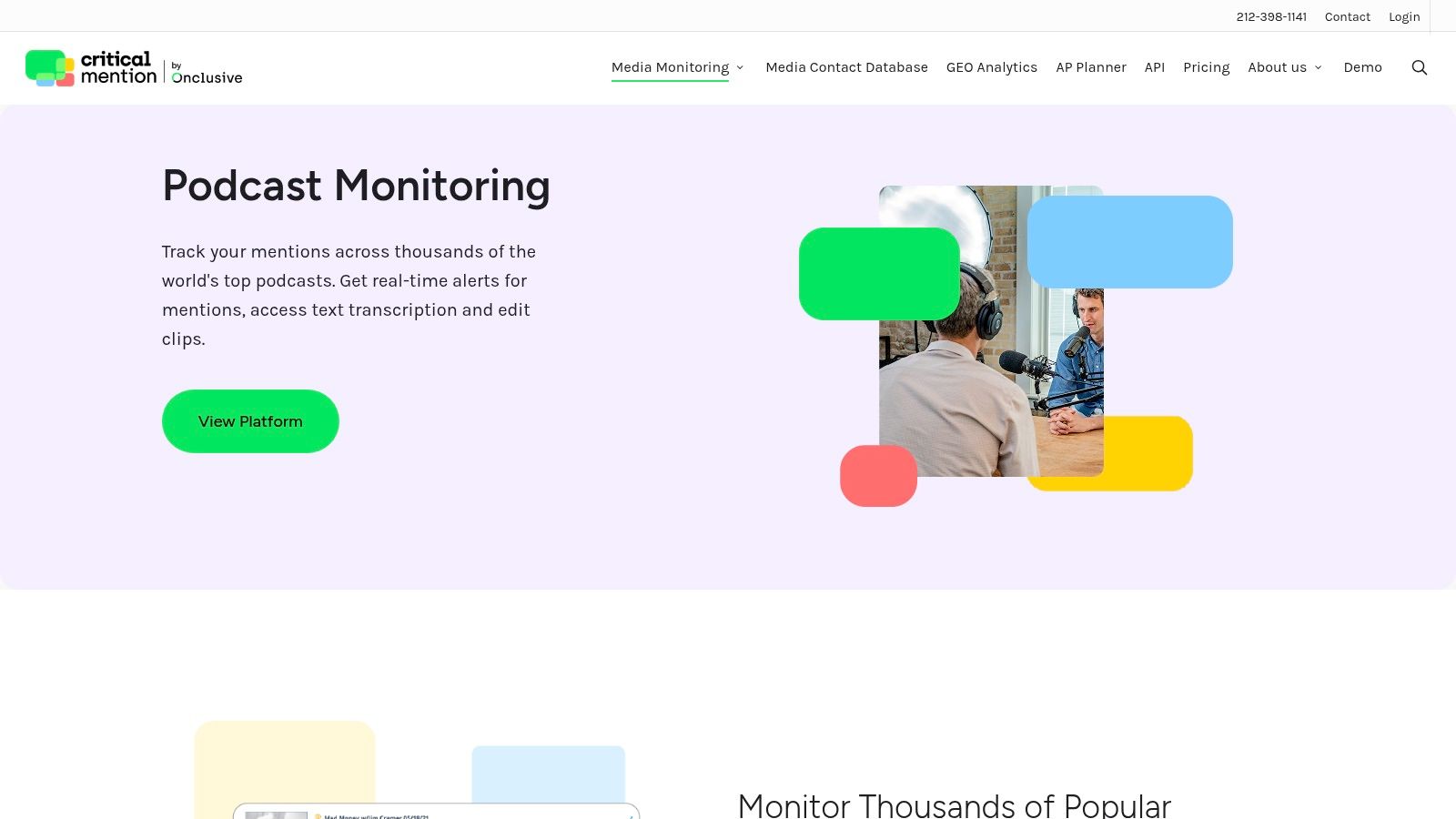
A client coverage report might need a television interview, an online article, and a podcast passage presented together. Critical Mention's podcast monitoring addresses that reporting job through speech-to-text search, alerts, transcripts, and editable clips alongside broader media coverage.
The advantage is the reporting workflow, rather than podcast specialization alone. A communications manager can investigate the spoken passage and prepare evidence for colleagues who don't need access to the full research environment.
A shareable clip helps explain a finding. It doesn't remove the need to review the surrounding discussion.
That matters when a competitor receives mixed coverage. A short excerpt might sound like an endorsement, while the following exchange introduces objections or qualifications. Reports should preserve the distinction between a mention, a recommendation, and a substantive comparison.
Coverage Before Contract Scope #
The product supports requests for podcasts not already included. That's useful, but a coverage request shouldn't be treated as confirmation that monitoring is already active.
- Strong fit: Agencies consolidating broadcast, online, social, and podcast evidence for client reporting.
- Practical benefit: Transcripts, editable clips, and cloud storage help turn discovery into a reviewable coverage item.
- Main limitation: Priority shows need explicit confirmation, including whether episode audio is searchable.
- Buying constraint: The podcast product page doesn't publish pricing, so evaluation requires a scoped quote.
The demo should follow a real reporting task: locate a known competitor passage, review context, create a clip, and place it into a client-ready output. A polished dashboard matters less if an analyst still has to rebuild every finding manually.
4. Meltwater #
Best for cross-media competitor visibility and consolidated communications reporting.
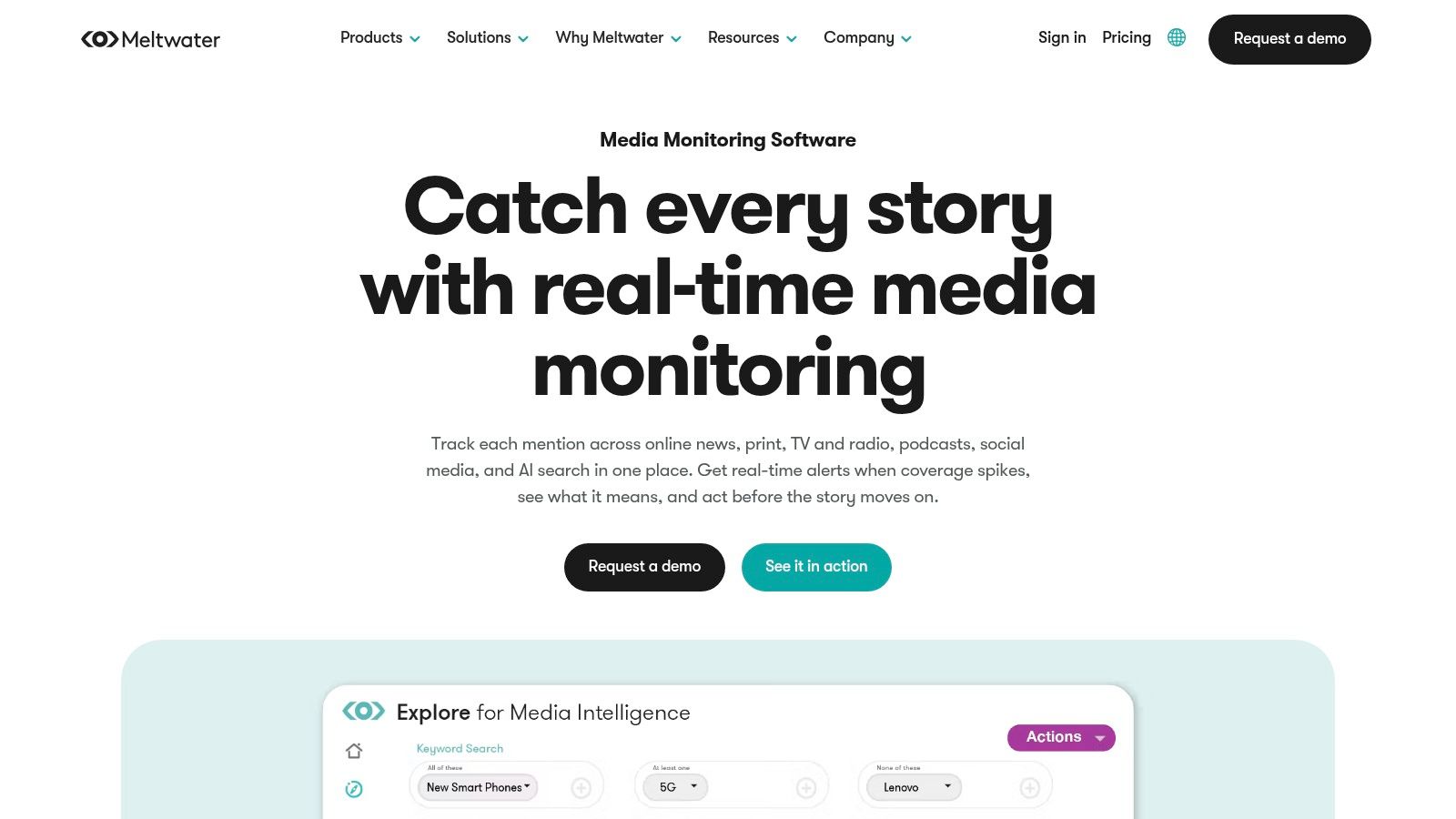
Meltwater's media-monitoring platform is a broader choice for teams tracking competitors across news, print, broadcast, podcasts, and social sources. Its benchmarking and reporting capabilities fit a communications lead who needs to explain relative visibility across channels, not to locate an audio mention.
Podcast results can include audio and transcripts, subject to coverage and subscription. That qualification belongs in the buying decision, not in a footnote after implementation.
Share of Voice Needs a Defined Denominator #
A competitor share-of-voice chart is only interpretable when the monitored brands, sources, geography, and query rules are consistent. Comparing a tightly filtered company query against a rival's ambiguous product name can produce a confident-looking but misleading result.
Teams should also separate earned coverage from advertising activity. An interview and an ad read may both contain the same brand name, but they represent different communications outcomes.
- Where it helps: Cross-media dashboards and recurring reports can reduce fragmented reporting across communications teams.
- Where it can be excessive: A small team seeking only podcast mention alerts may not need the broader platform.
- What remains uncertain until scoped: Podcast source access, transcript availability, historical depth, and subscription inclusions.
- Pricing model: Quote-based pricing requires a clear brief about channels, users, reporting, and markets.
The publisher's guide to competitive intelligence tools provides a useful distinction between collecting media signals and maintaining a wider competitive-intelligence process.
Meltwater is a sensible shortlist candidate when the deliverable is an integrated communications picture. It shouldn't be selected on the assumption that broad media coverage guarantees deep audio evidence for every niche podcast.
5. Brand24 #
Best for cross-channel keyword monitoring with accessible commercial evaluation.
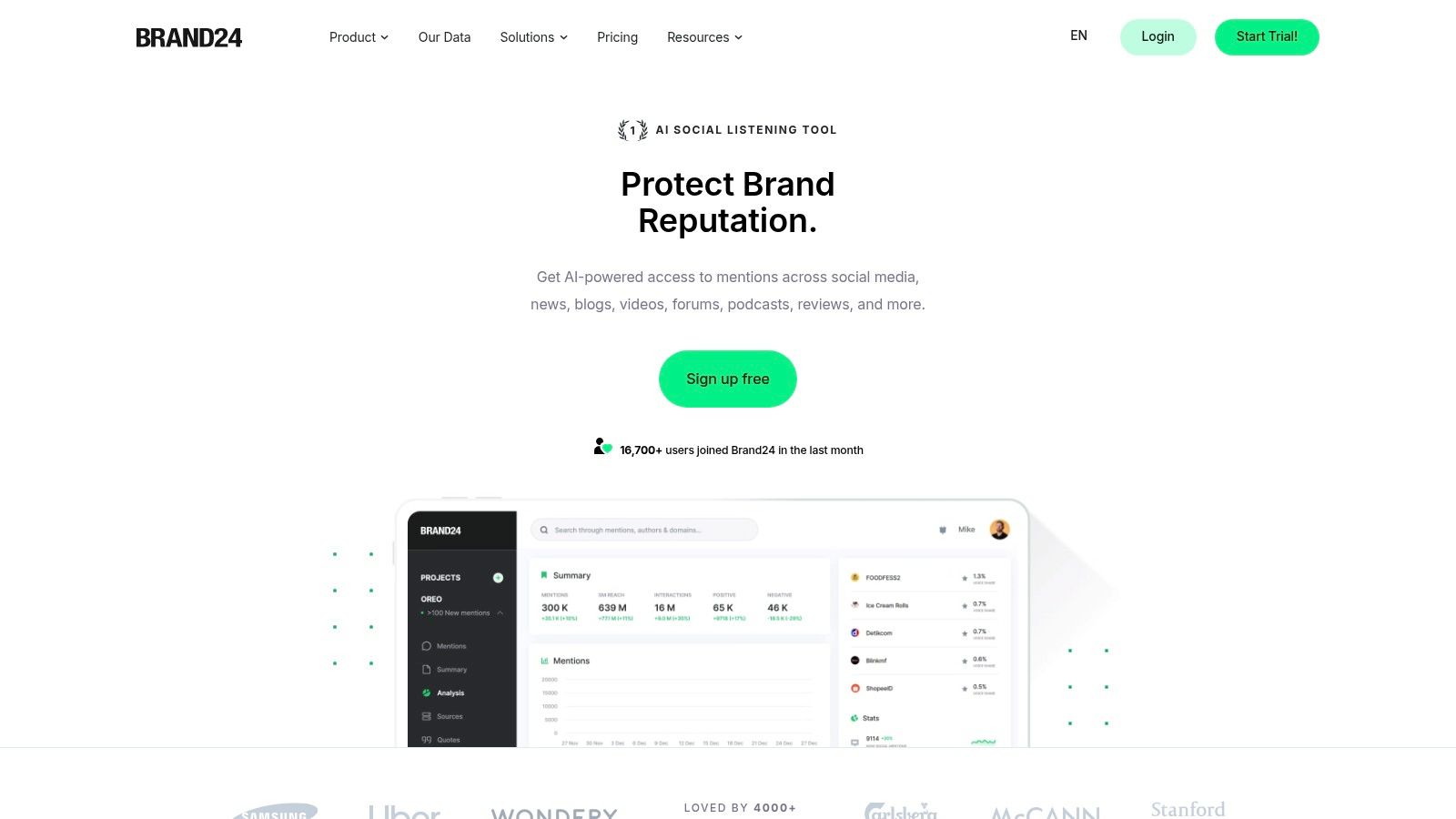
A rival launches a product, reviewers discuss it, customers complain on forums, and clips circulate through social channels. Brand24 is suited to following that broader online conversation rather than treating the podcast episode as an isolated event.
The platform combines keyword monitoring with sentiment, reach, mention-volume, and share-of-voice analysis. Alert delivery through email, Slack, Microsoft Teams, and a mobile app gives teams options for routing findings into existing review habits.
Query Quality Determines Report Quality #
The first configuration task is separating the competitor's company name from unrelated uses of the same words. Product names, executive names, exclusions, and contextual terms should be tested together before the team trusts a comparison chart.
Sentiment needs human review, especially when a post quotes criticism, uses sarcasm, or discusses competing products in the same passage. A negative label doesn't necessarily mean the author dislikes the monitored brand.
- Evaluation advantage: Published pricing and a free trial make initial commercial comparison easier than a quote-only process.
- Cross-channel strength: News, blogs, forums, reviews, video, social media, and podcast indexing support a broader view of competitor discussion.
- Capacity constraint: Keyword and monthly-mention limits can affect the cost of broad or noisy monitoring.
- Podcast limitation: It isn't a dedicated podcast research database, so show coverage, transcripts, and timestamp behavior need testing.
The distinction between indexing and evidence access is especially important. A podcast result may be useful for discovery without supporting the same verification workflow as a searchable transcript.
Brand24 fits teams that need practical online monitoring and competitor comparisons. It's less suitable as the sole research environment when a client expects a defensible record of precisely what was said in podcast audio.
6. Brandwatch Listen #
Best for complex competitor conversation research and historical analysis.
The question might not be whether a competitor was mentioned. It might be whether customers discuss that competitor differently by product category, audience, or market. Brandwatch Listen is better aligned with that analytical brief than a basic notification service.
Boolean queries, segmentation, historical analysis, sentiment, and alerts for unusual trends support investigation beyond a simple mention feed. The trade-off is that useful analysis depends on careful query construction and someone responsible for maintaining it.
Analyst's caution: A sophisticated query can still exclude the conversation that matters. Query review belongs in the monitoring process, not just setup.
For example, an exclusion intended to remove recruitment posts could also remove legitimate discussion of a competitor's workforce software. Teams should inspect relevant results and known misses before interpreting a trend.
Stronger Analysis, Different Audio Expectations #
The publisher's comparison of social-listening tools helps distinguish audience research from specialist podcast monitoring. Brandwatch Listen belongs primarily in the former category.
- Research strength: Segmentation and Boolean search support focused competitor and industry questions.
- Historical value: Analysis over time can help separate a sustained conversation shift from a temporary burst.
- Operational cost: Complex queries require ownership, review, and interpretation.
- Product boundary: It isn't a dedicated podcast transcript-search service, and pricing isn't publicly listed on the product page.
A changing conversation pattern shouldn't be reported as changing market share. The monitored sources describe observable discussion, not the competitor's complete customer base or revenue.
Brandwatch Listen makes sense when the team can specify the audience question and act on the answer. It's difficult to justify solely for finding occasional competitor podcast mentions.
7. Talkwalker #
Best for competitive benchmarking across markets, formats, and languages.
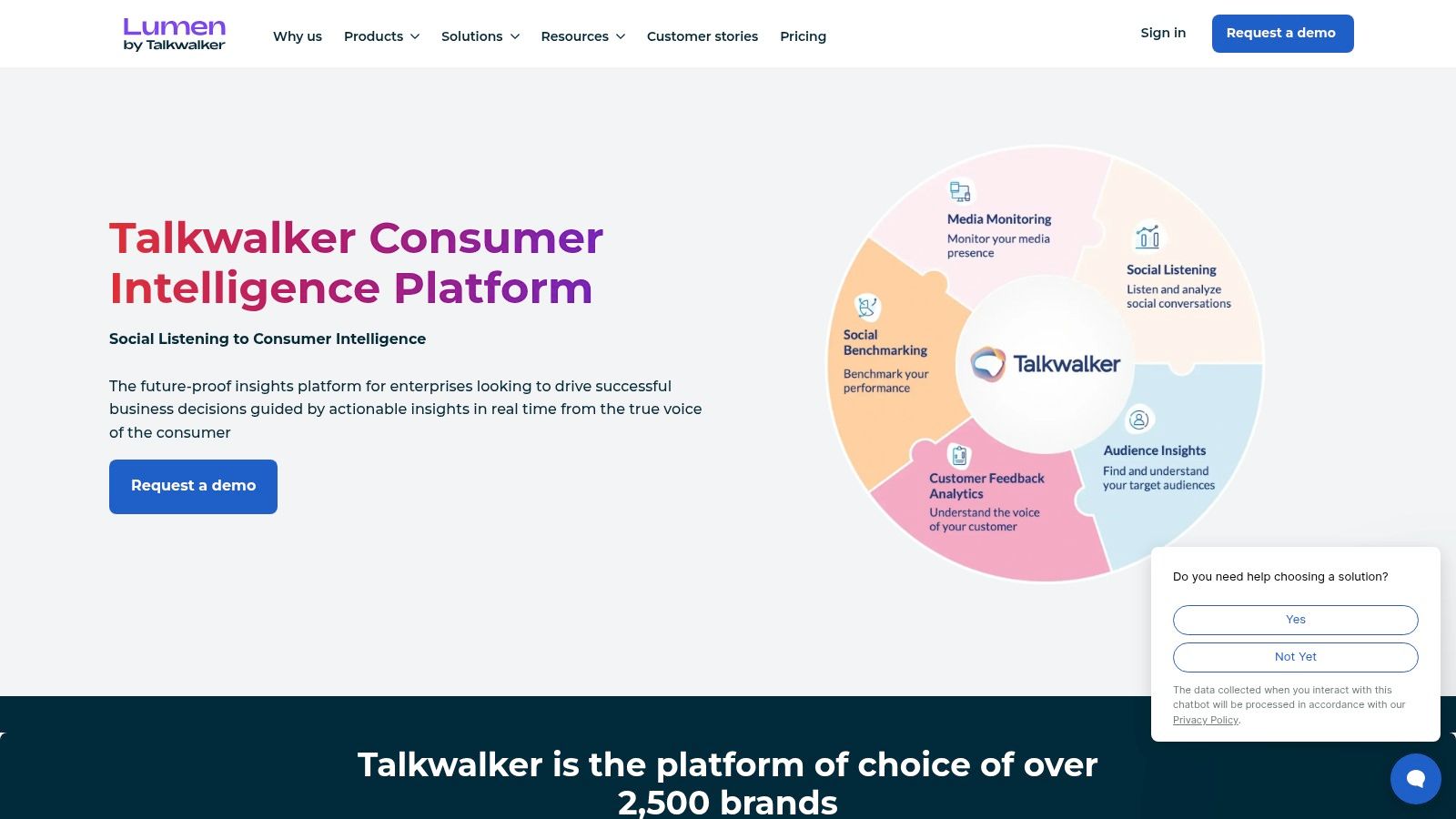
Text-only monitoring can miss a competitor's logo in an image or a brand presence inside video. Talkwalker combines social listening, benchmarking, media monitoring, visual analytics, and speech and text analysis, making it relevant to teams investigating more than written mentions.
Its multilingual monitoring is also relevant when a communications brief spans markets. However, multilingual capability isn't evidence of equivalent coverage in every language, channel, or format.
Compare Like With Like #
A global dashboard should preserve local context rather than merge every mention into a single total. A product nickname, a local distributor, or a campaign slogan can change which query captures the competitor accurately.
The same principle applies to visual results. A visible logo might represent a sponsorship, incidental background exposure, criticism, or resale activity. Analysts still need to classify what the result means.
- Distinctive strength: Visual listening can surface brand presence that text queries miss.
- Broad use case: Social benchmarking and media monitoring support competitor comparisons across markets.
- Procurement trade-off: Pricing requires a demo or quote rather than a public self-serve plan.
- Podcast uncertainty: Database coverage, transcript access, and alert timing need explicit validation.
Talkwalker is a shortlist option when the job includes comparing competitive conversation across media formats. It's not automatically the right choice for an agency whose primary output is a timestamped podcast coverage report.
The demo should include local-language examples and ambiguous visual matches, not only clean brand-name searches. A tool that performs well on a global brand's official spelling may still need substantial configuration for regional product names and informal discussion.
8. Awario #
Best for general web and social keyword monitoring with visible plan boundaries.
Awario's pricing and plan information makes it easier to assess a general listening workflow before entering an enterprise procurement process. It supports competitor, brand, campaign, and industry-topic monitoring through Boolean queries, mention history, reporting, exports, and API access listed among plan features.
The useful distinction is keywords versus capacity. Flexible keyword construction doesn't remove limits on monitored topics, incoming mentions, or stored results.
Build a Focused Topic Before Expanding #
Say a team monitors a competitor with an ambiguous name. A useful query could combine the company name with its product category, add distinctive product names, and exclude unrelated entertainment references. That produces a more reviewable stream than collecting every occurrence and trying to clean the report afterward.
Exports and reporting can support recurring competitor briefs, but teams should test whether the output preserves the fields needed for review. A mention without its source, date, and surrounding context is harder to defend.
- Commercial clarity: Public pricing helps teams compare plan structure with quote-based alternatives.
- Query flexibility: Unlimited keywords within a topic support detailed Boolean construction.
- Trial access: Awario states that its free trial doesn't require a credit card.
- Main constraints: Topic, new-mention, and stored-mention limits still govern practical capacity.
Awario is a general online-listening tool, not a specialist podcast-transcription service. A team shouldn't expect audio-level evidence merely because podcast-related pages appear in web results.
Its best role is focused monitoring of discoverable web and social discussion. When the missing information sits inside an interview or ad read, a separate podcast evidence workflow may still be necessary.
How the Eight Competitor Monitoring Tools Differ on Core Criteria #
The useful split is the job the evidence must do. Podcast-first services return an episode, passage and timestamp; general media platforms are stronger at consolidating earned coverage across channels. Use the table to shortlist, then confirm podcast coverage, transcript depth and alert delivery during a pilot.
| Item | Primary Focus | Podcast Transcript Search | Public Pricing | Best For |
|---|---|---|---|---|
| Podzone | Podcast monitoring, search, sponsor and guest intelligence | Searchable, timestamped transcripts; coverage figures are targets, not commitments | Free and paid plans | Teams needing podcast alerts, sponsor tracking, and API or MCP access |
| Podchaser Alerts | Podcast discovery and keyword alerts | Transcript search for a subset of shows | Free alert workflow; Pro pricing not specified | Finding podcast appearances and mentions |
| Critical Mention | Earned-media monitoring | Speech-to-text search, transcripts, and clips within earned-media coverage | Not published | PR teams combining podcast coverage with broader media reports |
| Meltwater | Cross-channel media intelligence | Podcast results with audio and transcripts, subject to coverage and subscription | Quote-based | Teams monitoring competitors across media types |
| Brand24 | Online media monitoring and social listening | Podcast indexing; transcript depth varies by source | Published pricing | Teams seeking cross-channel competitor monitoring |
| Brandwatch Listen | Enterprise social listening | No dedicated podcast transcript-search product | Not listed publicly | Complex audience, trend, and competitor research |
| Talkwalker | Consumer intelligence and media monitoring | Podcast transcript access depends on coverage and plan | Demo or quote-based | Organizations needing broad, multilingual monitoring |
| Awario | General web and social keyword monitoring | No specialized podcast transcript-search service | Published pricing; free trial available | Budget-conscious teams monitoring online mentions |
For advertising intelligence, sponsor records and offer-code context matter more than mention volume. For a recurring competitor brief, timestamped evidence and exportable source fields matter more than a long feature list.
Matching a Monitoring Tool to the Job You Need Done #
The buying decision should begin with the deliverable. Timestamped podcast evidence points toward a podcast-first service. Consolidated earned-media reporting favors a general media platform, while audience segmentation and cross-market conversation analysis justify evaluating enterprise social listening.
The operational test matters more than a feature comparison. In Crayon's State of Competitive Intelligence report, 88% of stakeholders wanted competitive updates weekly or monthly, while only 70% of CI leaders met that cadence. A monitoring tool needs to support a repeatable review and distribution process, not merely collect results.
Run a Pilot Against Known Evidence #
A two-week pilot on a known competitor provides a practical evaluation window. The team should select a recent episode containing a verified mention, then test whether each shortlisted service finds it, whether the timestamp reaches the right passage, and how long notification delivery takes.
The pilot should distinguish episode publication, content availability, match detection, and notification receipt. Otherwise, a fast webhook might be mistaken for fast ingestion, or a delayed email might obscure an earlier searchable result.
- Evidence quality: The result should identify the speaker or context well enough to separate an interview claim from an advertisement.
- Coverage: Priority shows, transcript availability, languages, and markets should be checked individually.
- Historical consistency: Changes over time should use stable queries and comparable source sets.
- Review effort: Analysts should record whether findings can be verified and shared without rebuilding them elsewhere.
Coverage and latency figures are targets rather than guarantees. A large database claim doesn't establish that the specific niche shows influencing customers are searchable.
Confirm Workflow and Commercial Boundaries #
Agencies managing multiple clients may need separate workspaces and alert ownership. The publisher's Pro plan is designed for agencies and larger teams tracking multiple clients or topics, with separate workspaces for each.
Teams building internal dashboards should examine API access, webhook behavior, request limits, and premium-request allowances before committing. In the publisher's service, API-created alerts record matches but don't email recipients, so integration design must account for delivery explicitly.
The final purchasing checklist should stay short:
- Define the monitoring job: Mention discovery, advertising evidence, share of voice, or historical change.
- List must-have sources: Named shows, channels, markets, and languages.
- Test real queries: Include ambiguous names, incidental mentions, and known misses.
- Verify pricing directly: Confirm current plans, capacity, workspaces, integrations, and premium features with the vendor.
Podzone combines searchable podcast transcripts, timestamped mention alerts, sponsor tracking, and host and guest information with API and webhook access. Teams comparing competitor monitoring tools can visit Podzone to test a known competitor mention and assess whether its podcast evidence fits their reporting workflow.
- competitor monitoring tools
- media monitoring
- podcast monitoring
- brand monitoring
- social listening